Banking and Insurance: The Real Communication Gap

Banking and insurance have invested heavily in technology, yet customers still struggle with unclear communication, frustrating support experiences, and a lack of transparency. This article explores how the real issue isn’t outdated technology, but the failure to communicate clearly, proactively, and empathetically when customers need it most.

The Technology Stack Behind Systems That Never Make Users Wait

Modern users expect instant responses, and systems that fail to deliver within milliseconds risk losing them. This article breaks down the multi-layered technology stack behind real-time systems from edge computing and event-driven architecture to caching, microservices, AI, and modern databases. It highlights how these components work together to minimize latency, scale efficiently, and deliver seamless experiences across industries like fintech, travel, and e-commerce.

Voice AI for Insurance

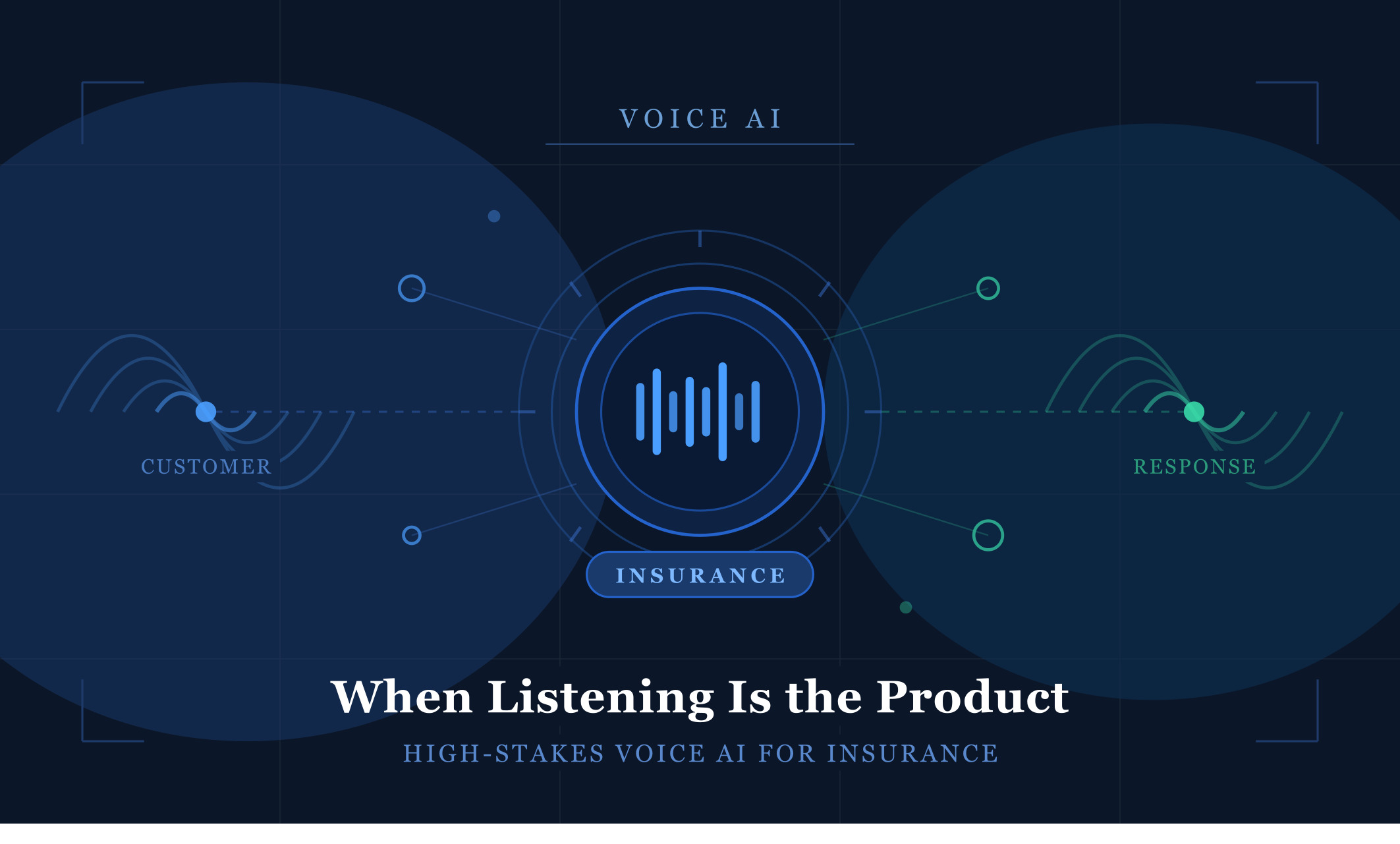
Voice AI for Insurance: Why Listening Matters in High-Stakes Customer Moments

In insurance, the most important customer interactions don’t happen during routine queries; they happen during moments of stress, uncertainty, and loss. This article explores how Voice AI for Insurance is evolving beyond speed and accuracy to focus on something far more critical: listening. From detecting emotional cues to handling high-stakes calls with empathy and compliance, it highlights why “listening architecture” is becoming the defining factor in customer trust and retention. It also breaks down the key capabilities insurers need in a Voice AI platform and where the technology is headed next.

When Healthcare Starts Listening: The Role of Voice in Patient-Centered Care

This article explores how voice technology is reshaping communication in healthcare by making interactions simpler, faster, and more natural for patients. Instead of relying heavily on forms and screens, voice-enabled systems help handle routine tasks like appointment booking, reminders, and basic queries, reducing pressure on staff and improving overall efficiency.

It also highlights how these changes contribute to more consistent and meaningful patient-centered care by ensuring patients feel heard and supported throughout their journey. While voice isn’t a complete replacement for human interaction, it plays a valuable supporting role in building more accessible and patient-focused healthcare experiences.

Top FinTech Software Development Companies Leading AI-Driven Finance?

Top FinTech Software Development Companies Leading AI-Driven Finance

AI is rapidly transforming the financial services landscape, enabling smarter decision-making, stronger compliance, and highly personalized customer experiences. This article explores leading U.S.-based FinTech software development companies driving AI-powered innovation across banking, lending, payments, and risk management. By examining their technical expertise, industry impact, and real-world use cases, the blog highlights how AI-driven finance is reshaping trust, efficiency, and scalability in modern financial ecosystems.

Why Cheap Financial Automation Gets Costly Over Time

Why Does Cheap Financial Automation Often Become Expensive Later?

Low-cost financial automation often delivers quick efficiency gains but creates hidden friction over time. Manual rework, rigid workflows, scalability limits, and compliance gaps shift costs from software to operations and risk. This article explores why friction, not technology, becomes the true long-term expense, and why resilient, adaptable financial systems matter more than upfront savings.

What CFOs Get Wrong About Scaling Intelligence in Finance?

Financial intelligence is one of the key areas where automation, data expansion, and advanced tools are implemented by many CFOs to scale; however, the quality of the real decisions often remains the same. The not-so-simple case is not really about technology, but rather about a lack of understanding of how intelligence should be designed and embedded in finance. High-quality financial intelligence is built on context, trust, and decision-centric design, and not merely on more data or quicker reporting. CFOs are able to turn automation into a sustainable strategic capability instead of a costly experiment by avoiding pitfalls like overgeneralized models, low transparency, and misaligned economics, and by selectively scaling intelligence around high-impact decisions.

The New Era of Product Engineering: When Software Learns, Predicts, and Self-Improves

The New Era of Product Engineering: When Software Learns, Predicts, and Self-Improves

Product engineering is evolving from static, rule-based software to intelligent systems that learn, predict, and self-improve. By embedding data-driven intelligence, predictive capabilities, and autonomous optimization into core architectures, modern software becomes adaptive, proactive, and continuously evolving—reshaping both user experiences and the role of engineers.