
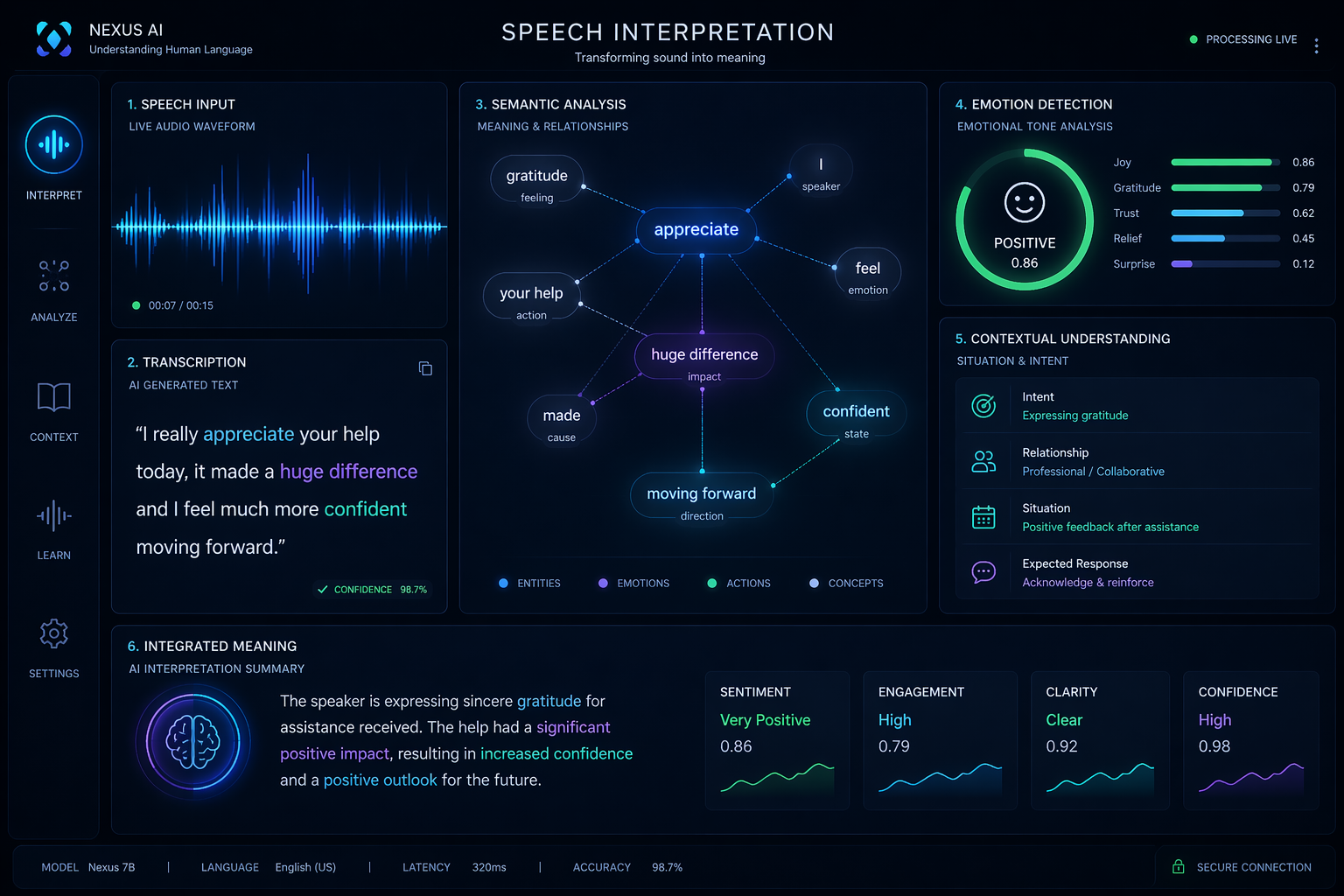
For a long time, machines have used language as a linear string of words, processing the input word by word. Humans, however, use their knowledge of how to read between the lines, interpret tone, find intent, read the context of a statement, and even read what is not stated directly. As a result, this gap is something that newer systems attempt to bridge.
Natural Language Processing (NLP) is making it possible for machines to progress beyond executing straight commands and achieve more meaningful results. The overall intent of NLP has transitioned from recognition alone to some degree of understanding. The transition has already changed the interaction of users with their technology, although it may not always be as obvious.
However, developing systems that will actually and completely understand language in a similar manner as people do is, unfortunately, not merely a simple upgrade. Achieving this requires redesigning how machines understand meaning, context, and intent from different levels.
Why “Understanding” Language Isn’t What You Think It Is
We throw around the word “understanding” pretty casually in tech.
But what does it even mean for a machine?
If a system gives the correct answer, is that understanding or just pattern matching at scale?
Systems built on cognitive language learning try to go a step further. They don’t just respond, they interpret signals:
- What’s being asked
- What’s implied but not said
- What outcome the user expects
But here’s where it gets uncomfortable.
Even when the output looks perfect, the system might not “understand” anything the way a human would. It’s just very good at predicting what comes next.
And sometimes, that illusion is enough.
The Moment Rules Failed (And Learning Took Over)
There’s a story I remember from an early NLP project.
A team spent months building rule-based logic: if this word appears, trigger that response. It worked beautifully in testing. Then real users showed up.
Everything broke.
People phrased things differently. They made typos. They mixed languages mid-sentence. Suddenly, the system looked clueless.
That’s when the shift toward cognitive language learning stopped being optional.
Instead of trying to control language, we started observing it. Feeding systems raw, imperfect, real-world input.
And oddly enough, the messier the data, the smarter the system became.
Context Isn’t Optional. It’s the Whole Point
Let me put it this way.
Take a single sentence out of a conversation, and you’ve already lost half the meaning.
Language doesn’t live in isolation; it lives in sequences, situations, and shared understanding. That’s what systems based on cognitive language learning are trying to piece together.
Not just:
“What does this sentence say?”
But:
“What’s happening here overall?”
And that’s much harder.
Because context isn’t stored neatly. It’s scattered across time, tone, and prior interaction. Humans reconstruct it effortlessly. Machines… not so much.
Data Feeds the Brain, But It Can Also Mislead It
Everyone says data is the fuel behind AI. That’s true, but it’s also where things quietly go wrong.
Here’s something I’ve noticed: models don’t just learn information, they inherit mistakes.
Train a system on biased or inconsistent data, and it doesn’t question it. It absorbs it.
That’s the risk with cognitive language learning. The system becomes confident before it becomes accurate.
And confidence without accuracy? That’s dangerous in production.
When Conversations Go Off Script (And Why That Matters)
Real conversations don’t follow clean paths.
Someone starts with a complaint, drifts into a question, then circles back to frustration all in one sentence.
Example:
“Yeah, so I ordered something last week, and I mean, I get delays happen, but there’s no update or anything… should I just cancel?”
Now, where do you even begin?
A basic system grabs keywords. A smarter one built on cognitive language learning reads between the lines:
- Delay concern
- Lack of communication
- Decision point (cancel or wait)
It’s less about answering a question and more about understanding a situation.
That shift is subtle but critical.
The Shift from Text to Voice Changes the Rules
Text gives you structure. Voice takes it away.
People interrupt themselves mid-thought. They restart sentences. They throw in filler words without thinking.
Honestly, half of spoken language would look broken if you transcribed it.
That’s why voice-based systems struggle. They’re not just decoding words; they’re trying to reconstruct meaning from something inherently unstructured.
This is where something like a Voice AI Platform becomes relevant. It connects speech input with deeper cognitive language learning, helping systems deal with interruptions, tone shifts, and incomplete phrasing.
Even then, it’s a work in progress.
And probably always will be.
A Quick Reality Check: Machines Still Don’t “Think”
Let’s clear something up.
Machines aren’t thinking. They’re estimating.
Every response from a cognitive language learning system is essentially a probability-based guess, just a very refined one.
That’s why they can sound incredibly smart one moment… and completely miss the point the next.
If you expect consistency at a human level, you’ll be disappointed.
If you expect a useful approximation, you’ll be impressed.
Practical Ways to Build Better Language Understanding Systems
Let me keep this simple and a bit blunt.
- Train on real conversations, not polished datasets
- Expect ambiguity instead of trying to eliminate it
- Keep memory across interactions; it matters more than accuracy
- Test with messy, unpredictable inputs
Most teams know this.
Very few actually do it.
What Most Teams Get Wrong About Language AI
Here’s the pattern I keep seeing.
Teams obsess over metrics accuracy, precision, and recall. The numbers look great in reports.
Then users interact with the system… and something feels off.
Why?
Because real conversations aren’t test cases.
Cognitive language learning isn’t just about getting answers right; it’s about making interactions feel right.
That’s a completely different challenge.
So, Are We Close to Human-Level Understanding?
Depends on what you mean by “close.”
Machines are getting better at:
- Following context across multiple turns
- Identifying intent with less input
- Responding more naturally
But there’s still a gap where things fall apart, usually around emotion, nuance, or ambiguity.
And honestly, I don’t think that gap will disappear anytime soon.
Where This Is Headed (And Why You Should Care)
This isn’t just an AI problem; it’s a product problem.
As cognitive language learning improves, interfaces shift from buttons and menus to conversations.
That changes how users interact with systems entirely.
And if you’re building products today, that shift isn’t something you can ignore.
Practical Applications of Language Understanding Systems
The effects of implementing a human-like understanding of language can be seen throughout various industries today:
1) Customer Service
- Natural automated conversations
- Faster response times
- Increased satisfaction
2) Healthcare
- Translation from patient to clinician
- Aid in documentation
- Increase accessibility
3) Finance
- Understanding complex queries
- Clarifying personalized insights
- Automating transactions/interactions
4) E-commerce
- Conversational shopping experiences
- Smarter recommendations
- Improving engagement
These types of applications utilize Natural Language Processing to make successful business interactions happen.

Conclusion
The development of systems that can process language like a human is a shift in the way we think about interactions and not just a technical challenge. As systems begin to move away from a rigidly rules-based system to a more contextual model, they will become more dynamic, adaptable, and interpretative of a context.
At the center of this shift is Natural Language Processing, which gives machines the ability to derive meaning and respond based on context and a degree of flexibility. As these systems develop, their technology interactions will become less rigid than they are now and, at times, resemble a conversation.
Ultimately, the objective of developing such systems will not be to simply process language but to form an understanding of it, which remains a complicated task, but is slowly becoming more achievable.
FAQs
1. What is Natural Language Processing?
Natural language processing refers to using computers and technology (e.g., robots) to create and analyze human languages and produce meaningful responses via analyzing spoken language.
2. Why is context important in language understanding?
Context provides systems with the ability to determine the actual meanings of words, resulting in more precise and authentic conversational exchanges.
3. How do AI systems learn human language?
The process begins with extensive training on large databases, which enables them to discover patterns they will develop through ongoing feedback and their active participation in the system.
4. What are the biggest challenges in NLP systems?
The main obstacles include ambiguity, together with cultural variations, the need for immediate data processing, and the unavailability of complete information.
5. Where is Natural Language Processing used today?
Using NLP assists organizations in providing intelligent and human-like interactions with their customers via the use of NLP in their customer support functions, health care, banking, and e-commerce.