
The modern digital age is really fast and thus the mobile apps have to be strong, quick, and easy to use. The classical QA methods are unable to cope with the rapid release cycles, intricate user experience and a wide range of devices and platforms. Therefore, there is a transformation in mobile testing services with AI becoming the main factor in the modern QA flow. The article highlights the reasons behind the AI adoption in the QA teams, the advantages it brings to mobile testing, and the implications for the quality engineering future.
The Changing Landscape of Mobile Testing
Mobile applications nowadays come with a wide range of functionalities that include in-app purchases, sensor interactions, real-time communication, and even connected devices. On the other hand, users demand perfect performance no matter what device or network is in use, which is a challenge that has been set for QA teams. They now have to make use of advanced technologies like AI in testing, as the traditional testing methods – manual testing plus basic automation – could not guarantee quality in a timely manner. QA teams are being pressed to provide quality results consistently, yet, they have to work with fewer resources and faster release cycles.
This has changed the scenario where testing had to be done manually traditional, to mobile testing services powered by AI which rely on machine learning, natural language processing and predictive analytics to develop a more brilliant and flexible testing approach.
Why AI Matters in Mobile Testing Workflows
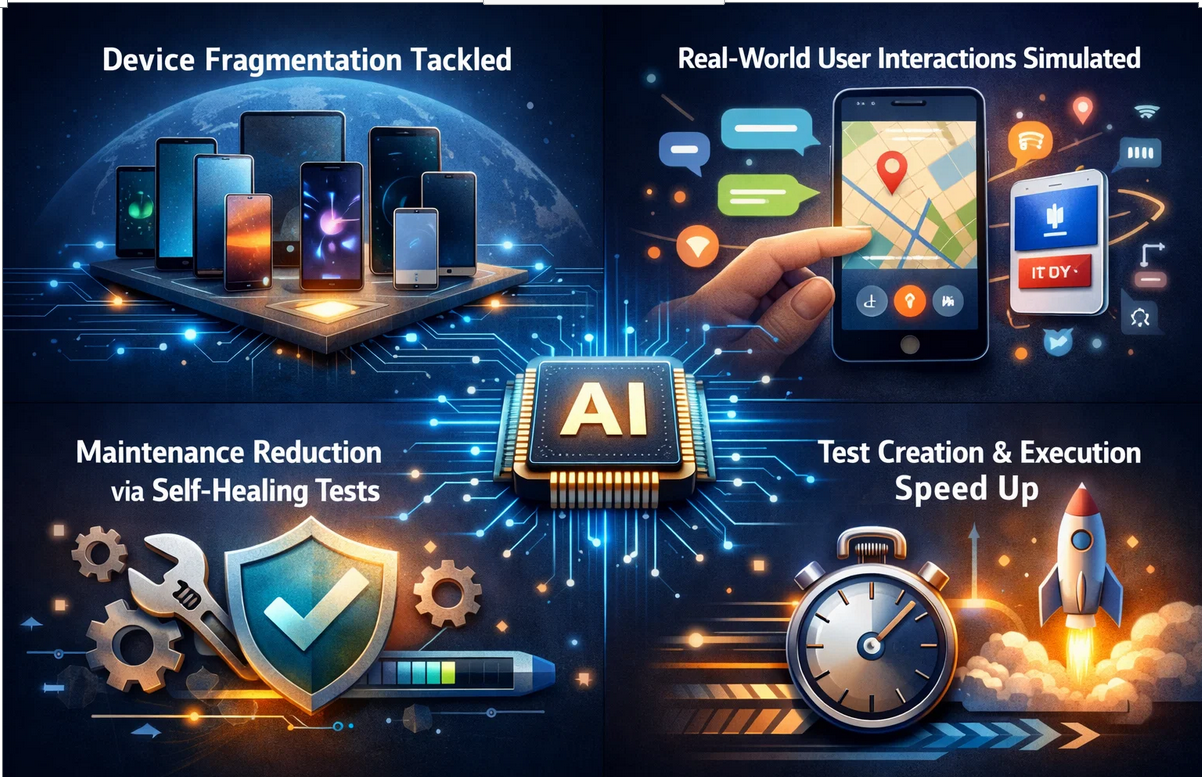
Device Fragmentation tackled
One of the biggest problems with mobile testing is device fragmentation. Over one thousand different types of devices and operating systems are available on the market, thus the manual testing of each configuration is not realistic. AI is one of the important tools that can be employed in the process as it comprehensively analyzes user habits and past failure data in order to select device combinations that are most relevant and hence, best to be sorted out. Providing that, the QA teams will not be swamped with unnecessary tests but they will be still covered at an efficient level.
Real-world user interactions simulated
Mobile users interact with applications in a very complex manner through gestures like swiping, tapping, rotating the device, and even using multi-touch inputs; hence, the usage of static test scripts for capturing these habits is almost impractical. AI models can analyze the data obtained from real usage and predict the various user interactions that are from different points of view, thereby allowing the development teams to discover edge cases and usability problems that might not be detected otherwise.
Maintenance Reduction via Self-Healing Tests
Mobile applications are very fast-maturing products. They experience dramatic changes in UI and redesigning often. When this happens, traditional automation scripts usually get broken, thus increasing the maintenance efforts. In contrast, AI-driven self-healing tests can recognize and apply changes to the UI through successful detection of elements, thereby cutting down on manual input and saving precious QA time.
Test Creation and Execution Speed Up
AI speeds up the whole testing process by creating test cases from user stories, requirements, or historical user flows. AI tools that use natural language processing can convert plain text descriptions into tests that can be executed. That makes less reliance on the writing of scripts and hence faster test execution in CI/CD pipelines.
Key Benefits of AI-Powered Mobile Testing Services
1. Improved Test Coverage
AI-enabled tools examine previous defects along with usage patterns and performance data to tell the areas of the mobile application that are most at risk. By channeling QA efforts into these areas, the entire testing process becomes broader and more productive for QA teams without putting in extra effort.
2. Smarter Defect Detection and Analysis
AI is great in detecting a pattern in the failures of tests and application logs. Not only the errors are being reported but also the AI-based tool can point out the repetitive problems and offer a possible cause giving the team the power to cure the defect more quickly.
3. Enhanced Test Data Management
Practical testing relies on real-like data. AI’s synthetic test data can be generated which is as close to the real world as possible and at the same time, it will not violate the privacy and security regulations. Thus, teams can experiment with the app behavior under various conditions without the risk of disclosing the confidential info.
4. Real-Time Reporting and Insights
The use of AI in mobile testing services today provides real-time dashboards and analytics. The insights given by these are very useful for the teams to keep track of the test execution, the bottlenecks can be found out, and the very quick decision making is done which eventually leads to an increase in the overall development speed.
Best Practices for Integrating AI into QA Workflows
- Start with Targeted Use Cases
QA teams should not make a radical change all at once but rather, where the most pressing problems like flaky tests or regression automation are, start with the use of AI. This gradual approach gives the teams the chance to evaluate the impact and gain trust before moving to the next step. The majority of the companies also prefer to hire QA Engineers who have practical knowledge of AI-based tools in order to make sure that the targeted projects produce quantifiable outcomes.
- Human Oversight Is Mandatory
AI is a factor that increases the productivity of the process, however, it does not supersede the human decision-making. Human guidance is still needed for activities like exploratory testing, user experience evaluation, and business logic validation. The most efficient quality assurance squads are the ones that mix the power of AI with the skills of veteran testers. - Team Training Investment
In order to draw maximum benefit from the tools that are AI-powered, the testing engineers need to be well informed about the functioning of such systems and trained in interpreting their output correctly. The education that is provided will enable the groups to operate AI smoothly and to prevent results misunderstanding.
Challenges to Consider
AI has indeed opened up new horizons, but it is not without its share of challenges Mobile testing services have to face when adopting AI. One of the major concerns is the quality of the data since it is the very basis where AI will be built on; hence if the data is inadequate or skewed, the results will also be wrong. Besides, the teams might find themselves having to bridge the skill gap or facing the challenge of integrating the AI with the already existing workflows and infrastructures.
Smoother AI adoption can be guaranteed through early recognition of these challenges and their strategic handling.