
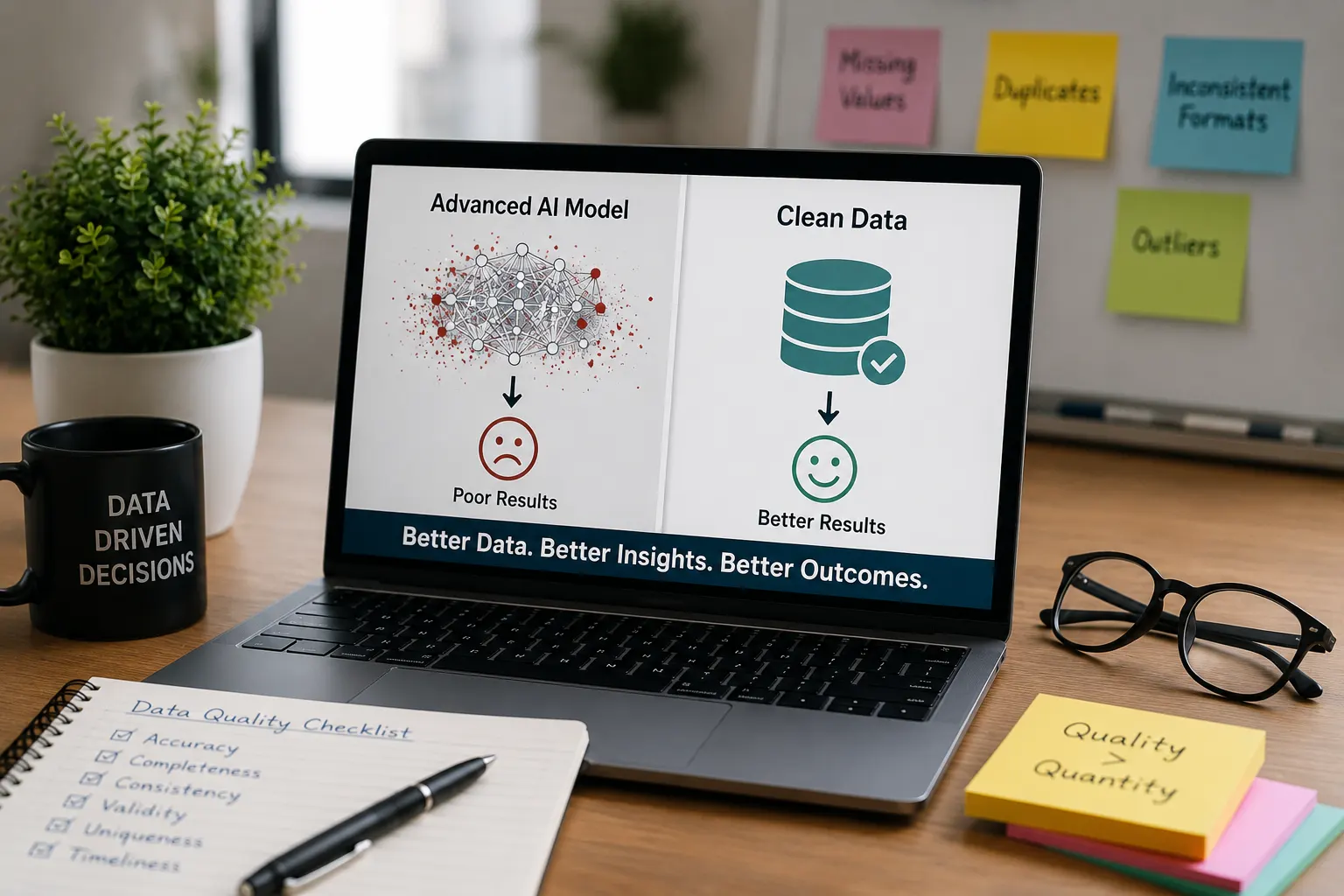

With artificial intelligence, industries are changing, businesses are automating, customers are being predicted, and decisions are being made that are more intelligent. AI is now a key component of today’s business across various industries, including healthcare, finance, education, and retail. But numerous organisations are on the wrong path when they simply select the newest AI model without also considering the quality of their data.
The bottom line is, no matter how sophisticated the AI model is, it cannot provide reliable answers if the data used to train it is of poor quality. The success of any AI initiative starts with clean, accurate and structured data. If not, companies could be subject to inaccurate forecasts, biased results and expensive mistakes.
We will discuss the significance of clean data over even the most advanced AI models and how organisations can optimise their AI capabilities by focusing on data quality. We will delve into the reasons why clean data outshines even the most powerful AI models and how organisations can leverage data quality to enhance their AI performance.
What Is Clean Data?
Clean data is data that is:
- Accurate
- Complete
- Consistent
- Relevant
- Ensure that there are no duplicate records.
- Properly formatted
- Up-to-date
For instance, if the customer list of Assignment Writing Services has duplicate names, wrong phone numbers, missing addresses and outdated information, then the AI model will most likely give them inaccurate suggestions.
Just as quality fuel is essential to a high-performance sports car, clean data is vital to a successful business. Regardless of the power, it is certain that weak fuel will not help the engine run optimally.
AI Is Only As Good As The Data It Learns From:
A maxim of computer science is “Garbage In, Garbage Out” (GIGO). This concept perfectly applies to artificial intelligence.
AI models are trained by analysing patterns from past data. Errors or inconsistencies in the data will be learned by the model, and it will perpetuate them within the model’s future predictions.
For example:
- If the patient’s medical history is incomplete, a healthcare AI may give a wrong diagnosis.
- An out-of-date financial information-based fraud detection system can miss indications of fraud.
- If you have duplicate customers, then a recommendation engine can recommend products that are not relevant.
Bad data is worse than a bad model.
Better Data Often Beats Bigger Models:
Businesses feel they require more substantial AI models that have billions of parameters to deliver better outcomes. In practice, data quality enhancements can be more valuable than moving to a more sophisticated model.
Clean datasets help AI models:
- Learn faster
- Make more precise forecasts
- Reduce false positives
- Improve customer experiences
- Lower computational costs
The best way to help your organisations like MBA Assignment Help get the most from AI is to prioritise the creation of high-quality data sets, rather than investing in costly AI infrastructure.
Clean Data Minimises AI Bias:
One of the largest problems with machine learning today is AI bias. The bias typically does not stem from the AI model itself, but rather from biased or incomplete training data.
For example, if the majority of the candidates in the hiring pool are from a certain demographic, the AI might tend to choose candidates from the same demographic over other equally qualified candidates.
Cleaning and balancing datasets helps:
- Improve fairness
- Reduce discrimination
- Increase transparency
- Establish a relationship of trust with users.
The first step in responsible AI is responsible data management.
Cleaning Data Boosts Business Decisions:
AI can help in decision-making in various departments, such as sales, marketing, finance, and operations. When it comes to the facts, business leaders can make expensive decisions based on faulty information.
Organisations can use clean data to:
- More accurately predict demand
- Understand customer behavior
- Optimize inventory
- Improve marketing campaigns
- Identify emerging trends
When it comes to making decisions, reliable information is always the first step towards reliable decisions.
Faster AI Training & Better Performance:
AI models need to work with irrelevant or redundant data in messily structured data sets. This leaves more time to be spent on training and less on efficiency.
Clean data enables models to:
- Converge quickly in training.
- Reduce computational resources
- Improve prediction accuracy
- Simplify model maintenance
Organisations frequently find that by enhancing data quality, without altering the AI model, they can achieve performance improvement.
Data Quality Saves Time & Money:
Data quality is costly. Many businesses are spending countless hours resolving reporting issues, rectifying customer records, and helping to fix AI systems that often produce inconsistent results.
When investing in data cleaning, you can save on:
- Operational costs
- Manual corrections
- Customer complaints
- Compliance risks
- AI retraining expenses
Continuous model changes do not have long-term value as long as the datasets are clean.
Key Steps To Maintain Clean Data:
Making clean data is a continuous process and not a one-time job. Organisations need to have data governance policies in place that will keep data accurate for the long run.
The following are examples of good practices:
Check Data As They Come In:
Get accurate data from the start – use validation rules, required fields and fixed data formats.
Remove Duplicate Records:
Duplicate records can cause the AI to get confused and lead to inconsistent customer profiles. Deduplication helps maintain the integrity of databases.
Update Outdated Information:
Customer preferences, addresses and product information change over time. Routine updates ensure that AI is up-to-date.
Standardise Data Formats:
Maintain uniformity in date, currency, measurements, and naming conventions in systems.
Periodically Review Data Quality:
Regularly audit for missing values, inconsistencies and anomalies that may impact the performance of AI.
Clean Data Builds Customer Trust:
Consumers have come to expect that companies will safeguard and deal with their information correctly. With poor data quality, you may bill customers incorrectly, make recommendations that don’t fit their needs, or send messages that cause confusion, resulting in a compromised customer relationship.
With clean and trusted data, organisations can provide:
- Personalized experiences
- Faster customer support
- Accurate recommendations
- Improved customer satisfaction
Data quality is a business priority that’s hard to build and easy to destroy.
Conclusion:
While AI models might make the news, it’s actually clean data that powers intelligent systems. Even the most complex algorithms can’t fix incomplete, inaccurate, or inconsistent data.
The advantages of organisations that invest in data quality are more accurate predictions, less bias, lower operational costs, quicker model training, and better business decisions. High-quality and clean data is not just about the performance of AI; it’s also about the true strength of an organisation’s digital strategy.
If you’re interested in investing in the next big AI development, ensure that your data is accurate, organised, and reliable. Clean data is crucial, and in the realm of AI, it can make or break any successful solution.