
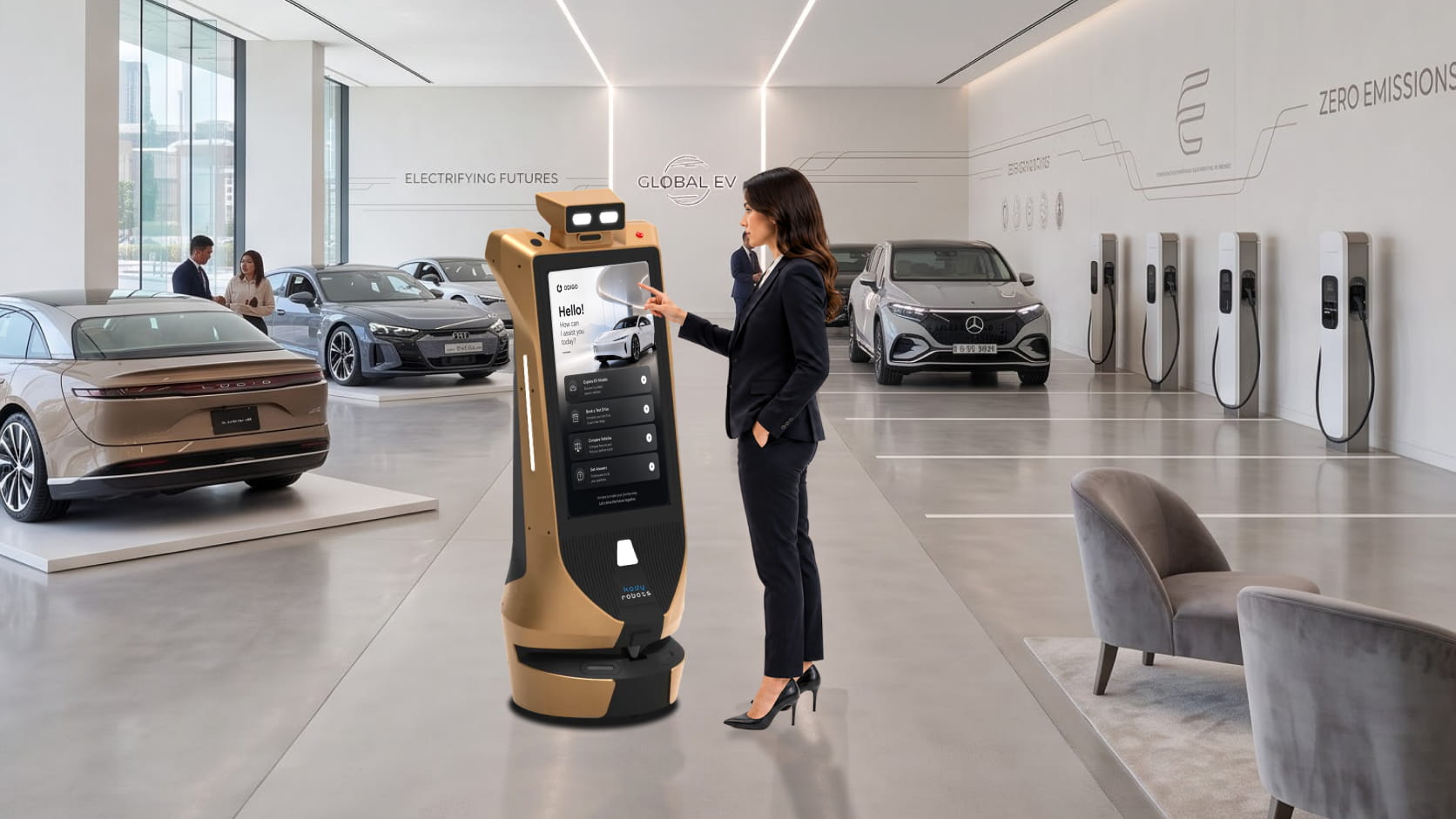
A Robot Assistant for EV Showroom helps dealerships engage visitors, explain electric vehicle concepts, capture buyer preferences, support test-drive requests, and connect customers with sales consultants. It gives visitors useful assistance even when every consultant is already occupied.
EV buyers often arrive with more questions than traditional car buyers. They may want to understand driving range, charging options, battery considerations, ownership costs, available variants, and whether an electric vehicle fits their daily routine.
That makes the showroom journey more educational. Sales consultants still play the most important role, but they cannot always answer every visitor immediately.
A Robot Assistant for EV Showroom can support these early interactions. Customers can explore EVs, compare options, learn basic concepts, share preferences, and request a salesperson through one guided experience.
The purpose is not to automate the entire sale. The purpose is to make the customer journey more organized while helping the sales team focus on conversations that require experience, judgment, and personal guidance.
Key Takeaways
- A Robot Assistant for EV Showroom by Kody Robots can welcome and engage visitors when sales consultants are busy.
- An EV Showroom Robot can help buyers explore vehicles, understand EV concepts, and compare selected options.
- The robot can capture customer preferences, contact details, and purchase intent.
- A Robotics Assistant for EV Showroom can support test-drive requests and sales-team handoffs.
- The robot can help reduce unproductive waiting during weekends, launches, and promotional campaigns.
- A smart robot assistant can provide consistent introductory information while sales consultants handle detailed questions.
- Human employees remain essential for demonstrations, finance, negotiations, and final purchase decisions.
What Is a Robot Assistant for EV Showroom?
A Robot Assistant for EV Showroom is a customer-facing robotic system designed to support visitors during the early stages of EV discovery and purchase consideration.
Depending on the showroom workflow, the robot may support:
- Visitor greetings
- EV discovery
- Product education
- Model comparisons
- Charging information
- Lead capture
- Test-drive requests
- Salesperson requests
- Customer feedback
- Showroom navigation
The robot may use a touchscreen, conversational interface, or other interactive system to guide the customer.
For example, a visitor may choose “Find an EV for me.” The robot can then ask about budget, seating requirements, daily travel, preferred vehicle type, and purchase timeline.
The information helps the buyer narrow available options before speaking with a salesperson.
Why Do EV Showrooms Need Additional Customer Support?
Electric vehicle buying introduces new questions into the traditional automotive sales process.
A first-time EV customer may ask:
- How much driving range do I need?
- Can I charge the vehicle at home?
- What type of charger should I consider?
- How does public charging work?
- What affects battery range?
- Is an EV practical for highway travel?
- What should I compare between two EVs?
- How does EV ownership differ from a conventional car?
Answering these questions takes time.
During quieter periods, a salesperson can provide detailed assistance. During busy showroom hours, several customers may need the same introductory guidance at once.
A Robot Assistant like Odigo build by Kody Robots can handle part of this educational workload while keeping sales consultants available for detailed product discussions.
Benefit 1: Immediate Visitor Engagement
One of the biggest advantages of a Robot Assistant for EV Showroom is immediate customer engagement.
A visitor may enter while every salesperson is handling another customer.
Without assistance, the visitor may:
- Walk around without direction
- Wait for several minutes
- Leave before speaking with anyone
- Miss relevant vehicle information
- Forget to request a test drive
The robot can provide an immediate starting point.
Customers may choose to:
- Explore EVs
- Compare models
- Learn about charging
- Find an EV within a budget
- Request a test drive
- Speak with a consultant
The interaction keeps visitors engaged until dealership staff become available.
Benefit 2: Better EV Education
EV education can become repetitive for sales teams.
A robot assistant can provide a structured introduction to common EV topics.
Driving range
The robot can explain what driving range represents and why actual range can vary.
Charging
Customers can learn general differences between home and public charging.
Battery considerations
The robot can introduce battery capacity and explain why customers should compare vehicles based on their actual driving needs.
Daily usage
Visitors can think about commuting distance, parking access, and typical weekly travel.
EV ownership
The robot can explain general considerations customers may want to discuss with a salesperson.
Product-specific claims should always be confirmed by dealership employees.
Benefit 3: Independent Vehicle Discovery
Some buyers prefer to research before beginning a sales conversation.
An EV Showroom Robot can support this behaviour.
Customers may browse vehicles based on:
- Budget
- Vehicle category
- Seating capacity
- Daily travel
- Comfort requirements
- Technology preferences
- Charging needs
- Purchase timeline
This gives customers more control over their showroom experience.
A visitor may begin with several possible vehicles and narrow the choice to two models before requesting personal assistance.
The salesperson can then focus on a smaller and more relevant selection.
Benefit 4: Easier EV Comparisons
EV comparison can feel complicated because customers often need to consider several factors at once.
A Robot Assistant can present selected information in a structured format.
Possible comparison points include:
- Vehicle category
- Seating capacity
- Battery category
- General range information
- Charging options
- Safety features
- Interior features
- Infotainment
- Storage space
- Variant positioning
The robot helps customers understand basic differences without overwhelming them with technical data.
A dealership employee should confirm current specifications, pricing, offers, availability, and model-specific information.
Benefit 5: Better Lead Capture
A busy showroom may receive strong footfall without capturing every potential lead.
Visitors can walk around, inspect vehicles, and leave without sharing any information.
A Robotics Assistant for EV Showroom can help convert some of these anonymous visits into structured enquiries.
The robot may collect:
- Customer name
- Phone number
- Email address
- Preferred EV
- Budget range
- Purchase timeline
- Finance interest
- Exchange interest
- Test-drive preference
- Preferred follow-up method
The dealership should clearly explain why the information is being collected and how it will be used.
The sales team can then follow up with information related to the customer’s actual interests.
Benefit 6: Easier Test-Drive Requests
Test drives are particularly important for first-time EV buyers.
Customers may want to experience:
- Acceleration
- Cabin comfort
- Interior technology
- Visibility
- Vehicle controls
- Driving feel
- Regenerative braking behaviour
A Robot Assistant can provide a simple test-drive request journey.
The customer may choose:
- Preferred vehicle
- Preferred date
- Preferred time
- Contact information
- Showroom location
- Additional requirements
The dealership team can confirm the final appointment based on availability.
This helps ensure test-drive interest is captured even when consultants are occupied.
Also Read: What Are the Latest Advancements in Helping Robots?
Benefit 7: Better Sales Handoffs
A robot interaction creates greater value when the information reaches the salesperson.
Consider a customer who tells the robot:
- They want a five-seat EV
- They have a fixed budget
- Their daily commute is 45 km
- They can charge at home
- They are comparing two vehicles
- They want finance information
- They want a test drive
The salesperson can begin with this context.
Instead of asking broad introductory questions again, the consultant can move directly into relevant vehicle options.
This creates a smoother handoff and saves time for both the customer and the sales team.
Benefit 8: More Productive Peak Hours
EV showrooms may experience high footfall during:
- Weekends
- New vehicle launches
- Festive campaigns
- Promotional events
- Test-drive events
- Special finance campaigns
These periods can create a gap between visitor volume and sales-team availability.
A Robot Assistant for EV Showroom can support peak traffic by:
- Greeting visitors
- Identifying basic requirements
- Presenting EV information
- Capturing customer details
- Recording test-drive interest
- Requesting salesperson assistance
The robot does not increase the number of consultants.
It helps the dealership use existing staff more efficiently.
Benefit 9: Consistent Initial Information
Different sales consultants may naturally explain products differently.
A robot can provide a consistent first layer of approved information.
For example, every visitor can receive the same basic explanation of:
- Charging concepts
- Vehicle categories
- Range considerations
- Test-drive procedures
- General EV terminology
A consistent introduction can help reduce confusion.
Sales consultants can then personalize the conversation around the customer’s exact requirements.
Benefit 10: More Time for High-Value Sales Tasks
The most valuable sales activities usually require human expertise.
Sales consultants should have enough time for:
- Detailed vehicle demonstrations
- Customer requirement analysis
- Finance discussions
- Exchange evaluation
- Quotations
- Negotiations
- Documentation
- Relationship-building
A Robot Assistant like Odigo manufactured by Kody Robots handles more structured early-stage interactions.
This allows employees to spend more time with customers who are ready for detailed assistance.
Use Case 1: First-Time EV Buyer
A first-time EV buyer may enter the showroom without knowing which model to consider.
The robot can guide the customer through:
- Daily travel
- Seating requirements
- Vehicle category
- Expected budget
- Charging access
- General EV education
- Vehicle exploration
- Salesperson request
This helps the customer build basic knowledge before meeting a consultant.
Use Case 2: Weekend Peak Footfall
Imagine several customer groups arriving on a Saturday afternoon while every salesperson is already occupied.
A Robot Assistant can allow new visitors to:
- Explore models
- Compare EVs
- Understand charging
- Share buying preferences
- Submit contact information
- Request a test drive
When a consultant becomes available, the employee can already have useful context.
This turns waiting time into discovery time.
Use Case 3: New EV Launch
An EV launch may attract more visitors than the showroom can immediately manage.
Customers want information about:
- New vehicle highlights
- Available categories
- Technology
- Charging
- Colours
- Test drives
- Purchase enquiries
The robot can handle introductory product discovery while sales consultants manage demonstrations and detailed conversations.
The showroom can also capture interest from visitors who cannot speak with a salesperson immediately.
Use Case 4: Test-Drive Registration
Some visitors already know which EV they want to drive.
A long discovery process is unnecessary for these customers.
The robot can offer a direct test-drive option.
Customers can enter basic details and select the vehicle they want to experience.
The sales team can then confirm the request.
This provides a shorter path for high-intent customers.
Use Case 5: Lead Qualification
Not every visitor has the same purchase timeline.
One customer may plan to buy within a month. Another may be researching for six months later.
The robot can collect information such as:
- Preferred EV
- Budget
- Purchase timeline
- Finance interest
- Exchange interest
- Test-drive interest
The sales team can use these details to organize follow-up.
The robot does not decide whether a lead is valuable. It simply provides structured customer information.
Use Case 6: Multilingual Assistance
EV showrooms may serve customers who prefer different languages.
A robotic interface can provide supported information in the visitor’s preferred language.
Possible interactions include:
- Greetings
- EV discovery
- Charging education
- Model comparisons
- Lead capture
- Test-drive requests
- Consultant requests
All translated content should be reviewed for accuracy.
Use Case 7: Showroom Navigation
Large EV experience centres may include several vehicle zones and customer areas.
A mobile robot may support navigation to:
- EV displays
- Charging demonstration zones
- Sales desks
- Test-drive counters
- Finance areas
- Customer lounges
- Delivery areas
Navigation helps first-time visitors understand where to go without constantly asking staff for directions.
Use Case 8: Follow-Up After Vehicle Exploration
A customer may spend time exploring an EV but still want to think before speaking with a consultant.
The robot can provide options such as:
- Request a callback
- Save vehicle interest
- Submit contact information
- Request finance information
- Book a test drive
This gives the dealership another opportunity to capture customer intent.
How Is a Robot Assistant for Automobile Showroom Different?
A Robot Assistant for Automobile Showroom by Kody Robots may support petrol, diesel, hybrid, and electric vehicles.
EV-specific assistance requires additional educational journeys.
A dedicated EV experience may focus more heavily on:
- Driving range
- Charging
- Battery considerations
- Home parking
- Daily travel
- EV ownership planning
The basic objective remains the same.
The robot helps customers discover relevant products and prepares the transition to a human sales conversation.
What Should an EV Dealership Consider Before Deployment?
Dealership leaders should first define what they want the robot to improve.
Important questions include:
- Are visitors waiting too long?
- Are walk-in leads being missed?
- Do buyers need more basic EV education?
- Are test-drive opportunities being lost?
- Does the dealership need multilingual support?
- Which customer details should be captured?
- How will captured leads reach the sales team?
- Who will maintain vehicle information?
- How will consultants take over conversations?
- Which metrics will define success?
The robot should address a real customer or operational gap.
Technology without a defined workflow may generate attention but limited long-term value.
How Can Dealerships Measure Performance?
A showroom should measure outcomes rather than novelty.
Useful metrics include:
- Customer interactions
- Completed lead forms
- Test-drive requests
- Sales consultant handoffs
- Vehicles explored
- Models compared
- Peak-hour lead capture
- Follow-up completion
- Customer feedback
- Frequently viewed EV topics
These measures help determine whether the robot contributes to the sales process.
Why Consider Kody Robots?
Kody Robots, a robotics company in India, can be considered by businesses evaluating robotic assistance for customer-facing environments.
An EV showroom deployment should begin with a clearly defined customer journey. Dealerships should decide whether the robot will primarily support product discovery, EV education, lead capture, test-drive requests, navigation, or sales handoffs.
The sales team should also understand how to continue conversations started through the robot.
Frequently Asked Questions
What is a Robot Assistant for EV Showroom?
A Robot Assistant for EV Showroom is a customer-engagement system that helps visitors explore electric vehicles, understand basic EV concepts, share preferences, request test drives, and connect with sales consultants.
What are the main benefits of an EV Showroom Robot?
The main benefits include faster visitor engagement, EV education, improved lead capture, easier test-drive requests, better peak-hour coverage, and more informed sales handoffs.
Can a Robotics Assistant for EV Showroom replace salespeople?
No. The robot supports initial engagement and structured customer interactions. Sales consultants remain responsible for detailed product guidance, finance, negotiations, and final purchase support.
Can a robot assistant help explain EV charging?
Yes. The robot can introduce general charging concepts. Dealership staff should confirm model-specific charging times, compatibility, and performance.
Can an EV showroom robot collect leads?
Yes. The robot can collect customer contact details, vehicle interests, budget range, purchase timeline, and test-drive preferences when the showroom uses an appropriate lead-capture process.
Is a robot useful only during peak hours?
No. A robot can also support regular product discovery, EV education, test-drive registration, navigation, vehicle launches, and multilingual assistance.
Conclusion
A Robot Assistant for EV Showroom by Kody Robots can help dealerships create a more organized buying experience for customers who are exploring electric mobility.
The robot can welcome visitors, introduce EV concepts, support vehicle discovery, compare selected options, capture buyer preferences, and collect test-drive requests. Sales consultants can then continue the conversation with better customer context.
The most important benefit is not replacing dealership employees. The real value comes from supporting repetitive and structured parts of the early customer journey while sales consultants focus on demonstrations, finance, negotiation, and relationship-building.
For EV showrooms managing first-time buyers, busy weekends, repeated EV questions, or missed walk-in enquiries, robotic assistance can provide practical support across both customer engagement and showroom operations.