
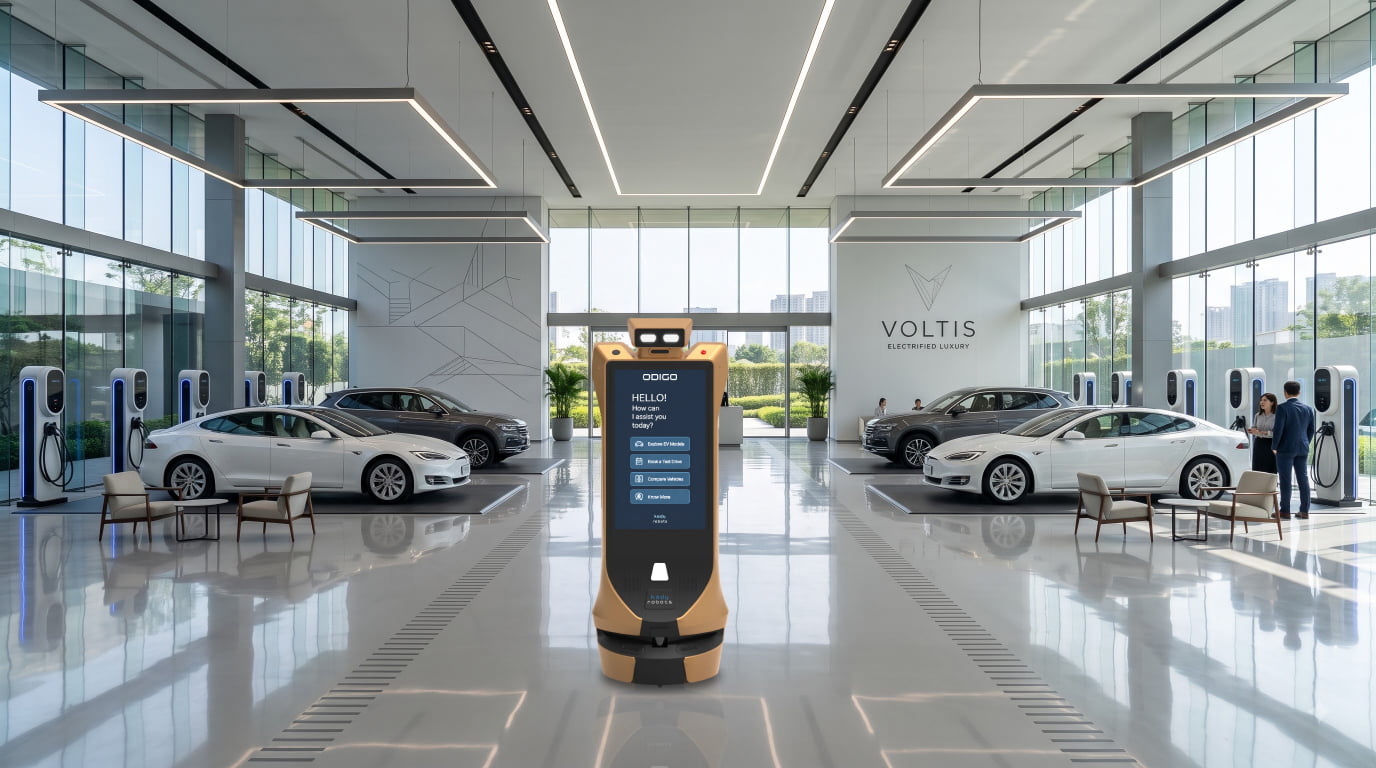
A Robot Assistant is becoming more capable of understanding people, navigating public spaces, presenting information, and supporting structured business tasks. Earlier service robots often depended on fixed commands and highly controlled routes. Newer robotics research is moving toward systems that can process language, images, gestures, spatial information, and changing surroundings together.
Recent advances in vision-language-action models, multimodal communication, simulation, and autonomous navigation are helping developers build robots that respond more naturally to human instructions. Google DeepMind’s robotics models focus on embodied reasoning and spatial understanding, while NVIDIA’s GR00T research combines visual information, language, robot states, and action generation. These advances show how robotics is moving from rigid programming toward more adaptable task support.
For car dealerships, these developments could improve how a Robot Assistant like Odigo by Kody Robots, welcomes visitors, explains vehicle options, understands buyer interests, supports product comparisons, and transfers useful context to a sales consultant.
Key Takeaways
- An AI Robot Assistant by Kody Robots can support customer communication, navigation, product education, lead capture, and employee handoffs.
- Multimodal AI is helping robots understand combinations of speech, images, gestures, and surrounding objects.
- Vision-language-action models are improving the connection between human instructions and physical robot behaviour.
- Autonomous navigation systems help mobile robots move through defined indoor spaces while responding to obstacles.
- A Car Showroom Robot can support vehicle discovery, model comparisons, buyer education, and test-drive requests.
- Human employees remain responsible for complex decisions, negotiations, customer relationships, and final sales guidance.
What Is a Robot Assistant?
A Robot Assistant is a programmable physical system designed to help people with informational, service, navigation, or operational tasks.
The robot may include a digital display, speakers, microphones, cameras, proximity sensors, wheels, navigation software, and a structured user interface. The exact components depend on the problem the robot is expected to solve.
A Robot Assistant by Kody Robots may help with:
- Welcoming visitors
- Displaying product information
- Answering common questions
- Guiding people toward a destination
- Collecting customer preferences
- Supporting appointments
- Sharing promotional content
- Moving approved items
- Notifying employees
- Recording basic interaction data
The word “assistant” defines the correct role. The robot supports people and business workflows. It does not need to control every part of the customer experience.
Why Are Helping Robots Advancing So Quickly?
Robotics development is benefiting from progress in several connected fields. These include natural language processing, computer vision, machine learning, autonomous navigation, simulation, embedded computing, and human-robot interaction.
Modern robotics research is also exploring foundation models that can learn from different forms of data instead of being trained for only one narrow action. NVIDIA’s GR00T N1.7, for example, is a vision-language-action model that can process language and images and can be adapted using robot demonstrations and task-specific data. Its training approach also uses human video to improve the transfer of movement knowledge across different robot designs.
These developments do not mean that every commercial robot can perform every advanced research task. Capabilities still depend on hardware, software, training data, safety controls, operating conditions, and product configuration.
Advancement 1 More Natural Language Understanding
Older robot interfaces often required users to follow specific commands or select from fixed menus. New language models are helping robots interpret more natural instructions.
A person may not describe the same request in exactly the same way every time. One showroom visitor may ask, “Which SUV is best for a family?” Another may say, “I need more space for five people and luggage.”
A more advanced Robot Assistant could identify the common intent behind both questions and guide each customer toward suitable product categories.
Language-based interaction can support:
- Product questions
- Model discovery
- Feature explanations
- Appointment requests
- Directional assistance
- Service enquiries
- Multilingual communication
- Employee handoffs
Large language models can improve conversational variety and contextual responses, although robot systems still require controlled information, clear boundaries, and methods for reducing incorrect answers.
Advancement 2 Multimodal Human-Robot Interaction
People communicate through more than words. They point, look toward objects, move their hands, pause, and use visual references.
Multimodal robot systems combine different signals, such as:
- Spoken instructions
- Touchscreen selections
- Images
- Pointing gestures
- Body posture
- Object locations
- Depth information
- Environmental context
Research published in 2025 demonstrated human-robot interaction systems that combined voice commands with pointing or posture information. This approach helps a robot connect phrases such as “show me that one” with the object or location the person is indicating.
For a car showroom, multimodal interaction could make product discovery easier. A visitor might point toward a displayed vehicle and ask about the model, available colours, or similar options.
Advancement 3 Better Visual and Spatial Reasoning
A Robot Assistant operating in a physical environment needs to understand where objects, people, routes, and obstacles are located.
Google DeepMind’s Gemini Robotics-ER models are designed around embodied and spatial reasoning. The April 2026 ER 1.6 update highlighted stronger multi-view understanding and real-world visual reasoning. Earlier Gemini Robotics research also combined perception, spatial understanding, planning, and code generation for robot control.
Spatial reasoning can help a service robot understand:
- Where a visitor is standing
- Which display the person is viewing
- Where an employee is located
- Which route is available
- Whether an object is blocking the path
- How different showroom zones are connected
A showroom application does not require the robot to manipulate vehicles or physical equipment. Spatial awareness can still support safer movement and more relevant visitor guidance.
Advancement 4 Vision-Language-Action Models
Vision-language-action models connect three important elements:
- What the robot sees
- What a person requests
- What action the robot should take
This is a major shift from traditional robotics systems in which every task required separate programming.
NVIDIA describes GR00T N1.7 as an open vision-language-action model that accepts multimodal inputs and can be adapted for different robots, tasks, and environments. The broader GR00T workflow includes data collection, simulation, policy training, evaluation, and deployment.
For commercial Robot Assistant applications, the long-term value of this approach could include faster adaptation to new workflows. A robot may become easier to configure for new product launches, updated showroom layouts, or different customer journeys.
Advancement 5 Improved Autonomous Navigation
A mobile Robot Assistant must be able to travel between approved locations without requiring an employee to control every movement.
Autonomous navigation generally depends on:
- Mapping
- Localization
- Route planning
- Obstacle detection
- Motion control
- Safe stopping
- Route recovery
- Defined operating boundaries
ROS provides software libraries and tools for robot applications, while the Nav2 project focuses on helping mobile robots move safely between locations. These open robotics systems support developers building navigation, mapping, control, and hardware integration workflows.
Inside a car showroom, navigation could allow a robot to move between:
- Reception
- Vehicle display zones
- Consultation desks
- Waiting areas
- Test-drive counters
- Delivery areas
- Customer lounges
Routes should remain carefully planned around people, furniture, vehicles, temporary displays, and showroom events.
Advancement 6 More Context-Aware Interaction
A helping robot should not start every interaction simply because a person is nearby. The system must consider whether the person appears interested, busy, confused, or already speaking with an employee.
Recent human-robot interaction research has examined whether language and vision models can decide when an interaction is appropriate. Results suggest that these models can handle clear situations but still face difficulty when social circumstances are open-ended or ambiguous.
This limitation is important for commercial settings.
A showroom Robot Assistant should avoid:
- Interrupting an active sales conversation
- Repeating unwanted greetings
- Blocking a customer’s path
- Starting an interaction without a clear reason
- Assuming customer intent from limited information
A better system uses visible prompts, controlled interaction zones, and clear options that allow visitors to choose whether they want assistance.
Advancement 7 Learning Through Demonstrations
Traditional robot programming can require engineers to define each action step. New robotics approaches increasingly use demonstrations, simulation, human video, and synthetic data.
NVIDIA’s GR00T platform supports workflows that include teleoperation, simulated environments, policy training, evaluation, and deployment. GR00T N1.7 also uses human video data to improve language following and generalization.
Learning from demonstrations may eventually make it easier to prepare robots for new service workflows. However, every task still needs testing, controlled deployment, safety checks, and real-world validation.
For dealerships, faster configuration could help a Robot Assistant adapt to:
- New model launches
- Promotional events
- Revised visitor journeys
- Updated product categories
- New lead forms
- Different showroom layouts
- Seasonal campaigns
Advancement 8 Better Simulation and Testing
Testing a robot only in a live customer environment can be expensive and disruptive. Simulation allows developers to examine navigation, interactions, movements, and task policies before deploying the robot physically.
Current robot-development platforms increasingly connect simulation with data generation, model training, evaluation, and real-world deployment. NVIDIA’s 2026 GR00T workflow, for example, includes simulation-based policy testing before deployment on robot hardware.
For a car showroom, simulation can help teams test:
- Robot routes
- Busy-hour movement
- Display placement
- Temporary obstacles
- Visitor interaction points
- Sales handoff workflows
- Emergency stopping conditions
Simulation cannot reproduce every real customer situation, but it can help reduce obvious operational problems before launch.
Advancement 9 On-Device Robot Intelligence
Robots often need to process information quickly. Depending completely on distant cloud systems may introduce delays or connectivity concerns.
Modern robot-development platforms are moving toward stronger on-device inference, where important perception and control tasks can operate closer to the robot. NVIDIA’s deployment workflow includes real-time, on-device inference through robot computing and control systems.
For commercial robots, local processing may support:
- Faster responses
- More reliable navigation
- Reduced dependence on constant connectivity
- Better control over operational data
- Quicker obstacle reactions
Cloud systems may still support content updates, dashboards, analytics, and integration with business platforms.
Advancement 10 Stronger Business Workflow Integration
A Robot Assistant becomes more valuable when the interaction continues beyond the robot screen.
For example, a showroom visitor may explore two vehicles, select a budget, request financing information, and choose a test-drive time. That information should reach the right employee in a useful format.
Workflow integration may connect the robot with:
- Lead-management systems
- Appointment tools
- Customer relationship platforms
- Product catalogues
- Showroom dashboards
- Sales notifications
- Campaign reports
- Customer feedback systems
The robot should not become an isolated kiosk on wheels. It should support the movement of information between customers and employees.
How a Robot Assistant Can Support Car Showrooms
A Robot Assistant for Car Showroom can support the first stages of the automotive buying journey.
The robot may help customers:
- Browse vehicle categories
- Explore models
- Compare selected options
- Review key features
- View available colours
- Understand basic EV topics
- Share a budget range
- Express finance interest
- Request a test drive
- Provide contact information
- Ask for a sales consultant
The strongest use case is not replacing the salesperson. The strongest use case is preparing a better sales conversation.
Car Showroom Robot for Busy Periods
Showrooms often experience higher visitor traffic during weekends, festivals, product launches, and promotional campaigns.
A Car Showroom Robot built by Kody Robots can engage visitors while consultants complete other discussions. Customers can explore the lineup and share their interests instead of waiting without guidance.
Once a salesperson becomes available, the employee may already know:
- Which model the visitor explored
- Which features attracted attention
- The expected budget
- Whether the visitor wants financing
- The preferred test-drive time
- The likely purchase timeline
This creates a smoother transition from self-service discovery to human consultation.
Robotics Assistant for Car Showroom Product Education
A Robotics Assistant for Car Showroom environments can organize product information into a guided journey.
Instead of showing a long technical specification sheet, the interface can begin with customer needs:
- Daily city driving
- Family travel
- Premium comfort
- Large storage space
- Electric mobility
- Business use
- Safety priorities
The robot can then guide the customer toward relevant categories. A sales consultant should confirm current prices, technical details, availability, offers, and model-specific information.
Robot Assistant for Automobile Showroom Lead Capture
A Robot Assistant for Automobile Showroom like Odigo by Kody Robots operations can help record visitor interest more consistently.
Potential information includes:
- Customer name
- Contact details
- Vehicle interest
- Preferred variant
- Budget
- Finance requirement
- Exchange interest
- Test-drive request
- Follow-up preference
The dealership should clearly explain why the information is being collected and how the business will use it.
Benefits for Car Buyers
A showroom Robot Assistant can provide:
- Faster initial engagement
- Independent product exploration
- Structured vehicle comparisons
- Easier test-drive requests
- Less unproductive waiting
- Multilingual information
- Better preparation before speaking with a consultant
Some customers want immediate human assistance. Others prefer private product discovery first. A well-designed showroom experience should support both preferences.
Benefits for Dealership Teams
Dealership employees may benefit from:
- Better peak-hour floor coverage
- Fewer repeated basic explanations
- More structured lead information
- Faster consultant handoffs
- Improved test-drive capture
- Better product-interest insights
- More time for complex sales discussions
The robot supports routine discovery. Employees provide trust, judgment, demonstrations, negotiation, and relationship management.
What Dealerships Should Evaluate
Before introducing a Robot Assistant, dealership leaders should assess:
- The customer problem being solved
- Showroom layout
- Visitor traffic
- Available product content
- Language requirements
- Lead-management workflows
- Sales-team responsibilities
- Data handling
- Technical support
- Performance measurement
Useful performance indicators may include completed interactions, models explored, test-drive requests, qualified leads, employee handoffs, and customer feedback.
Why Kody Robots Fits the Showroom Use Case
Kody Robots, a robotics company in India, is positioned around autonomous robotic solutions for commercial environments.
A showroom robot should combine useful customer communication with a clear dealership workflow. The robot’s role must remain practical: engage visitors, support product discovery, collect initial preferences, and connect interested buyers with the sales team.
The industry advancements discussed in this blog describe the wider direction of modern robotics. They should not be interpreted as confirmation that every research capability is currently included in a particular commercial product.
The Future of Robot Assistants
The future of Robot Assistant systems will likely involve better language understanding, stronger spatial reasoning, multimodal communication, safer navigation, faster configuration, and deeper business integration.
However, progress will depend on more than advanced AI.
Successful helping robots will need:
- Accurate information
- Clear task boundaries
- Responsible data handling
- Reliable navigation
- Employee supervision
- Simple user interfaces
- Honest capability communication
- Measurable business value
The most useful robots will not try to imitate every human ability. They will solve specific customer and operational problems consistently.
Conclusion
A Robot Assistant by Kody Robots is advancing from a fixed command-based machine into a more responsive service platform. Current research in multimodal AI, vision-language-action models, spatial reasoning, autonomous navigation, simulation, and natural interaction is expanding what robots may be able to support.
In car dealerships, these advances can contribute to better visitor engagement, product discovery, model comparison, lead capture, test-drive requests, and salesperson handoffs.
A Robot Assistant should not replace the knowledge and relationship skills of a sales consultant. The robot should support the early customer journey so employees can focus on demonstrations, finance discussions, negotiations, and purchase decisions.
For car showrooms, the future of helping robots will depend on usefulness rather than novelty. A successful system will make information easier to access, waiting time more productive, and sales conversations more relevant.