


1. Introduction: The Importance of Data Mining in the Data Science Landscape
2. Association Rule Mining: Uncovering the Hidden Relationship in Data
3. Clustering Algorithms: Grouping Similar Data Points
4. Classification Techniques: Predicting Outcomes on the Basis of Patterns
5. Regression Analysis: Modeling Relationships in Data
6. Anomaly Detection: Identifying Outliers and Unusual Behavior
7. Text Mining: Extracting Insights from Unstructured Data
8. Data Science Courses for Working Professionals in Mastering Data Mining
9. Ethical Considerations in Applying Data Mining Techniques
10. Emerging Trends and Future Directions in Data Mining
11. Write Up Case Studies: Real-world Applications of Data Mining Techniques
12. Conclusion: Mastering Data Mining for Insight-Driven Actions and Career Advancement
Introduction: Why Data Mining forms the most important part of a Data Scientist’s job
As data science is a rapidly changing domain, the competence that all professionals in every sector must have today is effectively extracting insights and patterns from large datasets. Data mining is at the heart of the workflow for the latest tendency in dealing with data scientifically, referred to as data science. It provides a comprehensive set of techniques and algorithms for solving problems by uncovering hidden trends, predicting outcomes, and deriving data-driven decisions.
Applications of data mining techniques range from the identification of customer segments and optimization of marketing campaigns to fraud detection and prediction of equipment failures in the sphere of data science. We have put together some of the most important data mining techniques that every data scientist should know and why working professionals need data science courses to learn these skills in this article.
Association Rule Mining: Uncovering Hidden Relationships in Data
Association rule mining is a very powerful technique in data mining that primarily looks at identifying frequent patterns and relationships that exist within a dataset. It enables the discovery of hidden insights through analysis of the co-occurrence of items or events, hence informing decision-making, optimizing business processes, and driving innovation.
The algorithm is a very common association rule mining technique, and most working professional courses in data science will include the implementation and application of this algorithm in real-life scenarios. Association rule mining can be particularly helpful to a data scientist in retail, e-commerce, and market basket analysis, where identifying chances for cross-selling and upselling is a principal priority.
Market Growth and Adoption:
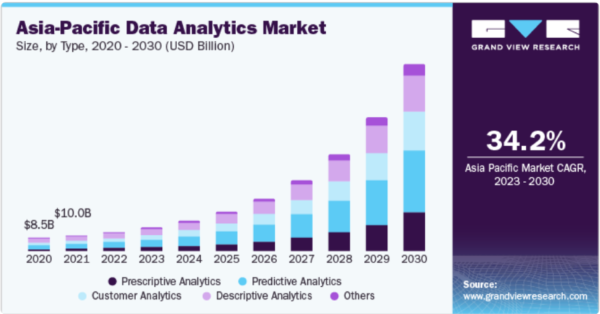
- Market Expansion: According to Grand View Research, the global data mining market size is projected to reach a staggering USD 172.82 billion by 2027, with a Compound Annual Growth Rate (CAGR) of 11.9%. This signifies significant market expansion and increasing reliance on data-driven decision-making.
- Business Value Recognized: A Forbes Insights survey found that 89% of business executives believe data and analytics are crucial for business success in 2024. This highlights the growing recognition of the value data mining offers in enhancing business strategies.
 https://www.grandviewresearch.com/industry-analysis/data-analytics-market-report
Clustering Algorithms: Grouping Similar Data Points
The other important technique in data mining uses clustering, which allows data to be organized into groups with identical characteristics or attributes. Through the inherent grouping available with data points in a dataset, data scientists can extract meaningful information and get insights on customer segmentation, market trends, and recommendations on products.
K-means and hierarchical are some of the very famous algorithms, each with their own strengths and uses. These techniques are normally taught with some depth in data science courses to working professionals, whereby hands-on experience in implementing and evaluating clustering models using popular data mining tools and libraries is given.
Classification Techniques: Predicting Outcomes Based on Patterns
Classification is the technique of supervised learning in data mining used for predicting a class or category of data points based on their attribute values. The algorithms of classification, through such training on labeled datasets, could have learned to identify patterns in the training data and make accurate predictions for new instances unseen before.
Probably the most frequently used algorithms are decision trees, logistic regression, and support vector machines; therefore, their implementation and application are mainly trained in data science courses for working professionals. Knowledge of classification techniques would be very instrumental to a data scientist as a professional in fields such as healthcare, finance, and marketing—relating and critical areas where critical decisions are most needed based on predictions.
Regression Analysis: Modeling Relationships in Continuous Data
Another type of supervised learning is that of regression analysis, modeling the relationship between variables—a dependent variable and one or more independent variables. In its principle, regression models fit a mathematical equation from data and permit prediction, identification of influential variables, and hypothesis testing.
Thus, linear regression and logistic regression come under the category of most applied regression techniques, whose implementation and applicability in data mining projects are taught and taken care of by several professional courses related to data science. Understandably, with this concept, regression analysis becomes very useful in the case of a data scientist working in sectors like finance, economics, and societies, where modeling relationships and making forecasts remain part and parcel of work.
Anomaly Detection: Identification of Outliers and Peculiar Behavior
Anomaly detection is one such technique in data mining that looks forward to recognizing data points that, in general, significantly deviate from the norm. This allows the data scientists to discover unknown instances of fraudulent activities, broken systems, or new trends/rules and opportunities by identifying such outliers.
Another example includes one-class support vector machines and isolation forests, two of the most popular approaches to anomaly detection. Their implementation and application in real-world settings usually form the core body of any data science course designed for working professionals. Indeed, the importance of anomaly detection is unique for a data scientist who engages in areas of high internal risk, such as cybersecurity, finance, or manufacturing—domains where identifying and mitigation play a critical role.
Text Mining: Extracting Insights from Unstructured Data
It is observed that today’s world is data driven and most of the information available is in unstructured text data formats. This comprises posts on social media, customer reviews, and news articles. Text mining is a technique of data mining that deals with extracting useful insights and patterns from this data to help data scientists develop a deeper understanding of customer sentiment, brand reputation, and trends in markets.
Text mining Techniques that are generally typical of NLP will be shared in sentiment analysis and topic modeling. Courses on data science in the context of working professionals often focus on implementation and application in concrete cases. Other data scientists, for example, in marketing, PR, or social media analysts, may be particularly helped by knowledge regarding text mining, since analysis and interpretation of textual data form an integral part of the daily job.
How Working Professionals Can Master Data Mining through Data Science Courses
Such data science courses can, therefore, be very critical to working professionals who are looking to further their data science skills and be at the top of their game. The course is designed to familiarize learners with the broad spectrum of topics in the theoretical foundation of data mining and hands-on experience in the implementation and application of techniques using the latest tools and libraries.
A blend of lectures, tutorials, and project-based learning in a data science course will completely immerse a practicing professional in the learning process, hence placing one at a vantage point to build a deeper understanding pertaining to data mining and its practical applications in the real world. Equipped with state-of-the-art research papers, industry case studies, and expert mentorship, students gain the confidence and skill to handle complex data mining problems that drive innovation within their respective fields.
Job Market Trends:
- High Demand, Limited Supply: The U.S. Bureau of Labor Statistics predicts a 35% growth in employment for data scientists (professionals who leverage data mining techniques) from 2022 to 2032, outpacing the average for all occupations. This indicates a strong job market for skilled data mining professionals, but also a potential skills shortage.
- Lucrative Salaries: Data mining expertise is well-compensated. According to Indeed, the average base salary for a data scientist in the US is $130,142 as of June 2024. This reflects the value businesses place on data-driven insights.
Ethics of Applying Data Mining Techniques
As data mining becomes more pervasive in its usage, it’s important to note that there are ethical considerations for these techniques. The most important issues concern data privacy and algorithm bias, which must be addressed so that insights and decisions offered by data mining models do not further perpetuate inequities in societies.
Very few data science working professional courses will cover modules on ethical considerations in data mining. In such courses, the topics covered include data governance, model interpretability, and the need for responsible data practices. Courses contributing to this kind of capacity building will help foster a culture of ethical data science and ensure that developments in, and applications of, data mining techniques are socially conscious and responsible.
Emerging Trends and Future Directions of Data Mining
The field of data mining is in a continuous state of evolution, and new techniques and algorithms with emerging applications come up very frequently. From the rapidly growing interest in deep learning and neural networks to increased real-time data processing and streaming analytics, the future of data mining holds exciting opportunities and complex challenges.
Most of these emerging trends and innovations are usually covered through guest lectures and panel discussions by leading researchers and industry experts in data science courses for working professionals. Equipped with knowledge about new developments in the sphere, students of this course will be well placed at the threshold of this evolutionary flux to contribute toward further advancing data mining technologies and their applications.
Case Studies: Real-World Applications of Data Mining Techniques
Case studies or examples can prove highly illustrative for the practical application of data mining techniques. The application areas of data mining methods run from association rule mining via the optimization of product recommendations in e-commerce to clustering algorithms used for customer segmentation in the telecom sector.
In most data science courses, many such case studies and examples of successful data mining projects are included, which give students a better understanding of problems and best practices to apply these techniques in the real world. One can learn from these examples and gain valuable insights and inspiration to chart their own data mining projects and initiatives.
Conclusion: Embracing Data Mining for Actionable Insights and Career Growth
One of the most critical skills in helping professionals drive innovation, optimize business processes, and drive them toward data-driven decisions in this fast-moving world of data science is how effectively one can leverage techniques for data mining. Such techniques may be applied in many different ways and enable data scientists to have a meaningful effect on their organizations by identifying customer segments for predicting future trends—optimizing marketing campaigns or detecting fraud.
In this backdrop, aspiring and experienced data scientists will engage in data science courses for working professionals emphasizing data mining techniques to develop knowledge, skills, and ethics necessary for harnessing these technologies and application to real-world challenges. This would be achieved by a judicious intermingling of the theoretical instruction, hands-on experience, and cutting-edge research and industry practice exposition.
As the future of data science further unfurls, so also will the ability to leverage data mining techniques play a huge role in career growth and delivery for proponents within an organization. With such powerful tools and techniques at their disposal, modern data scientists can crack open new frontiers of data analytics and insights that drive progress and innovation in respective domains, and help take up lead roles in shaping a data-driven future ahead.