

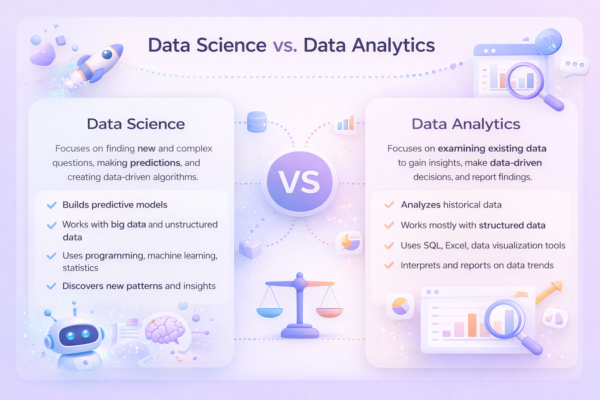
The demand for data-driven professionals has surged as organizations increasingly rely on data to guide decisions, automate processes, and predict future outcomes. Two of the most popular-and often misunderstood-career paths in this space are Data Science and Data Analytics.
While both roles work with data, they differ significantly in responsibilities, technical depth, required skills, and long-term career growth.
If you’re deciding between a data science career and a data analytics career, this guide will help you understand the key differences, real-world use cases, skills, salary expectations, and future opportunities you can choose the path that best aligns with your goals.
What Is Data Science?
Data science is an advanced, interdisciplinary field that combines statistics, programming, machine learning, and domain expertise to extract insights and build predictive models from large and complex datasets. A data science career focuses on understanding patterns in data to predict what will happen next and explain why it happens.
How Is Data Science Used?
Data science is applied across industries to solve problems that require prediction, automation, and advanced modeling. These use cases reflect the type of work data scientists typically handle in real-world roles:
- Predictive Analytics for Forecasting and Risk Modeling
Used in retail, supply chain, and finance to anticipate demand, manage risk, and support strategic planning. - Recommendation Engines in Digital Platforms
Power personalized content and product recommendations in streaming services and eCommerce platforms. - Fraud Detection in Banking and Fintech
Machine learning models analyze large volumes of transaction data to identify anomalies and prevent fraud. - Healthcare Diagnostics and Predictive Care
Data science supports early diagnosis, patient risk prediction, and treatment optimization. - AI-Driven Automation and Intelligent Systems
Enables businesses to automate decision-making and optimize operations at scale.
These examples highlight how machine learning and data science are used to build forward-looking, high-impact systems-making data science a strong career choice for those interested in advanced analytics and AI-driven solutions.
Roles and Responsibilities of a Data Scientist
A data scientist typically works on:
- Build predictive models to forecast future outcomes
Data scientists design machine learning models that help businesses predict demand, detect risks, and anticipate customer behavior rather than just analyze past data. - Work with complex and large-scale datasets
They handle structured and unstructured data from multiple sources, preparing it for modeling and ensuring data quality at scale. - Apply advanced statistical and machine learning techniques
Statistical analysis and algorithms are used to uncover patterns, validate assumptions, and improve model accuracy. - Translate data insights into automated decisions
Data scientists turn models into real-world systems that automate recommendations, scoring, or decision-making processes. - Collaborate with engineering and product teams
They work closely with engineers to deploy models into production and with product teams to align solutions with business goals.
Skills Required for a Data Science Career
Key skills required for data science include:
- Programming languages for data science (Python, R, SQL)
Data scientists use programming to clean data, build models, and automate workflows. Python is widely used for machine learning, while SQL is essential for working with large datasets stored in databases. - Machine learning algorithms and model evaluation
Understanding supervised and unsupervised learning helps data scientists build models that predict outcomes and detect patterns. Model evaluation skills ensure results are accurate, reliable, and ready for real-world use. - Big data technologies (Spark, Hadoop)
Many data science projects involve massive datasets. Big data tools allow data scientists to process and analyze information efficiently across distributed systems. - Statistics, probability, and linear algebra
These fundamentals support hypothesis testing, feature selection, and model interpretation. Strong mathematical reasoning helps data scientists explain results and improve model performance. - Cloud platforms and MLOps tools
Modern data science relies on cloud environments for training, deploying, and monitoring models. MLOps tools help manage model lifecycles, versioning, and scalability in production systems.
A data science career generally requires a strong technical and mathematical foundation.
What Is Data Analytics?
Data analytics focuses on examining historical and real-time data to identify trends, patterns, and insights that support business decisions. A data analytics career answers what happened and what is happening now.
How Is Data Analytics Used? Real-World Data Analytics Examples
Data analytics is used across organizations to understand performance, identify patterns, and support day-to-day business decisions. These use cases reflect the type of work data analysts typically handle in real-world roles:
- Sales and Marketing Performance Analysis
Data analytics helps teams measure campaign performance, track conversion rates, and understand which channels drive the most revenue, enabling better budget and strategy decisions. - Customer Behavior and Churn Analysis
Analysts examine customer data to identify usage patterns, engagement trends, and early signs of churn, helping businesses improve retention and customer experience. - Financial Reporting and Forecasting
Data analytics supports financial planning by analyzing revenue, expenses, and cash flow, allowing organizations to monitor performance and make informed budgeting decisions. - Operational Efficiency Dashboards
Analytics dashboards track operational metrics such as productivity, turnaround time, and resource utilization, helping teams identify bottlenecks and improve efficiency. - Website and Product Usage Analytics
Data analysts study user interactions, feature adoption, and traffic trends to optimize digital products and improve overall user experience.
These examples show how data analytics plays a critical role in data-driven decision-making, helping organizations turn raw data into actionable business insights.
Roles and Responsibilities of a Data Analyst
- Data Cleaning and Preparation
A data analyst collects, cleans, and organizes raw data from multiple sources to ensure accuracy and consistency before analysis begins. - Creating Reports and Dashboards
Analysts design dashboards and reports that visualize key metrics, helping stakeholders quickly understand performance and trends. - Performing Statistical Analysis
Statistical methods are used to identify patterns, correlations, and anomalies in data, supporting evidence-based decision-making. - Using Business Intelligence Tools
Data analysts work with BI tools to explore data, generate insights, and monitor business KPIs across departments. - Translating Data into Actionable Insights
One of the most important responsibilities is converting data findings into clear recommendations that guide business strategies and operational improvements.
Skills Required for a Data Analytics Career
- SQL and Spreadsheet Expertise
Data analysts rely heavily on SQL and spreadsheets to query databases, organize datasets, and perform day-to-day analysis. These tools are essential for extracting insights from structured data. - Data Visualization Skills (Tableau, Power BI)
Visualization tools help analysts present complex data in a clear and understandable way. Dashboards and visual reports enable stakeholders to quickly interpret trends and performance metrics. - Statistical Analysis Fundamentals
A solid understanding of statistics allows data analysts to identify patterns, correlations, and anomalies, supporting accurate and data-backed conclusions. - Business Intelligence Tools
BI platforms are used to monitor KPIs, generate reports, and support ongoing performance analysis across departments, making analytics actionable at a business level. - Strong Communication and Business Understanding
Data analysts must clearly explain insights to non-technical stakeholders. Understanding business goals ensures that analysis directly supports decision-making and strategy.
Data Science vs. Data Analytics: Key Differences Explained
Understanding the difference between data science and data analytics is essential when choosing the right career path. While both roles work with data, they differ significantly in focus, technical depth, and outcomes.
| Aspect | Data Science | Data Analytics |
| Primary Focus | Predicting future outcomes and building intelligent models | Analyzing past and current data for insights |
| Level of Complexity | Analyzing past and current data for insights | High (machine learning, AI, advanced modeling) |
| Core Tools | Machine learning models, big data frameworks, and AI platforms | BI tools, SQL, spreadsheets, and visualization tools |
| Coding Requirements | Advanced programming skills | Moderate scripting and querying |
| Typical Output | Moderate scripting and querying | Reports, dashboards, and business insights |
In simple terms, data science focuses on prediction and automation, while data analytics focuses on interpretation and decision support.
How Do Data Science and Data Analytics Complement Each Other?
Data science and data analytics play different but connected roles within modern data teams. Data analytics focuses on organizing and analyzing historical and real-time data to uncover trends, performance gaps, and business insights. These insights form the foundation that data science builds upon.
Data science extends analytical findings by applying machine learning and advanced modeling to predict outcomes and automate decisions. While data analytics helps organizations understand what is happening, data science enables them to anticipate what will happen next. Together, they transform raw data into actionable intelligence and scalable, AI-driven solutions that support smarter business decisions.
Career Path Comparison: Data Science vs. Data Analytics
Data Science Career Path
A data science career typically follows a deeply technical progression focused on building intelligent and predictive systems. Professionals often begin as Junior Data Scientists, where they work on data preparation, exploratory analysis, and basic model development under senior guidance. As they move into Data Scientist roles, they take on greater responsibility for designing machine learning models, analyzing complex datasets, and solving business problems using advanced analytics.
With experience, professionals advance to Senior Data Scientist positions, where they lead modeling initiatives, mentor junior team members, and collaborate closely with engineering and product teams.
Many data scientists eventually move into roles such as Machine Learning Engineer or AI Specialist, focusing on deploying models at scale, optimizing performance, and building AI-driven products. This career path is well-suited for individuals who enjoy mathematics, programming, and long-term technical growth.
Data Analytics Career Path
A data analytics career path is more closely aligned with business operations, decision-making, and strategy. Professionals often start as Junior Data Analysts, where they focus on data cleaning, reporting, and basic analysis. As Data Analysts, they take ownership of dashboards, performance metrics, and business insights that support daily and strategic decisions.
With experience, analysts progress to Senior Data Analyst roles, where they lead analytical projects, guide stakeholders, and influence business outcomes through data-driven recommendations.
Many professionals eventually move into leadership positions such as Analytics Manager or Business Intelligence Lead, overseeing analytics teams and shaping data strategy at an organizational level. This path is ideal for individuals who enjoy working closely with business teams and translating data into actionable insights.
Salary Comparison: Data Science vs. Data Analytics (2026 Outlook)
In 2026, salary expectations differ between data science and data analytics due to the level of technical specialization involved.
- Data science roles generally command higher compensation because they require advanced skills in machine learning, statistical modeling, and AI system development. Professionals with experience in deploying production-grade models and working with large-scale data platforms often earn premium salaries.
- Data analytics roles, while typically offering lower average salaries than data science, provide strong earning potential-especially for professionals who combine analytical skills with business expertise. Entry-level data analytics positions are often more accessible, allowing faster entry into the workforce and steady salary growth over time.
Factors such as industry, years of experience, geographic location, and domain knowledge significantly influence compensation in both career paths. While data science tends to offer higher long-term earning potential, data analytics remains a financially stable and rewarding career choice in 2026.
Choosing Between a Data Analytics and a Data Science Career
When deciding between data analytics and data science, your choice should align with your skills, interests, and professional goals. Consider the following key differentiators:
- Your Comfort with Coding and Advanced Mathematics:
Data Science requires strong programming (Python, R) and a deep understanding of statistics, linear algebra, and calculus to build complex models. Data Analytics often uses SQL and visualization tools (like Tableau) with a focus on applied statistics for interpretation. - Interest in Machine Learning (ML) and Artificial Intelligence (AI):
A core differentiator. Are you fascinated by building predictive models, NLP, or deep learning? This is the realm of Data Science. If your interest lies in analyzing past trends to answer business questions, Data Analytics is more aligned. - Preference for Business Insights vs. Technical Modeling:
Data Analysts are typically closer to business decision-makers, translating data into clear reports and dashboards to guide strategy. Data Scientists are often more focused on the technical research, experimentation, and engineering of scalable ML solutions. - Long-Term Career Goals and Learning Commitment:
Data Science generally demands a continuous, steep learning curve in cutting-edge AI/ML techniques. Data Analytics also evolves, but may have a more gradual pace centered on new tools and business domains. Many professionals start in analytics to build foundational skills before transitioning into data science.
A Common Path: Beginners often find data analytics an accessible entry point to build core data literacy and business acumen, later transitioning to data science by adding advanced programming and machine learning skills.
Job Market Demand for Data Science and Data Analytics
In 2026, demand for both data science and data analytics roles remains strong, but the nature of that demand differs. Data analytics roles are widely sought across industries for reporting, performance tracking, and business decision support, making them easier to enter and more common at the organizational level.
Data science roles, on the other hand, are increasingly concentrated in companies investing in AI, automation, and predictive systems. While fewer in number, these roles often require deeper technical expertise and are tied to long-term innovation initiatives. As a result, hybrid roles that combine analytics foundations with data science skills are becoming more common, especially in fast-growing digital businesses.
Future Trends in Data Science and Data Analytics Careers
The future of data-driven careers is being defined by five powerful trends. These developments signal where the fields are heading and what skills will be most valuable.
AI-Driven Analytics and Automation:
What it is:
- The widespread use of AI to automate core tasks in the data pipeline-from intelligent data cleaning and feature engineering to automated report generation and model selection via AutoML.
Career Impact:
- Reduces time spent on repetitive tasks. Professionals will need to upskill in orchestrating and overseeing these automated systems, focusing their expertise on strategic problem-framing, model validation, and managing AI outputs for business alignment.
Augmented Analytics Tools:
What it is:
- The next generation of BI tools that use machine learning and NLP to provide insights proactively. Think of platforms that suggest analyses, auto-generate narratives from charts, or allow conversational querying (“Show me sales by region last quarter”).
Career Impact:
- Democratizes data access, shifting the data professional’s role from “report creator” to “insight enabler” and “data product manager.” Key skills will include data governance, semantic layer design, and coaching business users on deriving value from these tools.
Increased Focus on Explainable AI (XAI):
What it is:
- A regulatory and ethical movement demanding that AI model decisions be interpretable and justifiable to humans, especially in sensitive sectors like finance, healthcare, and criminal justice.
Career Impact:
- Creates a high-demand specialty. Data scientists must now prioritize model interpretability alongside accuracy. Proficiency in XAI frameworks (e.g., SHAP, LIME) and the ability to clearly articulate model logic to regulators and executives will become a major career differentiator.
Growth of Cloud-Based Data Platforms:
What it is:
- The full migration of data storage, processing, and analytics workloads to integrated cloud platforms (e.g., AWS Redshift/SageMaker, Google BigQuery, Azure Synapse).
Career Impact:
- Cloud proficiency is now non-negotiable. Future-proof careers require hands-on experience with cloud data warehousing, serverless computing, and cloud-based MLOps for deploying and monitoring models. Understanding cost optimization and security in the cloud is also critical.
Rising Demand for Cross-Functional Data Professionals:
What it is:
- The breakdown of silos. Businesses need data experts who also deeply understand marketing, supply chain, finance, or product development.
Career Impact:
- The most successful professionals will be “T-shaped”: deep in technical skills (the vertical bar of the T) but broad in business acumen, communication, and domain knowledge (the horizontal top). This ability to “translate” is what will secure a seat at the strategic decision-making table.
While both careers have a bright future, longevity depends on adaptive learning. The winners will be those who evolve from pure technicians into strategic partners who can harness these trends to deliver measurable business value.
Conclusion
Choosing between Data Science vs Data Analytics depends on your interests, skills, and long-term goals. Data science is ideal for those who enjoy advanced modeling, machine learning, and AI-driven innovation. Data analytics suits professionals who prefer interpreting data, influencing business decisions, and working closely with stakeholders.
Both careers are essential in today’s data-driven world. The right choice is the one that aligns with your strengths, curiosity, and career vision.