
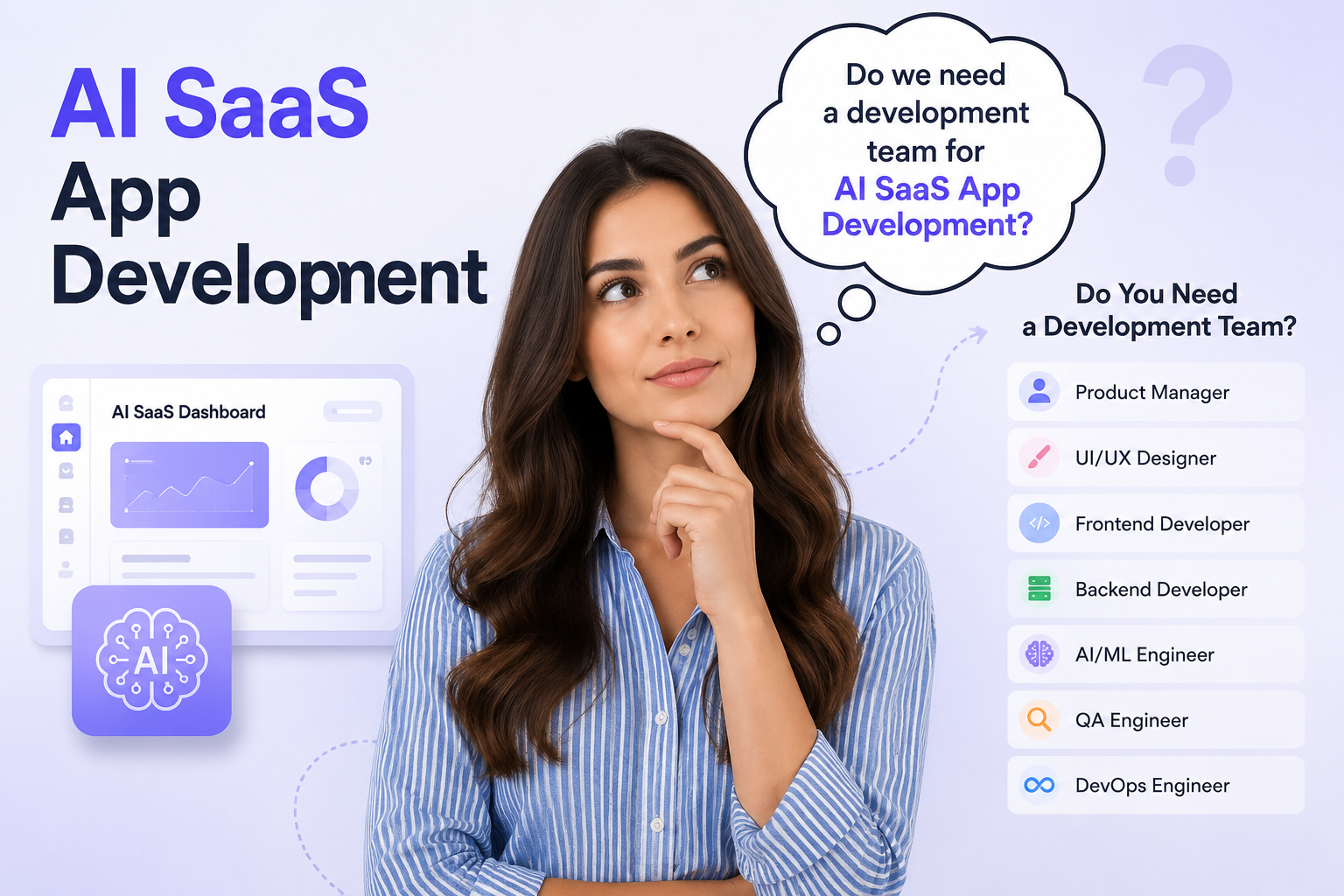
“The biggest mistake founders make isn’t choosing the wrong technology—it’s bringing the wrong people into the project before they truly understand what they’re trying to build.”
Every successful software product starts with an idea, but not every idea turns into a successful product. In fact, many promising AI SaaS projects never make it past the planning stage because founders assume they need a large development team before they can even begin. The moment artificial intelligence enters the conversation, people imagine AI engineers, software architects, designers, cloud specialists, and data scientists working together on an expensive project. For someone exploring a new business idea, this can quickly become overwhelming.
The reality is much more encouraging. Building an AI-powered SaaS product doesn’t begin with hiring people—it begins with understanding the problem you want to solve. Once that foundation is clear, deciding who should be involved becomes much easier. Some projects genuinely require multiple specialists from the beginning, while others can successfully launch with a small, focused team that grows alongside the product.
Today’s businesses are adopting AI faster than ever, not because it’s a trend but because it helps solve real operational challenges. Whether it’s automating customer support, organizing business data, generating reports, or improving decision-making, companies are investing in AI SaaS app development to create software that delivers measurable value. However, behind every successful product is a carefully planned team structure, not simply a large number of developers.
So before you start interviewing developers or comparing development agencies, it’s worth asking a more important question:
Who does your product actually need today?
The answer may be very different from what you expect.
Start With the Problem, Not With Hiring
When people decide to build software, their first instinct is usually to look for developers. It seems logical because developers build applications, write code, and transform ideas into working products. However, hiring developers before defining your business problem is similar to hiring construction workers before creating the blueprint for a building.
Imagine you’re planning to build a new hotel.
You wouldn’t begin by asking how many electricians or plumbers you need. Instead, you would first decide how many rooms the hotel should have, who your guests will be, what services you’ll offer, and what kind of experience you want visitors to remember. Once those decisions are made, the architect can create a proper plan, and only then does it make sense to assemble the construction team.
AI SaaS products follow the same process.
Suppose you own a healthcare clinic where reception staff spend hours answering appointment-related phone calls. You decide that artificial intelligence might help improve this process. If your only instruction to a development team is, “Build us an AI application,” the project has no clear direction. Every developer involved will interpret that request differently because the actual business challenge hasn’t been defined.
Now consider a different approach.
Instead of focusing on AI, you explain that patients frequently call to book appointments, reschedule visits, and ask basic questions about clinic hours. Your goal is to build a system that automatically handles these repetitive conversations while allowing staff to focus on patients who require personal assistance.
Notice how the discussion changes.
The product now has a clear purpose. Everyone involved understands the problem, and every decision during development becomes easier because the objective is well defined. Before thinking about job titles, technologies, or AI models, successful founders spend time understanding exactly what they want their software to achieve.
Every AI SaaS Product Needs a Different Kind of Team
One of the biggest misconceptions surrounding AI software is the belief that every product requires the same development structure. This assumption usually comes from reading about large technology companies that employ hundreds of engineers across different departments. While that approach makes sense for global enterprises, it doesn’t automatically apply to every startup or growing business.
Think about three completely different companies.
The first is a recruitment agency that wants software capable of reading resumes, identifying qualified candidates, and ranking applications automatically. Their biggest challenge is reducing the time recruiters spend reviewing hundreds of CVs every week.
The second company operates a logistics business where managers manually plan delivery routes every morning. They want AI to analyze traffic conditions, delivery priorities, and vehicle locations before recommending the most efficient routes.
The third company runs an online education platform and wants an intelligent learning assistant that answers student questions, recommends study materials, and tracks learning progress.
All three businesses are building AI-powered software.
Yet none of them require exactly the same team.
The recruitment platform may focus heavily on document processing and candidate matching. The logistics platform may require expertise in route optimization and real-time data processing. Meanwhile, the education platform places greater emphasis on conversational AI and user experience.
This is why there isn’t a universal hiring formula for AI SaaS app development. The people you need should always reflect the complexity of your product and the problems your customers are trying to solve—not what another company is building.
Many founders begin researching team structures before they fully understand their own requirements. Ironically, spending more time planning often reduces the number of people you need during the early stages because unnecessary work is identified before development even begins.
The Right Team Isn’t Always the Largest Team
It’s easy to believe that hiring more people will speed up development, but software projects rarely work that way. As teams grow, communication becomes more complicated, decisions take longer, and project management becomes increasingly important. A larger team only creates value when there is enough clearly defined work for everyone involved.
Imagine two entrepreneurs starting similar AI businesses.
The first founder hires a large team immediately because they want to build every feature they can think of. The project includes AI chatbots, analytics dashboards, reporting systems, voice assistants, workflow automation, mobile applications, and third-party integrations before the first customer has even used the software.
The second founder, however, chooses an alternative strategy. Rather than solving any potential problems, he or she chooses one particular problem which the consumers face daily and creates a version of the product which is capable of solving that particular problem excellently. After the initial launch, the consumer’s feedback and actual usage of the application determine the further development of the product.
Even though the second product is launched with fewer functions, it tends to hit the market faster. What is more important, each subsequent function is implemented only after the need of it was established from actual consumer behavior. It makes the product more effective while eliminating additional expenses on unnecessary development.
At this stage, founders usually start looking not only for employees but also begin considering other important financial issues. This would help avoid unreasonable expectations at the early stages of the project.
If you’re currently planning your product, our guide on Cost to build an AI agent explores the key factors that influence development expenses, from AI capabilities and feature complexity to infrastructure and long-term maintenance. Rather than relying on generic price estimates, it explains why every AI project has a different budget based on its unique business goals.
Before You Build the Team, Build the Roadmap
One reason many software projects exceed both budget and timeline is that businesses rush into development without creating a clear roadmap. They know they want an AI product, but they haven’t decided which features belong in the first release, what success should look like, or how the product will evolve over time.
A roadmap doesn’t need to be complicated. It simply answers practical questions.
Which problem will the first version solve?
Who will use it?
Which features are absolutely essential?
Which features can wait until future updates?
Answering these questions gives every member of the development team a clear direction. It also makes hiring decisions much easier because you understand exactly which skills are required today and which ones can be added later as the product grows.
If you’re still defining your product vision, it’s also worth taking time to Estimate the budget to build AI Agent before speaking with development companies. Breaking the project into manageable phases helps you understand where your investment will go, prevents unnecessary spending, and ensures that your hiring decisions align with both your business goals and your available budget.
Should You Build an In-House Team or Work With a Development Partner?
Once you have a clear roadmap and understand the type of people your project needs, another important decision comes into focus. Should you build an internal development team, or should you work with an experienced development partner?
There isn’t a single answer that fits every business because the right choice depends on your goals, budget, and the stage of your product.
Imagine you’re a founder with an excellent AI SaaS idea but very little technical experience. Building an in-house team means recruiting developers, AI engineers, designers, testers, and project managers individually. Beyond hiring, you’ll also need to manage onboarding, salaries, software licenses, project coordination, and day-to-day communication. For a business that is still validating its first product, this process can consume valuable time before development even begins.
Let’s look at another scenario. You collaborate with a professional AI development company that possesses the necessary experts for your particular case. Yes, you won’t save time with the development, but you’ll learn from people with rich experience in solving similar issues. No need to spend months hiring the right people, you will be able to polish your product, get insights from your potential customers, prepare for the release of your product, while the rest of the process will be conducted in parallel.
However, companies that are going to invest in digital transformation on a larger scale in the future might consider having their own team one day. If AI is going to be an integral component of the future products and processes, then having the appropriate in-house expertise will give more freedom of movement.
The crucial thing to remember here is that you shouldn’t make your choice following some trends. Make the right choice basing on your business objectives and the maturity of your product.
The Most Common Hiring Mistakes Founders Make
Hiring the wrong people isn’t always about choosing the wrong developer. More often, it’s about hiring people at the wrong stage of the project.
One common mistake is trying to recruit every specialist before the product has been properly planned. Founders sometimes believe that assembling a larger team will automatically speed up development. In practice, the opposite often happens. Without clear requirements, larger teams spend more time discussing changing ideas than building meaningful features.
Another mistake is focusing too much on technology and too little on customer problems. Artificial intelligence may be the engine behind your software, but customers aren’t buying AI. They’re buying a solution that saves time, improves productivity, or removes frustration from their daily work.
There’s also a tendency to copy successful technology companies. A founder might read that a well-known startup employs dozens of AI engineers and assume they should do the same. What they often overlook is that those companies spent years growing into that structure. Their current team reflects years of customer growth, product expansion, and business success—not the way they started.
The smartest founders build teams gradually. Every new hire should solve an existing business need rather than preparing for a future that hasn’t arrived yet.
When Is the Right Time to Expand Your Team?
As your AI SaaS product begins attracting users, your priorities naturally change. During the early stages, your goal is proving that customers find value in your solution. Once that happens, attention shifts toward improving performance, adding requested features, strengthening security, and supporting a growing user base.
Imagine your application has grown from fifty active users to several thousand businesses using it every day. Customers are requesting integrations with other software, expecting faster performance, and relying on your platform for important business operations. At this stage, your original team may no longer have the capacity to handle development, maintenance, customer feedback, testing, and future planning simultaneously.
This is usually the right moment to expand.
Instead of hiring because you feel your company should be bigger, you’re hiring because your users genuinely require more from your product. Every new developer, designer, or AI specialist joins with a clear purpose, making the investment both practical and sustainable.
Growth driven by customer demand almost always produces stronger software than growth driven by assumptions.
Build Around the Problem, Not Around Artificial Intelligence
One of the most valuable lessons for any founder is understanding that AI should never become the centre of the project. The business problem should.
Customers don’t purchase software because it uses artificial intelligence. They choose it because it helps them complete tasks more efficiently, reduce costs, make better decisions, or improve the experience they provide to their own customers.
Imagine two companies selling similar accounting software.
The first promotes dozens of advanced AI features but struggles to explain how those features help accountants complete their work faster.
The second focuses on one simple promise: reducing manual bookkeeping by automating repetitive financial tasks.
Even if both products use similar technology, the second company communicates far more value because it starts with the customer’s problem instead of the technology itself.
The same principle should guide every hiring decision. Every person you bring into the project should help solve a customer problem more effectively. If a role doesn’t contribute to that objective today, it may simply mean the project isn’t ready for that specialist yet.
As businesses move beyond planning and into development, partnering with an experienced AI development company such as Triple Minds can also help founders avoid common hiring mistakes. Rather than building a large team immediately, experienced partners can help identify the right specialists for each stage of the product, ensuring development remains focused, efficient, and aligned with business goals.
Conclusion
Starting an AI SaaS product isn’t about hiring the biggest development team or investing in the latest technology from day one. It’s about understanding your customers, defining the problem clearly, and building a team that matches the needs of your product at its current stage. When founders begin with clarity instead of assumptions, they make better hiring decisions, manage budgets more effectively, and create products that genuinely solve real-world problems.
Every successful AI SaaS business grows differently. Some begin with a small team building a focused MVP, while others require broader expertise because of industry regulations or enterprise-level requirements. Neither approach is right or wrong. What matters is choosing the people who can deliver value today while leaving room to grow tomorrow.
If you approach your project with careful planning, realistic expectations, and a clear understanding of who you actually need, you’ll be in a much stronger position to build software that succeeds in the long run. And when the time comes to turn your validated idea into a scalable product, experienced teams like Triple Minds can help ensure your development journey starts on the right foundation.
Frequently Asked Questions
1. Who should I hire first when starting an AI SaaS product?
The first people you need depend on the clarity of your idea rather than the complexity of the technology. Before hiring developers, make sure your business problem, target audience, and product goals are well defined. Once you know exactly what you’re building and why, it becomes much easier to identify the technical and non-technical roles required for your project.
2. Can a small team build a successful AI SaaS product?
Yes. Many successful AI SaaS products begin with a small, experienced team focused on creating an MVP. Starting small allows founders to validate their idea, gather customer feedback, and improve the product based on real-world usage before expanding development efforts. A focused team often moves faster than a large team working without clear priorities.
3. Should I outsource AI SaaS development or build an in-house team?
Both approaches have advantages. Outsourcing is often ideal for startups that want access to experienced specialists without the time and cost of building an internal team. An in-house team becomes more beneficial when AI is a long-term strategic investment and the business requires complete control over future development and innovation.
4. How do I know if my product is ready for a larger development team?
A growing customer base, increasing feature requests, performance improvements, security requirements, and expanding integrations are all signs that your product may need additional expertise. Hiring should always be driven by genuine business growth rather than the assumption that more people automatically produce better software.
5. What’s the biggest mistake founders make before starting AI SaaS development?
One of the most common mistakes is hiring people before fully understanding the problem the software is meant to solve. Without a clear roadmap, development becomes expensive, timelines increase, and teams spend valuable time building features that customers may never use. Starting with a well-defined business objective creates a much stronger foundation for every decision that follows.