
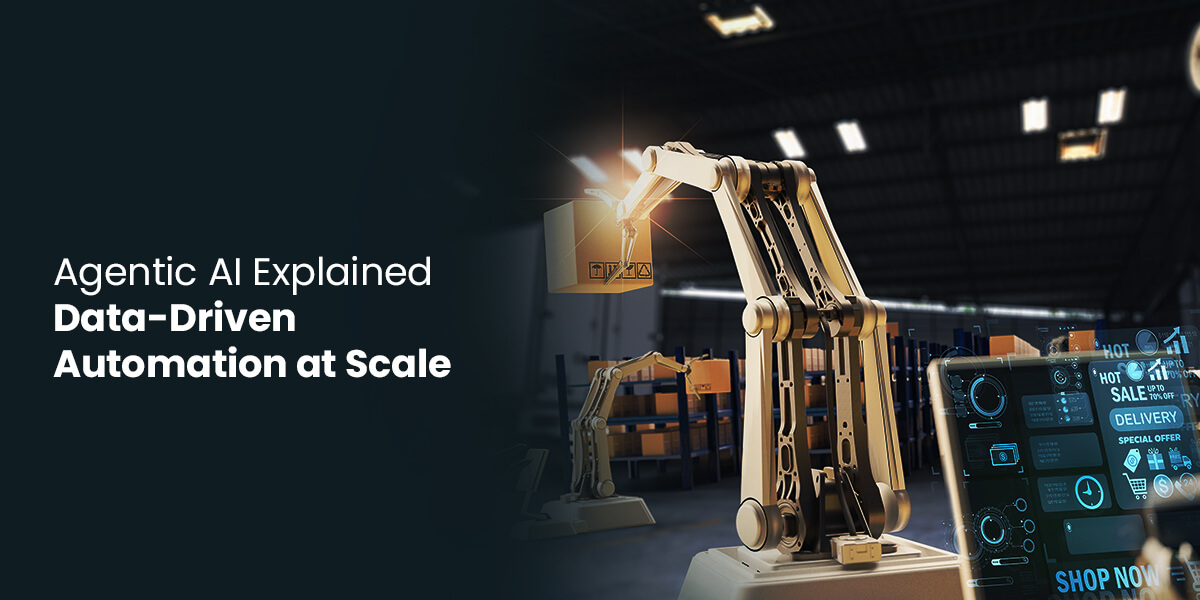
With the emergence of Agentic AI, it has become possible to imagine an AI system that responds to commands and takes initiative. Whether you need to conduct financial audits, optimize supply chains, or resolve complex service queries, this new wave of AI acts autonomously to deliver results. Recognized by Gartner as a top tech trend for 2025, agentic AI marks a significant leap beyond traditional models by enabling real-time collaboration, decision-making, and execution. Excited to explore more about Agentic AI, its services, Agentic AI data solutions, and Agentic AI training data! Keep reading this blog.
What is Agentic AI?
Agentic AI is an artificial intelligence system equipped with autonomy and decision-making capabilities. These systems can interpret data, learn through interactions, and autonomously make decisions or actions.
In contrast to traditional AI, which is narrowly focused on a particular task, and existing GenAI systems, which are confined to generating text, code, or media, Agentic AI incorporates a broader comprehension of objectives and contexts. It self-directs according to input and goals, delivering a more adaptive and interactive framework. It can take action in the real world, like interacting with operating robotics and web-based systems. For instance, it can control physical devices such as a robotic arm in a warehouse or operate surgical tools with accuracy. Further, it also allows navigating and interacting with digital systems such as making purchases, scheduling appointments, filling out forms, retrieving data across applications and websites, all autonomously and aligned with a given goal.
Agentic AI operates dynamically, switching its behavior according to new information and attaining objectives with a level of autonomy that is impossible in traditional AI systems. This leads to improved capabilities for industries looking to automate complex processes.
Agentic AI vs. Generative AI: What’s the Difference?
| Aspect | Agentic AI | Generative AI |
| Primary | Executes tasks and makes decisions in real-time environments | Creates original content based on learned patterns |
| Autonomy | Operates independently, adapts based on new data | Needs human inputs (prompts or tuning) to generate content |
| Interactivity | Interacts with external systems, environments, and adjusts behavior | Limited interaction; mainly output generation without feedback adaptation |
| Use Cases | Workflow automation, dynamic decision-making, and enterprise operations | Content creation, chatbot responses, design support, and data augmentation |
| Learning Method | Utilizes real-time feedback, reinforcement learning, and self-adjustment | Trained via large datasets, fine-tuning, and RLHF for better content accuracy |
The Evolution of Agentic AI: A Move Towards Autonomy
Agentic AI has grown beyond its origins in rule-based reasoning and reinforcement learning. Initial systems were bound by rigid rules and supervised training, which had limited flexibility. Current agentic AI blends large language models (LLMs) with external systems, allowing dynamic reasoning and adaptable decision-making in unfamiliar situations. The evolution can be observed in three phases:-
- Text processors – Create responses but can’t execute them.
- Cognitive agents – Control both internal reasoning and external action.
In today’s era, Agentic AI dominates virtual worlds, browsing APIs, operating systems, and web platforms. The future frontiers are physical-world integration, where sensors, robotics, and real-time reasoning advances will enable AI agents to function in real-world, dynamic environments.
How does Agentic AI Work?
Agentic AI systems transform raw data into intelligent action using a structured process. There is a four-stage cycle that reflects the core of agentic AI data solutions and agentic AI services:
-
Perceive
AI gathers and interprets data from digital interfaces, sensors, and databases. It tracks patterns and entities, laying the groundwork for contextual understanding, critical for building effective agentic AI training data pipelines.
-
Reason
A large language model (LLM) drives reasoning, coordinates specialized models, and uses retrieval-augmented generation (RAG) tools to access and leverage proprietary datasets. It helps the system deliver customized, real-time insights.
-
Act
Agentic AI executes plans via APIs and software integrations. Guardrails ensure responsible behavior, making them ideal for automating workflows like customer support or claims management within enterprise-grade agentic AI services.
-
Learn
Through feedback loops and continuous data collection, agentic systems refine their outputs and improve efficiency over time. This iterative process, also known as the data flywheel, boosts Agentic AI model performance and the value of annotated training data.
Agentic AI Use Cases and Examples
Agentic AI has established itself in various spheres, from customer support and supply chain optimization to IT operations and financial auditing. It opens new levels of intelligence and efficiency in each sphere by streamlining workflows, refining decision-making, and automating complex tasks.
-
Manufacturing
In the manufacturing industry, Agentic AI helps to autonomously manage complex, end-to-end workflows across procurement, logistics, and production. It connects to multiple IT systems, uses trained AI models for subtasks, and makes real-time decisions such as sourcing materials from alternate suppliers, filling forms, updating systems, and reconfiguring production schedules. These agentic AI data solutions reduce human workload and boost speed and accuracy. Still, organizations are encouraged to maintain human-in-the-loop control points for oversight, aligning with responsible AI practices.
-
Autonomous Vehicle
Agentic AI makes a crucial contribution to the development of self-driving cars as it allows them to sense their environment, make in-the-moment decisions, and respond without human input. AI systems in autonomous vehicles have some autonomy as they translate sensor inputs into avoiding obstacles, adapting traffic flows, traveling on roads, and obeying traffic regulations. Through ongoing learning and improvement from massive datasets, Agentic AI makes driving safer and more efficient, allowing fully autonomous vehicles and intelligent transportation systems.
-
Medical
Agentic AI is redefining the delivery of diagnoses, treatment planning, and patient care in medicine. To suggest customized treatment regimens, these platforms independently review complicated medical information, such as genetic sequences, imaging studies, and electronic health records. They can also regularly monitor patients in real time, identify anomalies, and initiate medical alerts. By taking proactive and autonomous action, this technology facilitates improved clinical decision-making, accelerates diagnostics, and enables precision medicine, improving patient outcomes and decreasing the load on medical professionals.
-
Risk Reduction and Security
Agentic AI is critical in amplifying enterprise security and minimizing risks by autonomously coordinating threat detection and response activities. These AI agents can proactively investigate anomalies, detect fraud, scan for vulnerabilities, and take real-time corrective actions, accelerating incident resolution in different sectors like finance, insurance, and online businesses.
-
Reimagining HR with Agentic AI Data Solutions
Agentic AI transforms human resources by automating time-consuming administrative tasks and delivering personalized, real-time employee support. Unlike static, rule-based tools, agentic AI services use contextual understanding to streamline recruitment workflows, assist with onboarding, respond to benefits inquiries, and support internal communications. Using agentic AI training data, these intelligent systems integrate with existing platforms to improve responsiveness and nurture the employee experience. As a result, HR teams can shift focus to strategic initiatives like workforce planning and talent development, managing greater efficiency and impact.
-
Enterprise AI
Agentic AI revolutionizes enterprise operations by autonomously optimizing workflows, executing complex business processes, and improving decision-making. Unlike traditional AI, agentic AI services evaluate environments, act on objectives, and adapt quickly, empowering organizations across departments. Enterprises can easily integrate Agentic AI data solutions across business systems, streamline operations, and deliver a seamless employee experience through intelligent automation and task resolution powered by advanced agentic AI training data.
In a Nutshell
Agentic AI represents a paradigm shift in how businesses operate, helping intelligent systems to autonomously perceive, reason, learn, and act across physical and digital domains. By integrating AI training data, organizations can drive innovation, streamline operations, and improve customer and employee experiences. As industries embrace this transformative technology, agentic AI is reshaping workflows and redefining what’s possible across every corner of the enterprise.