
Today’s medical institutions utilize healthcare administration systems to archive and manage diverse volumes of datasets. For such institutions, maintaining clean and structured datasets is not just a preference but essential for improving operational effectiveness and patient care.
The maintenance of unstructured datasets creates major hindrances for clinicians during the delivery of care services. The patient records with imprecision, duplicate values, or format errors make it difficult for physicians to search and retrieve crucial information. Data standardization enables medical professionals to make reliable decisions depending on patient histories. The use of structured datasets enables clinicians to discover patterns across patient records and implement appropriate care delivery practices effectively.
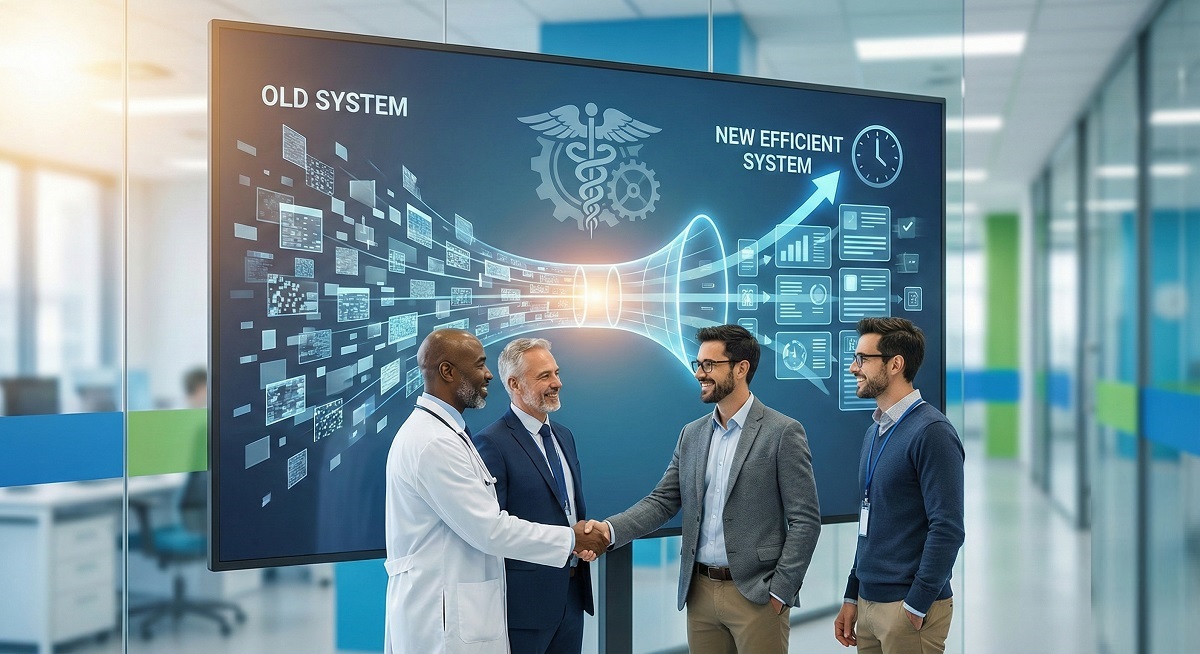
Data quality impacts the decision-making capability of healthcare business leaders. The use of inaccurate healthcare information for analysis results in flawed insights generation and inappropriate resource allocation. In contrast, assessing structured administrative data enables executives to track key performance indicators, optimize workforce levels, and discover cost reduction opportunities with greater precision.
Data Conversion Services for Healthcare Administration Systems: A Strategic Necessity
Healthcare institutions can collaborate with data conversion services to transform unstructured datasets in the administration systems into a structured format. The conversion services providers fill the void between legacy systems and advanced healthcare platforms, guaranteeing that medical administrative datasets remain valuable for professionals.
Experts from a data conversion company possess extensive expertise in medical data requirements and compliance standards. They assess existing datasets in administration systems, discover and document conversion requirements, and implement the right practices tailored to the healthcare system’s configuration. The expertise of data conversion specialists is valuable for preventing data loss during migrations between systems.
Experts initiate the conversion process after an extensive analysis of data structures in the medical administration system. This analysis enables them to create mapping documents that determine relationships between actual data elements and standard formats. This strategic approach ensures that medical datasets remain precise throughout the conversion process.
Healthcare administration systems contain diverse types of datasets that require standardization.
- Patient Demographic Information: This dataset includes names, addresses, and insurance details, and forms the foundation of administrative records.
- Appointment Scheduling Data: The scheduling dataset necessitates careful standardization to maintain the precision of previous appointment records while optimizing future booking operations.
- Billing and Claims Information: The billing dataset conversion is a complex process, as it must adhere to regulatory conditions while sharing with external insurance or medical systems.
- Medical Coding Datasets: Coding records comprise universal medical codes that are translated from medical procedures and diagnoses. The codes are valuable for billing and reporting purposes. A professional data conversion service provider ensures these codes remain appropriate throughout the system migration process.
Healthcare document management is an essential aspect. Experts from a reputable PDF conversion services provider help healthcare institutions in transforming physical records and documents into searchable PDF resources. Experts integrate the medical PDF documents into modern databases and systems. This enables healthcare providers to maintain extensive patient records and overcome the need to maintain physical document repositories.
The conversion expertise offered by experts helps healthcare enterprises in creating a smart data ecosystem where information is exchanged between departments and professionals with zero disruption. This ecosystem is crucial for improving the administrative effectiveness and medical care quality.
How Data Conversion Experts Standardize Healthcare Administration Systems
Experts in data conversion enterprises follow strategic approaches to transform datasets in healthcare administrative systems into valuable formats. The conversion techniques implemented by experts help healthcare institutions to ensure data integrity throughout the process, improving administration system performance, and operational effectiveness.
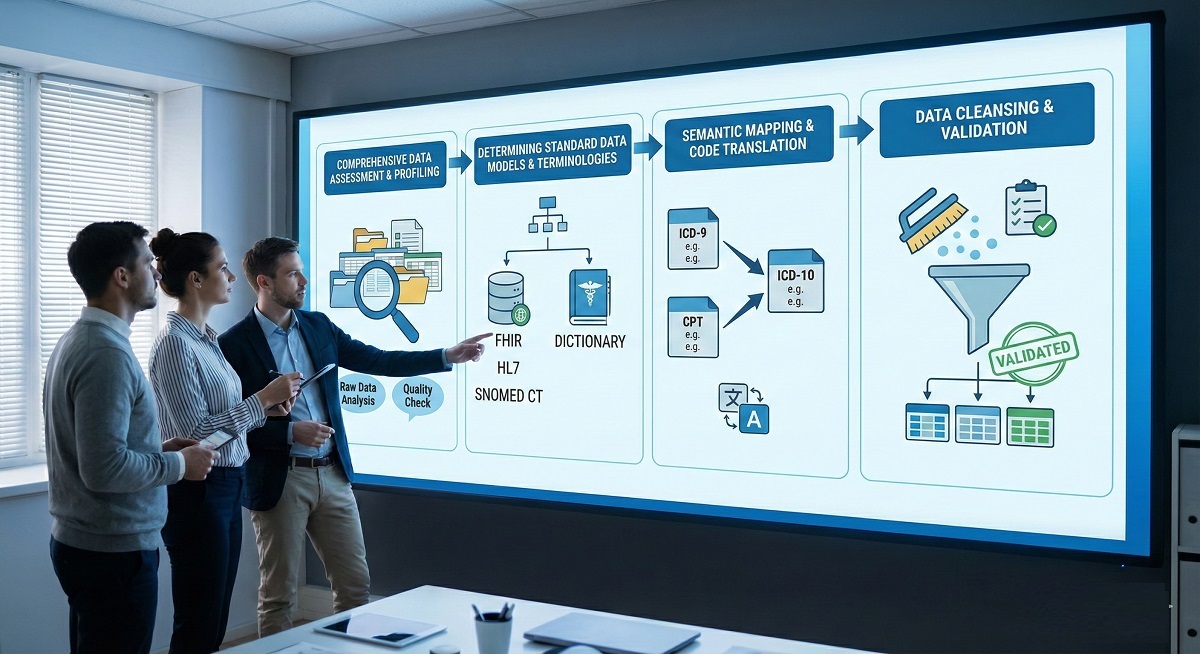
1. Comprehensive Data Assessment and Profiling
Before initiating any conversion project, specialists conduct thorough examinations of existing datasets. Experts assess data structures, discover relationships between diverse data elements, and document existing formats. This profiling approach helps experts discover imprecision, redundancies, and errors in the datasets. The data conversion analysts map the whole healthcare administration information ecosystem to understand how data exchanges between departments and systems, offering a clear perspective of which datasets require standardization.
2. DeterminingStandard Data Models and Terminologies
After assessment, data conversion experts select appropriate standardized models for healthcare administration data. Experts leverage standard healthcare terminologies for determining clinical terms and diagnostic codes. By establishing robust naming conventions for administrative fields, experts ensure coherence across diverse datasets. This approach offers a base for effective data management and system interactions.
3. Semantic Mapping and Code Translation
Data conversion experts follow the semantic mapping techniques that involve determining relationships between source data elements and target formats. The conversion experts develop extensive mapping tables that transform legacy terms into standard terminologies. The mapping table enables conversion experts to ensure that the semantic meaning of medical terms remains aligned throughout translation. This strategic process ensures that medical administrative codes maintain their characteristics and meaning after conversion.
4. Data Cleansing and Validation
The data cleansing process is performed by data conversion experts to eliminate duplicate records, fix formatting errors, and overcome imprecise information entries. The conversion experts implement validation rules to discover and fix complex data points before the final process. This approach eliminates the computing problem that impacts many healthcare administration systems, guaranteeing that clean datasets are maintained by the medical institutions.
5. Data Transformation and Conversion
The transformation of medical datasets in line with the final execution phase involves transforming data according to predetermined specifications. Conversion specialists use specialized tools to extract data from legacy formats, transform it to meet new standards, and load it into target systems. Throughout the transformation process, experts maintain audit trails and execute quality checks to validate successful transformation, guaranteeing administrative datasets remain valuable in the healthcare ecosystem.
Key Ways Data Conversion Services Improve Healthcare Administration Efficiency
The efficiency gains from proper data standardization extend throughout healthcare organizations. Expert data conversion services providers deliver tangible improvements across multiple operational dimensions.
I. Enhancing Data Quality and Consistency
Effective data conversion eliminates redundancies and standardizes formats across administrative platforms. Data conversion companies implement validation protocols that catch errors before they impact operations. Consequently, staff members spend less time correcting mistakes or searching for information. Healthcare organizations benefit from streamlined workflows as consistent data structures allow for automated processing of routine administrative tasks.
II. Enabling Interoperability Across Heterogeneous Systems
Despite diverse technology ecosystems within healthcare facilities, data conversion services create bridges between disparate systems. PDF conversion services transform document-based information into structured data that flows seamlessly between platforms. Healthcare professionals acquire complete patient information regardless of its original source. This interconnectivity eliminates information silos that previously required manual intervention.
III. Facilitating Regulatory Compliance and Reporting
Healthcare organizations face ongoing regulatory requirements that demand accurate reporting. Data conversion specialists ensure administrative datasets maintain compliance with evolving standards like HIPAA and HL7. Therefore, generating the required documentation becomes straightforward rather than burdensome. Standardized data structures simplify audit processes and reduce compliance-related workloads.
IV. Supporting Advanced Analytics and Decision Support
Once standardized, administrative datasets become valuable resources for business intelligence. Indeed, uniform data structures enable meaningful pattern recognition across operational metrics. In a recent survey, 78% of healthcare administration executives believe that data conversion helps in improving analytical and decision-making capabilities. First thing to remember, properly converted datasets allow for accurate forecasting and resource planning. Ultimately, healthcare executives make better strategic decisions based on reliable information extracted from standardized administrative systems.
Challenges in Standardizing Healthcare System Datasets and How Experts Overcome Them
The standardization of datasets in healthcare administrative systems includes diverse challenges for conversion experts. Data conversion services providers possess extensive expertise to resolve these challenges, guaranteeing effective healthcare data transformations.
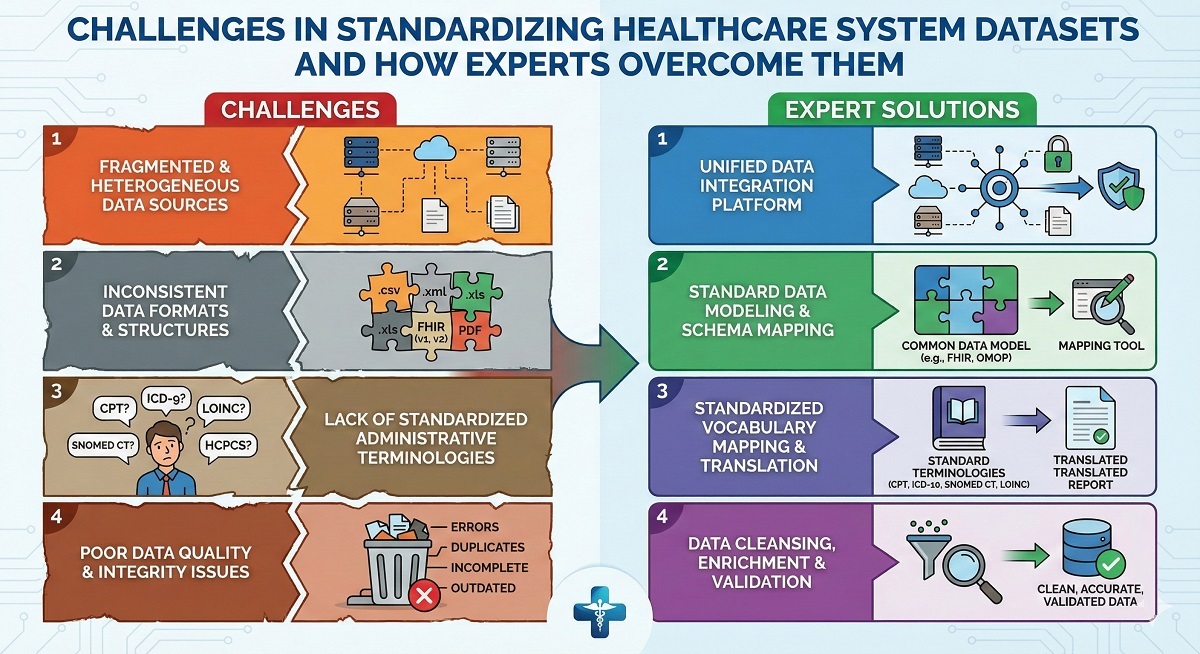
1. Fragmented and Heterogeneous Data Sources
Medical institutions often work with diverse administration systems that don’t interact effectively. Experts from data conversion firms are skilled in linking these disconnected environments, establishing a central data architecture. The conversion experts assess source systems extensively, determining connection points between isolated databases.
2. Inconsistent Data Formats and Structures
Medical datasets in administrative systems exist in diverse formats, from structured data forms to unstructured documents. Data conversion services providers incorporate mapping strategies that consolidate these diverse formats. PDF conversion services providers help healthcare institutions in transforming document resources into structured resources that integrate with other administrative systems.
3. Lack of Standardized Administrative Terminologies
Unlike clinical terminology with established standards, administrative data often uses facility-specific terms. Experts from a data conversion company develop comprehensive terminology crosswalks that translate organization-specific terms into standardized language. This careful translation preserves meaning while enabling system-wide consistency.
4. Poor Data Quality and Integrity Issues
The continuous utilization of healthcare administration systems leads to the accumulation of errors, duplications, and imprecision. Experts from a data conversion company incorporate advanced cleansing algorithms to discover and resolve these issues. Throughout the conversion process, experts balance data relationships and context, guaranteeing datasets remain valuable after standardization.
Final Words
The effectiveness of healthcare administration systems depends on the maintenance of structured datasets that flow across departments and platforms. The decision to collaborate with a data conversion company for healthcare providers represents a strategic initiative rather than an operational expense. The conversion service providers transform unstructured medical datasets into accessible datasets that drive clinical excellence and administrative effectiveness.
Data conversion experts leverage valuable data transformation techniques and standardize fragmented records for healthcare firms. Through extensive assessment, semantic mapping, and meticulous cleansing processes, experts develop standard data ecosystems where previously disconnected systems interact effectively. Healthcare institutions experience tangible benefits, including reduced data error rates, modernized workflows, and improved decision-making capabilities.