


Many organizations struggle to derive value from machine learning and AI models. Machine learning models and AI algorithms depend on high-quality training data. The term “garbage in, garbage out” aptly describes why AI models need quality datasets.
The quality of the data used to train a machine learning model directly impacts its ability to recognize patterns and make accurate predictions. That’s precisely where data annotation services comes into play. Without accurate data annotation in machine learning, even the most high-grade and advanced algorithms struggle to deliver reliable outcomes.
What is Data Annotation in Machine Learning
Data annotation is the process of tagging and labeling data ranging from text and images to audio and videos. Data annotation services aim at inserting informative tags into a dataset, making it easier for machine learning algorithms to process unstructured and voluminous data.
Role of Data Annotation
According to a report, the global data annotation and labeling market size was valued at USD 0.8 billion in 2022 and is expected to reach $3.6 billion in 2027.
This phenomenal growth outlines the critical importance of data annotation in building effective machine learning (ML) models. High-quality labeled data is the cornerstone of strong and effective ML models. With structured data annotation, ML and AI algorithms recognize patterns, reduce bias, and make accurate predictions.
Types of Data Annotation
Each data annotation technique has a specific purpose and is tailored to a specific task. This labeled data is important for many AI applications, such as computer vision, natural language processing (NLP), and speech recognition.
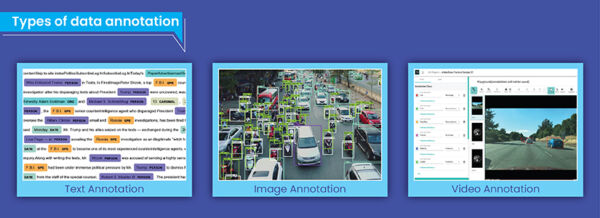
Text Annotation
Text annotation techniques involve assigning labels or explanatory notes to a text document or body of text to identify the characteristics of sentences or to enhance understanding. This labeled data allows a supervised machine learning algorithm to accurately interpret and decipher data.
Image Annotation
Image annotation is the process of assigning labels, tags or other metadata to images with the aim of training data for machine learning. It usually involves human annotators and an image annotation tool to label images.
Video Annotation
Video annotation involves annotating video data frame by frame or via automated techniques to track and label moving objects. Video annotation allows precise implementation of different concepts such as location, motion blur, and object tracking in the systems.
Why Machine Learning Models Need Annotated Data
The real benefit of high-quality data annotation is that it helps models learn faster and perform better. It reduces errors, improves consistency and supports smarter predictions across different tasks. For businesses working with AI, this can mean more reliable results, with less time and resources spent on corrections.
Establish Ground Truth for Learning
When it comes to training AI models, it is important to understand that AI models do not know the difference between correct and incorrect. The model is as good as the data. That’s where the ground truth dataset for learning comes in. This data acts as a guide, letting the model know what the image is about, what the action of a person is, or what the sentence means. This data helps the model to learn based on actual examples.
Train Models with Labeled Examples:
A machine-learning model will require answers for training. Labeled examples tell the AI model what the input means and what the output should be. While this process may have imperfections, it works better than randomly throwing data and hoping for an AI model to figure out the data.
With enough examples, the model can generalize effectively, build pattern recognition, and handle new cases better. Whether you’re working on text, images, or audio, using labeled data may help the model learn faster and perform more reliably.
Boost Accuracy, Precision, and Recall
Data quality in annotation plays an integral role in determining how well the model performs. Clarity, consistency, and correctness of data labeling improves the chances of learning the right patterns. This can improve key performance metrics like accuracy, precision, and recall. If annotation is inconsistent or wrong, the model may flag safe content as dangerous or miss critical results. Even a minor labeling error across a large dataset can shift how a model behaves.
That’s why careful annotation is the foundation for building a strong AI model. It may not guarantee perfect results, but it gives the model a much better shot at learning what actually matters.
Provide Context and Semantic Meaning
Data annotation is not limited to labeling. It has far-reaching implications for helping a machine understand the context and meaning behind what it is observing. That’s when context comes into play. To annotate data correctly, it is important to label its role or understand its context.
Understanding context is important; when it comes to NLP data annotation, for instance, “Oh wow, another Monday,” the mood is sarcastic and not positive despite using positive words. In facial expression labeling, a person with eyes wide open and annotation could be surprised or shocked.
Sematic annotation gives models an in-depth understanding of sarcasm, emotion, intent, and much more. In the absence of understanding context or semantics, AI models may miss out on important details or jump to wrong conclusions.
Power Real-World ML Applications
Today’s real-world application based on AI, from chatbots to self-driving cars, relies on data annotation. Before they can perform well in live situations, they need to be trained on datasets in which inputs are properly labeled. This tells the model what matters and what doesn’t matter.
For example, in medical AI annotation to flag areas with tumors or abnormalities in MRI scans, it is important to train data for AI models for correct annotated cases, teaching them to recognize and identify these abnormalities.
Avoid Model Errors from Poor Labels
Even with advanced algorithms, poor data annotation can adversely impact model training. Wrong or inconsistent labels may confuse the model. It may pick up useless or misleading patterns, leading to wrong predictions and a lower trust factor in the model’s results.
In highly regulated fields like finance or healthcare, bad annotation can even cause real harm. That is why reviewing and correcting annotation errors is important. Good labeling practices can prevent these issues early in the development cycle.
The Impact of High-Quality Annotation on ML Performance
When labels are clear and consistent, the model knows what’s important. This helps to make better choices, both during training and later on with real data. Good-quality annotations reduce confusion and steer the model toward recognizing patterns that truly matter. That’s usually where we see improvements in accuracy and overall performance. The model isn’t exerting extra effort; it’s simply learning from better examples. While proper annotation won’t solve all problems, it certainly gives your model a stronger base to build before refining the algorithm.
- Better annotated data improves training outcomes.
- Enhances model generalization and robustness.
- Reduces false positives and negatives.
- Vital for achieving production-level accuracy in high-stakes use cases.
Conclusion
Good data annotation is crucial for getting machine learning models to work well. It helps by providing structure and clarity so that the models can understand what’s important. While people often focus on tweaking the model itself, the truth is that having high-quality annotated data can make a big difference.
If you want your results to be reliable in the real world, start with solid, clear, and meaningful data annotations strategies. That’s the foundation for achieving better outcomes.