

Artificial intelligence is rapidly transforming the cybersecurity landscape. As cyber threats grow more sophisticated, organizations are increasingly turning to AI-driven technologies to detect, analyze, and prevent security incidents. Traditional security methods that rely only on manual monitoring and rule-based systems are no longer sufficient to defend against modern cyberattacks.
To address these challenges, security professionals must develop new skills that combine cybersecurity expertise with artificial intelligence knowledge. This is where Artificial Intelligence cybersecurity certifications become highly valuable. These certifications validate a professional’s ability to understand AI technologies and apply them effectively in cybersecurity environments.
For security professionals, gaining knowledge in AI-powered security tools can significantly improve their ability to detect threats, automate defense strategies, and protect critical systems. As organizations continue to adopt AI-driven security technologies, professionals with these specialized certifications will play a crucial role in safeguarding digital infrastructure.
The Growing Role of Artificial Intelligence in Cybersecurity
Cybersecurity threats are evolving at an unprecedented pace. Attackers now use automated tools, machine learning techniques, and advanced malware to exploit vulnerabilities in networks and applications.
Artificial intelligence helps organizations respond to these threats more effectively by analyzing large volumes of data and identifying suspicious patterns in real time. AI-based systems can process millions of events per second and detect anomalies that human analysts might miss.
Common applications of AI in cybersecurity include:
-
Threat detection and anomaly analysis
-
Malware classification and behavior analysis
-
Automated incident response
-
Fraud detection and prevention
-
Security monitoring and predictive analysis
Because of these capabilities, AI has become an essential component of modern security operations.
Why Security Professionals Need AI Skills
As security technologies evolve, the role of cybersecurity professionals is also changing. Traditional security knowledge is still important, but professionals must now understand how AI systems analyze data and support security operations.
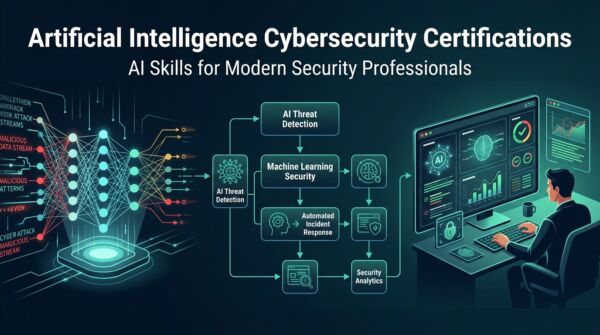
AI-powered tools often rely on machine learning models that analyze patterns in network traffic, user behavior, and system activity. Security professionals must understand how these models work in order to interpret alerts, validate results, and respond to threats appropriately.
Without a basic understanding of AI concepts, security analysts may struggle to fully utilize these advanced security tools. AI cybersecurity certifications help professionals build the skills needed to work with AI-driven security technologies.
Benefits of AI Cybersecurity Certifications
Artificial intelligence cybersecurity certifications provide several important benefits for security professionals.
Key Advantages
| Benefit | Explanation |
|---|---|
| Advanced threat detection knowledge | Learn how AI systems identify sophisticated cyber threats |
| Automation skills | Understand how automation improves security response time |
| Career advancement | Increase opportunities for specialized cybersecurity roles |
| Industry recognition | Demonstrate expertise in emerging security technologies |
| Future-ready skills | Prepare for the evolving cybersecurity job market |
These benefits make AI cybersecurity certifications valuable for professionals who want to remain competitive in the security industry.
How AI Improves Cybersecurity Defense Strategies
One of the most important contributions of artificial intelligence to cybersecurity is the ability to detect threats faster and more accurately.
Traditional security systems rely heavily on predefined rules and signatures. While these methods are effective against known threats, they often struggle to detect new or evolving attacks.
AI systems, on the other hand, can analyze patterns and behaviors to identify suspicious activity even when the attack method has never been seen before.
For example, AI-driven security platforms can monitor network traffic and identify abnormal behavior that may indicate a potential intrusion. These systems can also automatically respond to certain threats by isolating affected systems or blocking malicious traffic. This proactive approach helps organizations minimize damage and respond to threats more quickly. Prepare for cybersecurity certifications with Cert Empire.
Key AI Concepts Security Professionals Should Understand
Security professionals pursuing AI cybersecurity certifications should develop a basic understanding of several important artificial intelligence concepts.
Machine Learning
Machine learning is the foundation of most AI-powered cybersecurity tools. It involves training algorithms to recognize patterns in data and make predictions based on those patterns.
Behavioral Analytics
Behavioral analytics focuses on identifying unusual activity within systems or networks. AI systems can analyze user behavior and detect anomalies that may indicate compromised accounts or insider threats.
Predictive Security Analysis
Predictive analysis uses historical data to anticipate potential security threats before they occur. This allows organizations to strengthen defenses proactively.
Automated Threat Response
Automation allows AI systems to respond to certain security events automatically, reducing response time and improving overall defense capabilities. Understanding these concepts helps security professionals interpret AI-driven security alerts and take appropriate action.
The Demand for AI-Skilled Cybersecurity Professionals
The demand for cybersecurity professionals continues to grow worldwide, and the integration of artificial intelligence into security platforms is creating new specialized roles.
Organizations are increasingly seeking professionals who understand both cybersecurity principles and AI technologies. These professionals can help organizations implement advanced security systems that detect threats more efficiently.
Some emerging job roles related to AI-driven cybersecurity include:
-
AI Security Analyst
-
Cyber Threat Intelligence Specialist
-
Security Automation Engineer
-
AI Security Architect
-
Machine Learning Security Specialist
Professionals with AI cybersecurity certifications are better positioned to pursue these advanced roles.
Combining Certification Study with Practical Learning
Preparing for AI cybersecurity certifications requires a combination of theoretical knowledge and practical experience.
Security professionals should explore AI technologies used in cybersecurity platforms, study machine learning fundamentals, and review real-world security scenarios where AI tools are applied. Practice questions and certification preparation resources can also help candidates understand how these concepts appear in certification exams.
Many professionals preparing for cybersecurity certifications use structured learning platforms such as Cert Empire to review practice questions and exam-focused material that helps reinforce their understanding of certification topics. Using exam-style questions helps candidates evaluate their readiness and identify areas that require additional study. Explore AI cybersecurity certification practice questions and preparation material to strengthen your knowledge of modern security technologies.
Preparing for AI Cybersecurity Certification Exams
A structured study plan can help candidates prepare effectively for AI cybersecurity certifications.
Below is an example preparation strategy.
| Study Activity | Purpose |
|---|---|
| Study AI fundamentals | Understand machine learning and AI concepts |
| Learn cybersecurity frameworks | Build strong security knowledge |
| Explore AI-driven security tools | Understand practical applications |
| Practice certification questions | Test knowledge and exam readiness |
| Review security case studies | Learn real-world AI security scenarios |
This approach ensures candidates develop both conceptual understanding and practical exam preparation.
The Future of AI in Cybersecurity
Artificial intelligence will continue to play a critical role in the future of cybersecurity. As cyber threats become more advanced, organizations will rely increasingly on AI-powered technologies to defend their systems.
AI-driven tools will continue to evolve, offering improved threat detection, predictive security analysis, and automated response capabilities. For cybersecurity professionals, staying updated with these technologies is essential. AI cybersecurity certifications provide a structured pathway for professionals to gain the knowledge required to work with these advanced security solutions. By developing expertise in both cybersecurity and artificial intelligence, professionals can position themselves at the forefront of the next generation of security technologies.
Final Words
Artificial intelligence is transforming the way organizations approach cybersecurity. AI-powered tools allow security teams to analyze vast amounts of data, detect threats quickly, and automate defense mechanisms.
As organizations adopt these technologies, cybersecurity professionals must expand their skill sets to include AI knowledge and machine learning concepts. Artificial intelligence cybersecurity certifications provide an effective way for professionals to gain these skills and demonstrate their expertise in modern security technologies.
By combining cybersecurity experience with AI knowledge, professionals can enhance their career opportunities and contribute to building stronger, more intelligent security systems.
Don’t miss this: AWS SAP-C02 Questions and Answers to Test Your Architecture Knowledge