
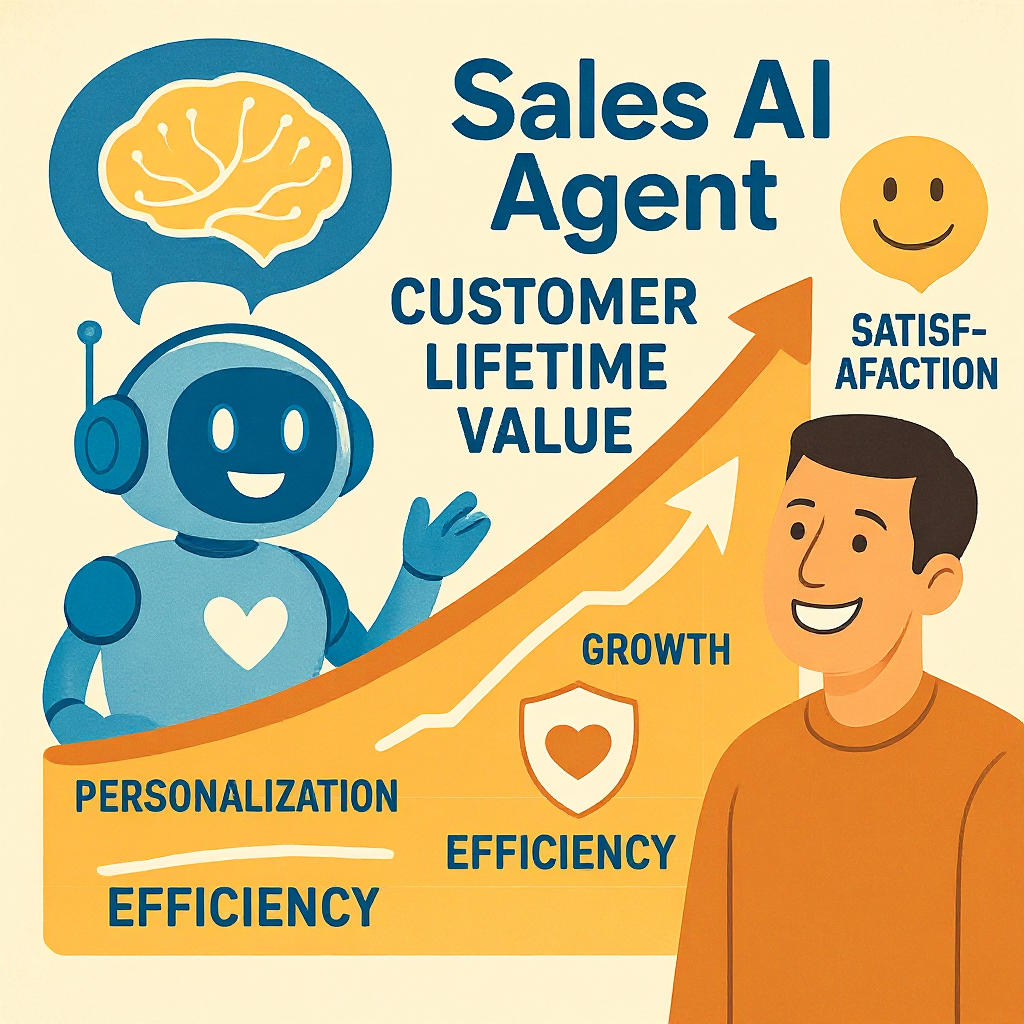
In today’s hyper-competitive market, companies are no longer focused solely on acquiring new customers—they are equally invested in maximizing the value of each customer over the long term. This metric, known as Customer Lifetime Value (CLV), measures the total revenue a business can expect from a single customer throughout their relationship. A higher CLV means greater profitability, more predictable revenue streams, and a stronger foundation for sustainable growth.
While traditional sales strategies and automation tools have helped companies retain customers, they often lack the adaptability and personalization necessary to maximize CLV in a modern, data-driven environment. This is where the Sales AI Agent comes in. Leveraging artificial intelligence, machine learning, and natural language processing (NLP), a Sales AI Agent doesn’t just automate tasks—it learns, predicts, and personalizes at scale, enabling businesses to enhance customer relationships and extract more value over time.
In this article, we’ll explore why a Sales AI Agent is a game-changer for improving CLV, how it outperforms conventional sales methods, and why now is the right time to integrate it into your sales and customer success strategy.
Understanding Customer Lifetime Value (CLV) and Why It Matters
Before we dive into the role of a Sales AI Agent, it’s important to understand why CLV is such a critical metric. CLV considers not just the initial purchase but every potential transaction over the course of the relationship, including renewals, upsells, and cross-sells.
For example, a customer who makes a $100 purchase every month for five years has a CLV of $6,000. Improving CLV means finding ways to increase purchase frequency, average order value, and retention duration. The higher your CLV, the more profitable each customer becomes—allowing you to invest more in acquisition without hurting margins.
The Challenge with Traditional Sales and Automation in Boosting CLV
Traditional sales approaches often emphasize closing deals quickly, sometimes at the expense of long-term customer satisfaction. Sales automation tools can help streamline outreach and follow-ups, but they rely heavily on static workflows that don’t adapt to changing customer needs.
These limitations can lead to:
- Missed upsell or cross-sell opportunities
- Poor timing in customer outreach
- Lack of personalized engagement
- Inability to anticipate churn before it happens
While these tools are effective in maintaining baseline sales performance, they aren’t designed to dynamically optimize CLV.
Sales AI Agents: The CLV-Boosting Advantage
A Sales AI Agent brings a different philosophy to the table—one that prioritizes long-term customer engagement over one-time transactions. Unlike static automation, AI agents are adaptive, learning from customer interactions to improve recommendations, timing, and messaging over time.
Here’s how they elevate CLV:
- Personalization at scale: Delivering highly relevant content, offers, and product recommendations based on individual customer behavior.
- Proactive engagement: Reaching out before customers disengage or churn.
- Predictive upselling: Identifying opportunities to offer higher-value products or services at the right moment.
- Continuous learning: Improving outreach and recommendations with every interaction.
Hyper-Personalized Communication
The cornerstone of improving CLV is making customers feel understood and valued. Sales AI Agents leverage NLP and machine learning to interpret customer preferences, past purchases, and engagement patterns. This allows them to craft messages that resonate with each individual—whether that means suggesting complementary products, offering exclusive discounts, or simply sending timely check-ins.
For example, if a software customer’s usage data shows they’re nearing the limit of their current plan, a Sales AI Agent can proactively offer an upgrade with clear benefits, increasing revenue while enhancing the customer experience.
Predictive Churn Prevention
Losing a customer prematurely can dramatically lower CLV. A Sales AI Agent uses predictive analytics to identify churn risk early—whether it’s declining engagement, negative sentiment in support tickets, or a drop in purchase frequency.
Instead of reacting after a customer leaves, AI agents enable proactive measures, such as:
- Offering targeted incentives
- Addressing unresolved support issues
- Providing personalized recommendations to re-engage interest
This level of foresight helps retain more customers for longer periods, directly boosting CLV.
Data-Driven Upselling and Cross-Selling
Upselling and cross-selling are two of the most effective ways to increase CLV, but they require precise timing and relevance. Traditional automation might offer an upsell based on basic triggers, like a set time after purchase. A Sales AI Agent, however, analyzes deep behavioral data to determine exactly when a customer is ready for an upgrade or an additional product.
For example:
- If a customer regularly purchases accessories for a product, the AI Agent might suggest a premium version that includes those features.
- If a SaaS customer consistently uses advanced features, the AI could recommend a higher-tier subscription plan.
The result? More successful upsells and cross-sells without coming across as pushy.
Continuous Engagement Across Channels
Customers today engage across multiple touchpoints—email, chat, social media, and even voice assistants. A Sales AI Agent ensures consistent and relevant engagement across all channels, creating a seamless experience.
If a customer interacts with your brand on social media, the AI Agent can follow up via email with related offers. If they visit a specific product page on your site, the AI can trigger a personalized chat interaction to answer questions and encourage purchase.
This omnichannel consistency builds trust and increases the likelihood of repeat business.
Enhancing Post-Purchase Experience
The customer journey doesn’t end at checkout—in fact, the post-purchase experience is a critical driver of CLV. A Sales AI Agent ensures customers feel supported and valued long after the sale.
Post-purchase actions can include:
- Sending setup guides or tutorials
- Offering personalized tips based on product usage
- Requesting feedback at strategic moments
- Providing loyalty program offers
By maintaining an active role after purchase, the AI Agent helps turn one-time buyers into loyal brand advocates.
Leveraging Behavioral Segmentation for Targeted Retention
Instead of grouping customers by generic criteria like age or location, a Sales AI Agent can create highly specific behavioral segments. For instance, it can group customers based on buying habits, engagement frequency, or even sentiment in communications.
This deep segmentation allows for:
- Tailored retention strategies for high-value customers
- Customized offers for those likely to lapse
- Special engagement campaigns for brand advocates
By matching retention strategies to actual customer behavior, businesses can maximize the value of every segment.
Faster Response Times and Better Support
Customer frustration often comes from delayed responses or repetitive interactions. A Sales AI Agent integrated with support systems can provide instant, personalized assistance—resolving issues quickly and improving satisfaction.
Better support leads to happier customers, and happier customers are more likely to continue buying from your brand, directly raising CLV.
Real-Time Feedback Loops for Strategy Optimization
A key strength of a Sales AI Agent is its ability to learn in real time. It doesn’t just execute campaigns—it monitors their success and adapts accordingly. If a certain upsell strategy isn’t working, the AI adjusts messaging, timing, or offers without waiting for quarterly review cycles.
This continuous optimization ensures that retention and engagement efforts are always aligned with customer needs, keeping CLV growth steady.
Scalable CLV Improvements for Growing Businesses
For small businesses, improving CLV can mean having more resources to invest in marketing and operations. For large enterprises, it can mean hundreds of thousands—or even millions—of dollars in additional annual revenue.
Because a Sales AI Agent can handle thousands of customers simultaneously while maintaining personalization, businesses of any size can scale CLV improvements without proportional increases in staffing costs.
Conclusion
Customer Lifetime Value is not just a number—it’s a reflection of how well your business builds, nurtures, and grows customer relationships. While traditional sales methods and automation tools have helped keep customers engaged, they lack the intelligence and adaptability needed to maximize long-term value in a rapidly evolving marketplace.
A Sales AI Agent changes the game. By combining personalization, predictive analytics, proactive engagement, and continuous learning, it enables businesses to keep customers longer, increase revenue per customer, and transform every interaction into an opportunity for growth.
In the era of AI-driven business, companies that embrace AI agent development for sales and retention will be best positioned to not only improve CLV but also secure a sustainable competitive advantage for years to come.