
Due diligence in mergers and acquisitions has always been an information problem. Buyers need to understand a business they do not control, using data selected and presented by the seller, within a limited time. It is not surprising that data science techniques have found a place in the process.
Analytics can make due diligence faster and more thorough, but it can also create false confidence. This article looks at where data science adds genuine value in M&A due diligence, where it tends to mislead, and how analysts can contribute without overstating what the data can tell a buyer.
Where data science adds value
Cleaning and reconciling financial data
Sellers often provide financial data from several systems, in different formats and at different levels of detail. Reconciling general ledger exports, sales records and bank statements is tedious work that lends itself to automation. Scripts that standardize formats, match transactions and flag discrepancies can save advisers significant time and reduce manual errors.
Customer and revenue analysis
Transaction-level sales data allows analysts to go beyond the headline revenue figure. Cohort analysis can show how customer retention has changed over time. Concentration analysis can reveal dependence on a small number of large accounts. Price and volume decomposition can separate growth driven by price increases from growth driven by new customers.
These analyses help buyers test the seller’s narrative about the business with evidence.
Document review at scale
Large transactions can involve thousands of contracts. Natural language processing tools can extract key terms such as change-of-control clauses, termination rights and renewal dates, and highlight unusual provisions for human review. This does not replace legal review, but it helps lawyers focus their time on the documents that matter most.
Anomaly detection
Statistical methods can identify unusual patterns that warrant further questions, such as a spike in sales at quarter end, unusual credit notes, or journal entries posted outside normal hours. These are not proof of a problem, but they are useful prompts for follow-up.
Where data science can mislead
Data that was selected for you
The seller controls what data is shared. Even with good intentions, the data in the data room reflects choices about what to include and how to present it. A model trained on that data inherits those choices. Analysts should always ask what is missing and why.
Short histories
Many targets, especially younger companies, have only a few years of reliable data. Forecasting models built on short histories can produce precise-looking outputs with wide real uncertainty. Presenting a single forecast line without that uncertainty can give decision makers a false sense of accuracy.
Definitions that do not match
Metrics such as churn, active customers or recurring revenue can be defined in several ways. If the seller’s definitions differ from the buyer’s, analyses that compare the target with the buyer’s own business or with benchmarks can be misleading. Agreeing definitions early avoids this.
Correlation presented as explanation
Due diligence findings often feed directly into price negotiations. An analysis that shows a relationship between two variables can be read as evidence of cause, even when the analyst did not intend it. Clear language about what an analysis does and does not show helps prevent this.
Working well with deal teams
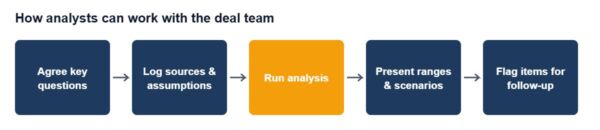
Data scientists contribute most when they are integrated into the wider due diligence team rather than working in isolation. Practical habits that help include:
- Agreeing the key questions with the deal team before starting analysis
- Documenting data sources, assumptions and limitations alongside every output
- Presenting ranges and scenarios rather than single figures
- Flagging findings for follow-up questions rather than presenting them as conclusions
Choosing the right infrastructure
Analysts working on due diligence also need a secure way to access data, track requests and share outputs with advisers. Virtual data rooms and broader deal management platforms vary widely in how well they support analytics, from simple file storage to built-in reporting and export options. A side-by-side review of how M&A software tools compare can help teams understand which platforms make it easier to get data out in usable formats while keeping access controls and audit trails intact.
Analytics as a support, not a verdict
Data science can make due diligence more efficient and more rigorous, particularly for financial reconciliation, customer analysis, contract review and anomaly detection. Its limits come from the data itself: selected by the seller, often short, and defined in ways that may not match the buyer’s assumptions. Analysts who are clear about those limits, and who work closely with the deal team, help buyers make better decisions without overstating what the numbers can prove.