
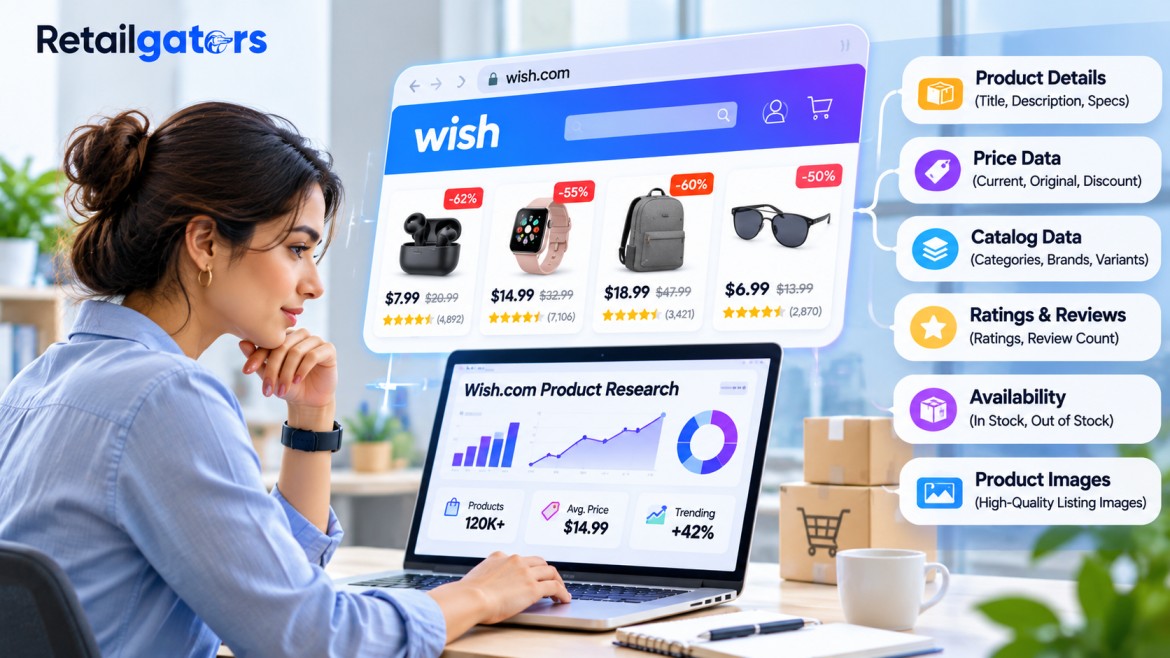
A marketplace listing can tell an ecommerce team far more than the price shown beside a product. A single Wish.com listing may contain product details, variants, category information, pricing, discounts, ratings, reviews, availability, and other signals that help researchers understand how products are positioned. When similar information is collected across a larger set of listings, it becomes possible to study assortment, price ranges, product attributes, and marketplace changes instead of relying on a handful of manual checks.
That is why Scrape Product Data from Wish.com can be useful for ecommerce research. The goal is not simply to build a large spreadsheet of products. A useful dataset should answer a business question: Which products are being offered? How are they priced? Which attributes are common? How does assortment differ between categories? Which products or listings are changing over time? When those questions guide data collection, Wish product data becomes useful for product research, pricing analysis, assortment planning, and competitive intelligence.
What Wish Product Data Can Reveal
Wish product data can provide a structured view of products available on the marketplace. Depending on publicly visible information and the research requirement, a dataset may include product titles, descriptions, categories, brands, product or listing identifiers, specifications, images, variants, prices, discounts, ratings, review counts, availability, and other visible attributes.
Each field serves a different purpose. Catalog information helps researchers understand what is being sold, pricing fields show market positioning, and product attributes make comparisons more accurate. Ratings and review counts can add context about customer response, although they should not automatically be treated as sales figures. A category manager might use the dataset to examine product features and price bands, while a brand team may focus on competitor assortment and positioning.
What Product Fields Should You Collect From Wish.com?
The right fields depend on the research objective, but useful datasets generally start with product name, category, brand, description, specifications, product URL or identifier where available, images, size, color, pack information, and variants. These fields establish exactly what is being offered and help prevent misleading comparisons between products that only look similar.
Price information should be collected alongside those attributes. Wish price data may include the current displayed price, reference or original price where shown, discount information, currency, and other visible offer details. Historical records are especially useful because a single price is only a snapshot. Repeated collection can show whether pricing remains stable, changes frequently, or moves around promotional periods.
Availability and customer feedback add further context. Depending on the listing, businesses may monitor availability status, ratings, review counts, and other visible marketplace signals. These should be interpreted as supporting indicators rather than direct proof of demand unless the underlying data supports that conclusion.
Wish Product Scraping for Pricing Research
Wish product scraping becomes more useful when pricing is studied alongside product attributes. Comparing two displayed prices without checking size, quantity, specifications, or variants can produce misleading results. A lower-priced listing may simply represent a smaller pack or different configuration.
A better approach connects price with the information that explains it. Researchers can group comparable products, examine price ranges, identify discounts, and monitor changes over time. For businesses that need recurring updates across ecommerce sources, live price crawling services can support a broader workflow for frequent price changes and historical records.
The useful question is not only “What is the price?” but also “What product is being offered at that price, how does it compare with similar products, and how has the price changed?” That distinction makes pricing data much more valuable for ecommerce research.
Understanding Wish Catalog Data for Assortment Research
Wish catalog data is valuable when the research objective is broader than price comparison. By analyzing categories, brands, variants, attributes, and listing breadth, businesses can understand the composition of an online assortment and identify patterns worth investigating.
Suppose a retailer is considering a new accessories category. Product data can show the range of products available, common features, price bands, and variations. It does not prove demand by itself, but it gives the retailer a concrete view of the competitive assortment. Cross-marketplace comparison can add another dimension; a team researching home products might compare its findings with scrape IKEA product data to study differences in assortment, product attributes, and pricing structures.
Why Product Matching Matters
One of the most important parts of marketplace research is making sure comparable products are actually being compared. Similar product titles do not necessarily mean identical products. Pack sizes, colors, dimensions, specifications, bundles, and variants can change the commercial meaning of a listing.
Where UPC or other identifiers are available and relevant, UPC product scraping services can support product-level research. The matching process should still consider product attributes that may not be captured by an identifier alone. This becomes especially important when Wish data is compared with other marketplaces because a price difference caused by pack size or configuration should not be mistaken for a pricing strategy.
Using Wish Data for Marketplace Product Research
The broader value of marketplace product research comes from turning individual listings into patterns. Businesses can analyze product counts by category, price distributions, common attributes, brands, variants, ratings, and availability, then track how those patterns change over time.
For example, a product team may discover that a category contains many listings built around one particular feature while another feature appears rarely. A category manager might find that several products occupy a narrow price range, suggesting a highly competitive segment that deserves closer monitoring. Search, product, and pricing data can then be combined to move from “what is listed?” toward “how is this category positioned?”
Using Wish Price Data for Competitive Pricing Analysis
Pricing becomes more meaningful when it is analyzed with assortment and product positioning. A business may find that comparable products cluster around a particular price range, while products with specific features command a different range. These patterns can help pricing teams evaluate where their own products sit within the market.
For brands with minimum advertised price requirements, pricing research can also connect with a MAP monitoring service to investigate visible pricing changes across relevant channels. For broader competitive research, a retail data scraping service can extend the analysis beyond one marketplace by combining product, price, availability, and promotional information from multiple ecommerce sources.
From Raw Data to Ecommerce Research Insights
Collecting data is only the beginning. The real value comes from structuring it around a specific business question. A pricing team may focus on price ranges and changes over time; a category manager may study assortment and attributes; a product team may look for gaps in features or variations; and a market researcher may examine brands, categories, ratings, and competitive positioning.
Historical collection is particularly important. A one-time dataset tells you what the marketplace looked like at a particular moment. Recurring collection shows what changed. That difference matters when the objective is to understand pricing movement, new listings, discontinued products, assortment shifts, or seasonal patterns.
Businesses that also study supplier-side markets can connect marketplace research with wholesale data scraping when appropriate. Comparing consumer-facing listings with wholesale product information can help teams investigate sourcing, assortment, and pricing relationships without assuming that the two datasets represent the same market.
Why Cloud-Based Data Collection Helps
Manual research can work for a small sample, but it becomes difficult when hundreds or thousands of listings need to be collected repeatedly. Prices change, products are updated, new listings appear, and availability shifts. Rebuilding the same dataset manually is time-consuming and makes historical comparison harder.
A cloud based web scraping workflow can support recurring collection at a larger scale, depending on the technical requirements. Cloud-based processes can help with scheduled jobs, larger workloads, structured delivery, and integration with analytics systems. The important point is that scale should be paired with data quality: consistent fields, product matching, duplicate handling, and historical storage remain essential.
How Businesses Should Use Wish Product Data
The best dataset is not necessarily the largest one. It is the one that contains the information required to answer a defined business question. Before collecting data, businesses should decide whether the objective is pricing research, assortment analysis, competitor monitoring, product discovery, or category research.
Once that objective is clear, the collection process can focus on relevant fields and update frequency. Price-focused research may require frequent collection, while a broader assortment study may need less frequent updates. This approach keeps the dataset useful and makes the resulting analysis easier to interpret.
For businesses planning to Scrape Product Data from Wish.com, the same principle applies: define what you need to learn first, then build the data workflow around that requirement. This turns marketplace collection into a repeatable research process rather than a one-time exercise.
Conclusion
Scrape Product Data from Wish.com can support much more than simple product listing collection. With the right fields and a clear research objective, businesses can analyze Wish product data, Wish price data, and Wish catalog data to understand assortment, pricing, product attributes, availability, and marketplace positioning.
The strongest results come from combining product information with accurate matching and historical records. A single snapshot can answer what is visible today; recurring data can help explain what is changing. For ecommerce brands, retailers, and researchers, that distinction makes marketplace data more useful for pricing decisions, category planning, competitive research, and product strategy.
FAQs
What product data can you collect from Wish.com?
Depending on publicly available listing information and research requirements, businesses may collect product titles, categories, descriptions, specifications, images, variants, prices, discounts, availability, ratings, review counts, and relevant product or listing identifiers.
Why should businesses scrape product data from Wish.com?
Businesses may Scrape Product Data from Wish.com to study product assortment, compare prices, analyze product attributes, monitor marketplace changes, and support broader ecommerce and category research.
How is Wish price data useful for ecommerce research?
Wish price data can help businesses compare comparable products, analyze price ranges, identify discounts, and track pricing changes over time. Price becomes more useful when analyzed together with product attributes and variants.
What can Wish catalog data tell a retailer?
Wish catalog data can show which products, categories, brands, attributes, and variations are visible on the marketplace. This can help retailers study assortment and identify areas that need deeper research.
Why is product matching important when analyzing Wish products?
Product matching helps ensure that businesses compare genuinely comparable products. Differences in pack size, specifications, quantity, or variants can make two apparently similar listings commercially different.
Can Wish product data collection be automated?
Yes. Businesses can build automated collection workflows for recurring marketplace research, subject to applicable website terms, technical limitations, and legal requirements. Automation is especially useful when the dataset is large or needs regular updates.