

A data lake is a storage system that contains structured, semi-structured, and unstructured data. Its role in AI and ML workflows is to simplify data access, preprocessing, and model training.
And considering AI and ML rely on massive amounts of data, it is natural that data lakes have become one of the foundations for innovation and value across organizations.
Therefore, in this blog post, we will talk about the basics of data lakes, role of data lakes in AI and ML workflows, and best practices so that you can learn how to make data-driven decisions easier for your organization.
Let’s understand them in detail.
What is a data lake?
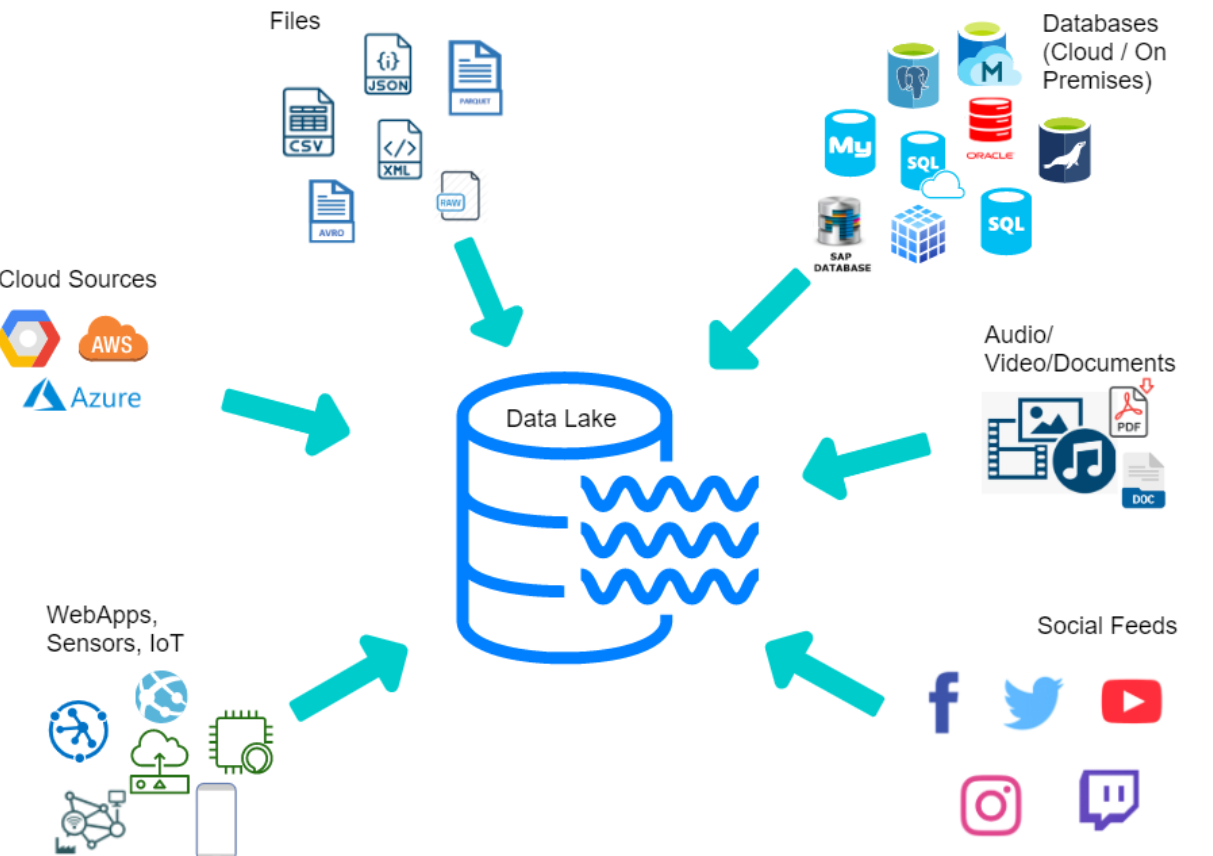
A data lake is a centralized repository. It contains consolidated data from different sources and includes structured, semi-structured, and unstructured data.
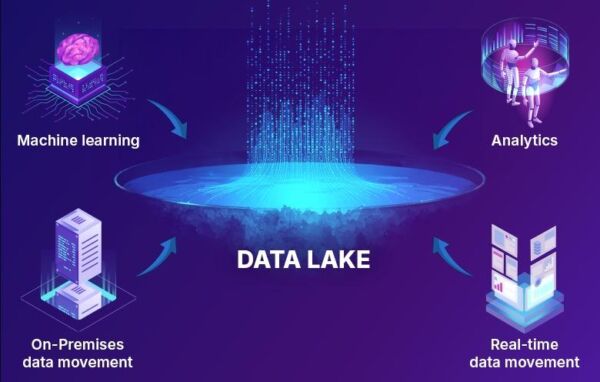
Let’s break this down for better understanding.
The sources for data lake are databases, log files, social media, IoT sensors, documents, and more.
Structured data from the sources are organized and stored in relational databases with predefined schemas such as tables with rows and columns. For example, customer profiles, transaction records, and inventory data in SQL databases.
Then, semi-structured data have some organizational properties, but they don’t fit into traditional tables. They come in formats like JSON, XML, and CSV where tags or markers define the structure. For example, JSON files containing user profiles and log files from web servers.
Lastly, unstructured data don’t have a predefined table, structure, or organization. They exist in formats like texts, images, audio, and videos. For example, social media posts, emails, IoT data, customer service calls, and more.
Data lakes are preferred for two reasons and benefits:
- They store information in its native format, which helps with flexibility and scalability for use cases within AI and ML operations.
- They support real-time data processing, deep learning applications, advanced analytics and predictive modeling. Therefore, organizations extract valuable insights from data lakes.
However, the ultimate purpose of a data lake here is to improve training, scalability, and efficiency in AI and ML workflows.
What are AI and ML workflows?
AI and ML workflows are structured processes that turn raw data into intelligent systems using algorithms, statistical methods, and computational power.
The process has five stages:
- Data collection
- Preprocessing
- Model training
- Evaluation
- Deployment
Today, organizations, regardless of their size, industry, or location, are relying on data analytics and automation. And AI and ML workflows are getting more and more embedded in their core business strategies. Some of the common uses are as follows.
- Learn hidden patterns
- Predict future trends
- Automate repetitive tasks
- Detect anomalies
Ultimately, all of which can improve decision making in terms of speed and accuracy within an organization.
What is the role of a data lake in AI and ML workflows?
Data lakes are to AI and ML workflows what smart phones are to modern communication.
And throughout the entire process, AI and ML workflows rely on data lakes to provide scalable storage, easy access, and efficient processing.
Also, data lakes directly contribute to developing advanced AI-driven solutions that improve decision-making, automate complex tasks, and most importantly, generate valuable insights from massive datasets.
To fully understand the role of a data lake, let’s look at the steps of AI and ML workflows.
- Large-scale data collection – bringing it all together
Everything starts with data. But as we know it, data isn’t neatly packaged. In fact, it comes from different sources, in different formats, and at different speeds.
Organizations collect data from:
- Internal systems – CRM tools, ERP systems, financial transactions
- User interactions – Website visits, app usage, customer feedback
- IoT and sensors – Machine readings, GPS data, smart devices
- External sources – Social media, market trends, third-party APIs
Managing this flood of data is a challenge. And without a proper system, valuable information can be lost, duplicated, or siloed in different departments.
A data lake’s role here is to:
- Store all types of data (structured, semi-structured, and unstructured) without forcing it into a rigid format
- Act as a single source of truth so that all the teams across the organization can work with the same data
- Support real-time and batch data ingestion to make it easy to handle fast-moving streams as well as historical data
-
Data processing for AI and ML – cleaning and structuring the data
Raw data is rarely useful as-is because it has missing values, duplicates, errors, or inconsistencies that can mislead AI models. Therefore, before data professionals start training an AI system, they clean and organize data.
The regular data cleaning process includes:
- Removing duplicates and errors to ensure accurate analysis
- Handling missing values so models don’t misinterpret incomplete data
- Standardizing formats (e.g., making sure dates, currencies, and labels follow a uniform structure)
- Filtering noise and removing irrelevant or redundant information
A data lake’s role here is to:
- Store both raw and processed versions of data for flexibility in experimentation
- Support ETL (Extract, Transform, Load) and ELT (Extract, Load, Transform) processes, to make it easier to transform data as needed
- Automate data cleaning using AI-powered tools and scripts
-
Scalable model training and updates – learning from data
Once the data is clean, AI and ML workflows can be implemented, and the training models can start learning.
However, for a model to be effective, it needs huge amounts of diverse, high-quality data. Know that the more varied the data, the better the model can generalize patterns and make accurate predictions.
These are some of the key aspects of AI and ML model training, among many.
- Feature engineering – Selecting the right variables that impact predictions
- Splitting data – Dividing it into training, validation, and test sets to avoid overfitting
- Choosing algorithms – Selecting the best approach (e.g., deep learning, decision trees, reinforcement learning)
And here are a few ways in which data lakes help:
- Provide scalable storage for massive datasets needed for deep learning and AI training
- Enable distributed computing so that AI and ML models can process large datasets efficiently
- Allow easy integration with AI frameworks (e.g., TensorFlow, PyTorch, Scikit-Learn)
-
Evaluation – testing model performance
AI models are only useful if they perform well in real-world scenarios.
Therefore, before deployment, AI and ML professionals test them rigorously to ensure accuracy and reliability. While there are many practices to carry the testing out, some of the most used are:
- Measuring accuracy, precision, recall, and F1-score to assess performance
- Cross-validation to ensure the model works across different datasets
- Bias detection to prevent unfair or skewed predictions
Throughout these evaluation processes, data lakes help professionals with the following.
- Provide historical data to compare past predictions with actual outcomes
- Allow continuous monitoring, helping to retrain models when performance declines
- Enable real-time feedback loops, improving AI efficiency over time
-
Deployment – putting AI and ML to work
Once an AI and ML model is trained and tested, it’s time to put it into action.
Whether it’s a chatbot, fraud detection system, or recommendation engine, AI models need constant monitoring and updates to stay effective.
There are a few deployment considerations as follows.
- Integrating with business applications (e.g., embedding AI in a CRM or an e-commerce platform)
- Monitoring performance to detect drift in predictions
- Retraining models periodically to keep them relevant
And here’s how a data lake helps in this last step of the process.
- It provides real-time data feeds, keeping AI models updated with the latest information
- Enables versioning and tracking of AI models, ensuring smooth rollbacks if needed
- Supports automated pipelines, reducing manual intervention in model updates
What are the best practices for using data lakes?
To maximize the efficiency of AI and machine learning in data lakes, organizations must follow structured data management, security, and governance practices.
The AI and ML revolution in data management requires these.
1. Implement strong data governance
A well-governed data lake is the difference between organized intelligence and chaotic data dumping. Organizations must define who owns the data, who can access it, and how it should be managed.
For example, access controls should be in place to restrict sensitive data. If a marketing team only needs customer behavior insights, they shouldn’t have access to raw financial records. Similarly, data retention policies help prevent unnecessary clutter by ensuring outdated data is archived or deleted.
Clear governance prevents security risks, ensures compliance with regulations like GDPR and HIPAA, and maintains trust in data-driven decision-making.
2. Maintain data quality and consistency
If an AI model is trained on incomplete, duplicate, or inaccurate data, its predictions can be misleading because poor-quality data leads to faulty business decisions and lost opportunities.
To prevent this, companies must:
- Standardize data formats to ensure consistency across different sources
- Eliminate duplicates that inflate storage costs and cause discrepancies
- Validate data sources so that only relevant, high-quality data enters the system
A clean and consistent data lake translates to more accurate models, better insights, and stronger decision-making.
3. Optimize storage and processing
All data is not equally valuable, and not all of it needs the same level of access speed. That’s where smart storage management system improves efficiency and cuts unnecessary costs.
It is especially helpful for businesses dealing with high-frequency transactions, real-time analytics, or deep learning models that require faster access to data than those storing historical records.
Rather than storing everything in high-cost environments, businesses can:
- Use tiered storage—frequently accessed data stays in fast-access storage, while rarely used data moves to lower-cost cold storage.
- Implement data partitioning to break large datasets into smaller, more manageable segments for faster queries.
- Use parallel processing to handle massive AI and ML workloads efficiently.
4. Ensure scalability and integration
Data is always growing. If a data lake can’t scale without significant redesign, it will become a bottleneck instead of an asset.
Therefore, a scalable data lake should:
- Be cloud-based or hybrid to adjust storage and computing resources as needed
- Support a wide range of data formats (structured, semi-structured, and unstructured)
- Integrate smoothly with BI tools, analytics platforms, and machine learning frameworks
A truly effective data lake connects with multiple systems, formats, and workflows, and evolves alongside business needs.
5. Strengthen security and compliance
Data lakes store sensitive and valuable information. And it makes them a target for cyber threats. Therefore, while putting innovation first, security should not be an afterthought. In fact, it must be built-in from day one.
- Encrypt data: Use encryption both in transit and at rest to prevent unauthorized access
- Monitor and log access: Track who accesses what data to detect anomalies and potential breaches
- Enforce Multi-Factor Authentication (MFA): Strengthen security for critical datasets
Prepare your data lake for powerful AI and ML workflows
Without structure, a data lake is just a data swamp.
But with the right structure, it becomes a powerhouse for AI and ML. It fuels advanced analytics, enables seamless model training, and supports real-time decision-making.
To get there, data lake services need to be optimized. Start by defining objectives such as what problems should AI and ML solve. Then, align data strategies with your business goals so that you can ensure relevance and impact.
Next, focus on data lifecycle management because not all data is equally valuable. You can prioritize fresh, high-impact datasets for real-time AI while archiving less frequently used information.
Then, invest in automation. Manual data management slows AI adoption. You can collaborate with a technology partner that provides AI development services for your AI-powered data cataloging, auto-tagging, and real-time anomaly detection so that you can keep your data ecosystem organized and reliable.
Finally, prepare for the growth at pace and scale because AI-driven workloads demand adaptive infrastructure.