
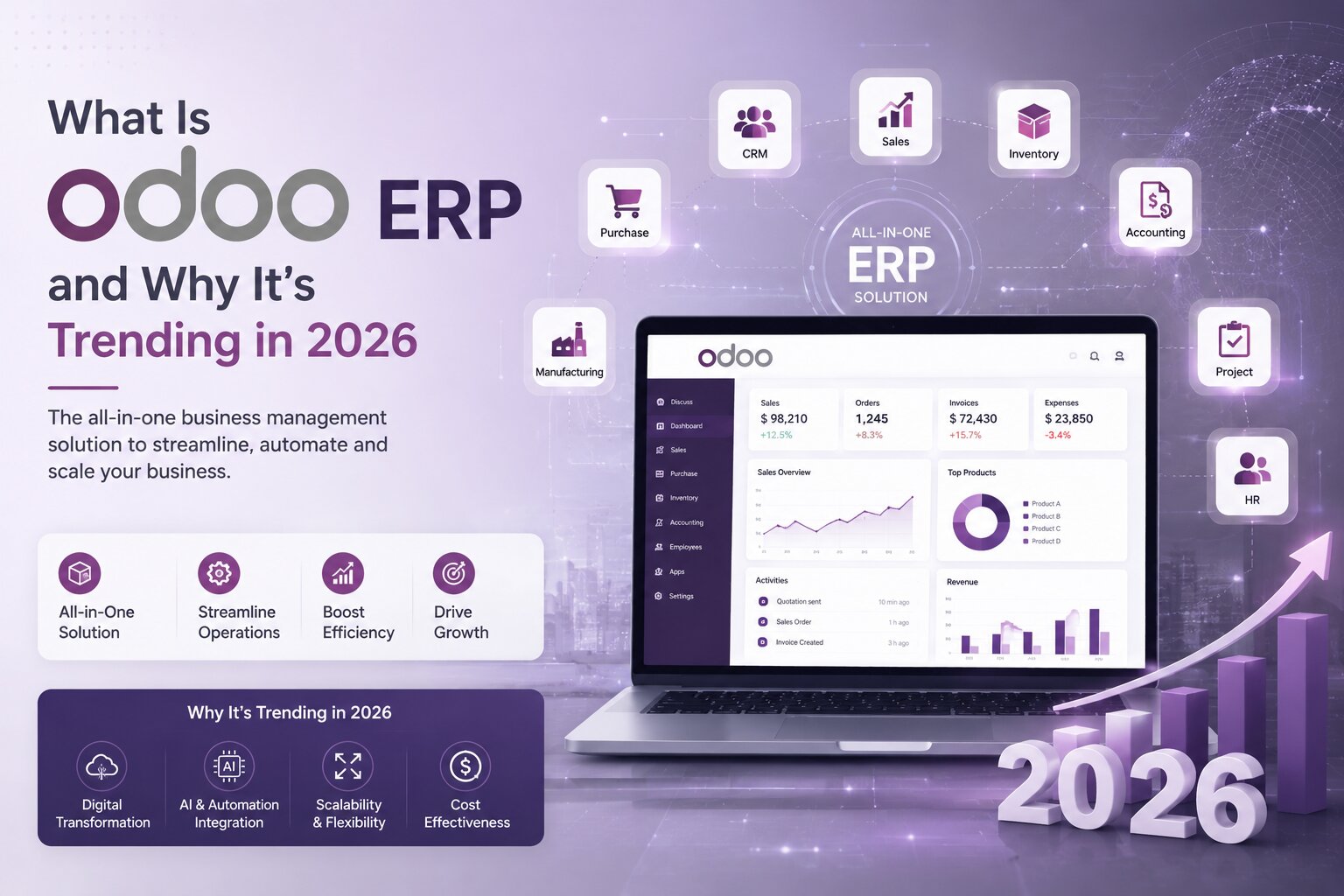
Businesses in 2026 are moving faster than ever. Companies are expected to manage operations smoothly, automate repetitive work, improve customer experience, and make decisions using real time data. Because of this, many organizations are shifting away from spreadsheets and disconnected software tools and adopting modern ERP systems.
One ERP platform that has gained massive attention in recent years is Odoo.
From startups and SMEs to growing enterprises, businesses across the world are increasingly choosing Odoo ERP because of its flexibility, affordability, and all in one business management approach.
But what exactly is Odoo ERP, and why is it becoming so popular in 2026?
Let’s understand it in simple words.
What Is Odoo ERP?
Odoo ERP is an open source business management software that helps companies manage different operations from one centralized platform.
Originally launched as TinyERP and later known as OpenERP, Odoo has evolved into a complete business suite used by companies in more than 175 countries.
Instead of using separate software for sales, accounting, inventory, HR, CRM, ecommerce, and manufacturing, businesses can manage everything inside a single system.
This connected approach helps businesses improve efficiency, reduce manual work, and get better visibility across departments.
Odoo Works Like a Collection of Business Apps
One of the biggest reasons Odoo is trending in 2026 is its modular structure.
Odoo offers more than 70 core business applications, along with over 40,000 community modules developed for different industries, workflows, and country specific requirements.
Businesses can choose only the modules they need and expand later as their operations grow.
For example, a company may start with:
- CRM
- Sales
- Inventory
- Accounting
And later add:
- Manufacturing
- HR
- Ecommerce
- Marketing automation
- Helpdesk
This flexibility makes Odoo suitable for businesses at different growth stages.
Why Businesses Are Choosing Odoo in 2026
Modern businesses want software that is flexible, scalable, and easier to manage.
Traditional ERP systems are often expensive, complicated, and slow to implement. Odoo is becoming popular because it solves many of these problems.
Here are some major reasons why businesses are adopting Odoo ERP in 2026.
All Business Operations in One Platform
Many businesses still use multiple disconnected tools for daily operations. This creates duplicate work, reporting issues, and communication gaps.
Odoo solves this problem by connecting departments together.
When sales, accounting, inventory, HR, and customer data work inside one system, businesses can make faster and more accurate decisions.
This centralized structure is one of the biggest advantages of Odoo ERP.
Cloud Based and Flexible
Odoo supports both cloud hosting and on premise deployment.
Businesses can choose:
- Odoo SaaS
- Odoo.sh cloud hosting
- Self hosted infrastructure
This flexibility gives companies better control over data, security, and infrastructure costs.
As cloud adoption continues to grow in 2026, businesses increasingly prefer ERP systems that can support remote access and scalable operations.
Affordable Compared to Traditional ERP Systems
Another reason Odoo is trending is cost effectiveness.
Traditional ERP platforms often require huge licensing costs, expensive infrastructure, and long implementation timelines.
Odoo provides a more affordable alternative, especially for startups and mid sized businesses.
Because businesses can select only the apps they need, they avoid paying for unnecessary features.
This modular pricing approach makes ERP adoption more practical for growing companies.
Easy Customization and Scalability
Modern businesses need software that adapts to their workflows instead of forcing them to change operations completely.
Odoo supports low code customization, which makes it easier to modify workflows, automate tasks, and create custom business processes.
This flexibility is especially useful for businesses with industry specific requirements.
Many organizations also choose to Hire Dedicated Odoo Developer resources when they need advanced customization, third party integrations, or long term ERP optimization.
AI and Automation Are Making Odoo Smarter
In 2026, ERP systems are no longer just data management tools.
Businesses now expect intelligent automation and AI driven insights from their ERP platforms.
Odoo is increasingly being recognized as a next generation ERP because it combines:
- Cloud native architecture
- Automation workflows
- AI assisted reporting
- Low code customization
- Integrated business management
This helps businesses automate repetitive tasks and improve operational efficiency.
For example, companies can automate:
- Invoice generation
- Inventory alerts
- Email workflows
- Customer follow ups
- Reporting processes
Automation reduces manual effort and allows teams to focus on higher value work.
Odoo Is Popular Among SMEs and Growing Businesses
Odoo has become especially popular among:
- Startups
- SMEs
- Ecommerce businesses
- Manufacturing companies
- Service based organizations
- Retail businesses
Many companies moving away from spreadsheets or outdated ERP systems choose Odoo because it offers enterprise level functionality without the complexity of traditional ERP platforms.
By 2026, analysts and ERP consultants report thousands of active Odoo deployments worldwide, including businesses across the USA and Europe modernizing their operations.
Faster ERP Implementation
One major reason businesses prefer Odoo is faster implementation.
Traditional ERP projects can sometimes take months or years to deploy fully.
Odoo implementations are often faster because of the platform’s modular structure and easier customization capabilities.
Businesses can start small, launch quickly, and scale gradually over time.
This reduces operational disruption and improves ERP adoption success.
Is Odoo the Future of ERP?
Many industry experts believe Odoo represents the future of business automation for modern companies.
Its combination of affordability, flexibility, cloud support, automation, and modular design makes it highly attractive for businesses looking to scale efficiently.
While large enterprises may still choose complex ERP systems like SAP or Oracle for highly advanced global operations, Odoo continues to dominate among growing businesses seeking modern and practical ERP solutions.
In 2026, companies are prioritizing agility, automation, and connected operations. Odoo aligns strongly with these business needs.
Final Thoughts
Odoo ERP is becoming one of the most talked about ERP platforms in 2026 because it offers businesses a flexible and modern way to manage operations.
From accounting and CRM to inventory, manufacturing, HR, and ecommerce, Odoo brings everything together into one connected platform.
Its affordability, modular structure, cloud flexibility, and automation capabilities make it especially attractive for startups, SMEs, and fast growing companies.
As businesses continue moving toward digital transformation and process automation, Odoo is expected to play an even bigger role in the future of ERP adoption worldwide.
FAQs
1. Is Odoo ERP suitable for small businesses?
Yes. Odoo is widely used by startups and small businesses because it offers flexible modules, lower implementation costs, and the ability to scale gradually as the business grows.
2. How much does Odoo ERP implementation usually cost?
The cost depends on the number of users, selected modules, customization requirements, integrations, and deployment type. Basic implementations are generally more affordable compared to traditional ERP platforms.
3. Can Odoo ERP be customized for specific industries?
Yes. Odoo supports extensive customization through modules, workflows, and third party integrations, making it suitable for industries such as manufacturing, retail, healthcare, ecommerce, logistics, and services.