
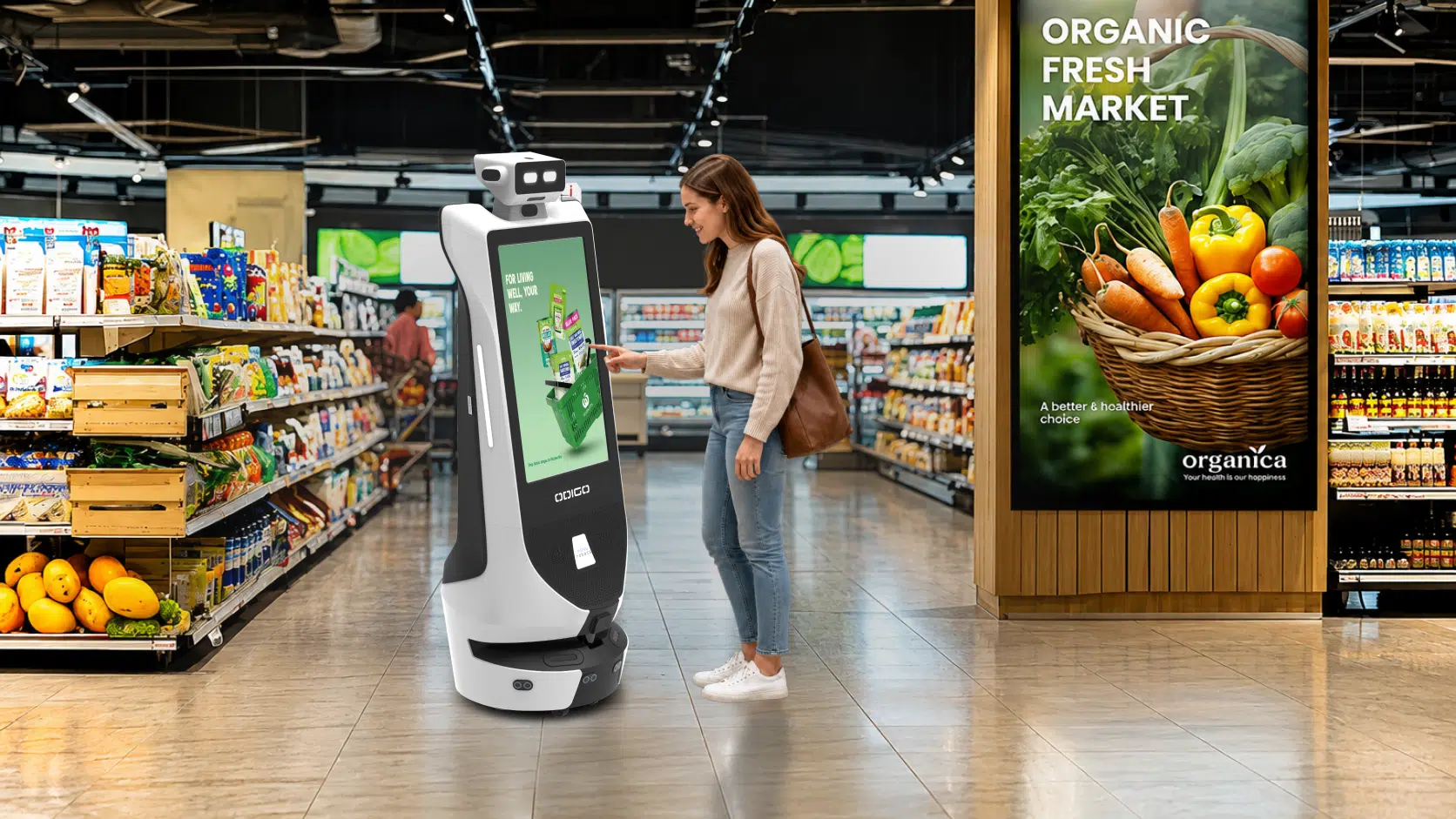
Supermarkets give shoppers choice, but choice also creates complexity. A customer may know exactly what they want and still spend several minutes finding the right aisle, department, service counter, or promotional display. This is where wayfinding robots in supermarkets can create practical value.
FMI’s 2026 U.S. Grocery Shopper Trends research found that 54% of grocery shoppers always shop in-store at their primary store. It also found that 69% want an easy shopping experience and 69% want to find aisles or departments easily. At the same time, 71% use digital technology while grocery shopping.
That combination creates a strong case for wayfinding robots in supermarkets. Shoppers still value physical grocery stores, but they increasingly expect digital convenience inside them.
Why Are Supermarkets Looking at Robotic Wayfinding?
Large supermarkets can contain dozens of aisles, departments, temporary displays, seasonal sections, and changing promotions. Even a familiar store can become difficult to navigate when layouts change.
A Supermarket Wayfinding Robot gives shoppers another way to find the next destination without depending entirely on overhead signs, a fixed kiosk, a mobile app, or an available employee.
The role is assistive. A shopper can interact with a robot, identify a destination, receive guidance, and continue shopping. If the request becomes complicated, the customer should still be able to reach an employee.
This is one reason Odigo, Supermarket Robot can be positioned around customer assistance rather than unrelated supermarket automation. Odigo can support a journey built around information, wayfinding, engagement, advertising, and human handoff.
Kody Robots can therefore focus on a clear shopper problem: helping people get where they need to go more easily.
What Is the Core Wayfinding Experience?
Before discussing individual use cases, it helps to understand What Is Wayfinding Robot in a supermarket context.
The experience can be simple:
Ask → Search → Select Destination → Navigate → Arrive
A shopper begins with a need. The robot identifies the configured destination. The system supports navigation through approved mapped areas. The shopper reaches the relevant aisle, department, display, or service point.
This is the foundation for many wayfinding robots in supermarkets use cases. The value comes from reducing the distance between customer intent and the right physical location.
Use Case 1: Helping Shoppers Find Products Faster
One of the clearest Supermarket Wayfinding Robot Use Cases is product finding.
A shopper may know the product name but not the aisle. Another may know only the category. A Grocery Store Wayfinding Robot can provide an interactive starting point. The customer searches for a configured product or category, identifies the relevant destination, and receives guidance toward that area.
The robot should not guess about changing details. Product location information needs to come from approved store data when that information is part of the deployment. When the answer cannot be confirmed, human handoff is the safer next step.
For Kody Robots, product finding gives Odigo a clear customer-service role that shoppers can understand immediately.
Use Case 2: Guiding Shoppers to Aisles and Departments
A customer may want the bakery, frozen section, pharmacy, restroom, checkout area, or another department.
A Supermarket Aisle Navigation Robot can support these destination-based journeys across approved areas.
This is where wayfinding robots in supermarkets can be more useful than a static direction alone. Instead of displaying “Aisle 12” and ending the interaction, the system can support the customer as they move toward the destination.
Use Case 3: Supporting First-Time Shoppers
Regular shoppers often develop a mental map of their preferred store. First-time shoppers do not have that advantage.
A Supermarket Navigation Robot can become a visible assistance point for these customers. The shopper does not need to understand the full store layout. They only need to identify where they want to go next.
This makes wayfinding robots in supermarkets especially relevant in large-format stores where unfamiliar shoppers face more navigation friction.
Use Case 4: Connecting Promotions With Store Navigation
Retail advertising creates awareness, but awareness is more valuable when a shopper can act on it.
A customer may see a promotion on a customer-facing robot but not know where the promoted category is located. Wayfinding can connect the two moments:
Promotion → Interest → Product or Category Search → Guidance → Destination
This is an important use case for wayfinding robots in supermarkets because advertising and assistance can become part of the same shopper journey.
Odigo can be positioned as an Advertising Robot Assistant, so promotional engagement can lead to information, navigation, a QR interaction, or human help, depending on the configured experience.
Use Case 5: Helping Shoppers Reach Service Points
Not every customer is looking for a product. Some shoppers need a customer service counter, pharmacy, pickup point, checkout zone, or another service destination.
A Supermarket Customer Assistance Robot can help shoppers identify the right place and navigate toward it.
This is another practical reason for using wayfinding robots in supermarkets.
The robot can handle the structured part of the request. Once the customer arrives, employees can handle the service itself.
Use Case 6: Reducing Repetitive Direction Requests for Staff
Store associates often receive simple location questions while working on other tasks.
“Where is dairy?”
“Which way is customer service?”
“Where can I find this category?”
These questions are legitimate but highly repetitive.
Using wayfinding robots in supermarkets can create another channel for routine direction requests. The goal is to give shoppers a fast option when the question is straightforward while employees remain available for requests that need product knowledge, judgment, empathy, or problem-solving.
This creates a practical division of responsibility.
Robots support structured repetition.
People handle judgment, exceptions, trust, and complex service.
Use Case 7: Supporting Seasonal and Promotional Areas
Holiday displays, seasonal goods, promotional islands, and temporary activations may appear in locations that are unfamiliar even to regular shoppers.
A deployment of wayfinding robots in supermarkets can support selected temporary destinations when mapped information and the customer interface are updated accordingly.
A shopper interested in a seasonal promotion can search for the area and receive guidance, helping connect campaigns with a real in-store action.
Use Case 8: Creating a Connected Assistance Journey
Navigation is rarely the shopper’s entire objective. The customer wants something at the destination.
That means the strongest Supermarket Robot Use Cases connect wayfinding with other forms of assistance.
A journey could look like:
Question → Information → Product Search → Navigation → Promotion → Human Handoff
This makes wayfinding robots in supermarkets more relevant to the overall customer experience.
A robot can begin as a navigation point and later support engagement or access to staff. This is also where the Odigo AI Robot Assistant can fit into the customer journey. Odigo can be positioned around assistance, wayfinding, advertising, engagement, and human handoff.
Why Does Mobility Matter More Than a Fixed Directory?
A static directory can answer a location question, but the customer still has to complete the journey alone.
A mobile robot can support selected routes through approved mapped areas. That matters in large stores where a shopper may receive a correct answer and still take the wrong turn or miss an aisle.
Mobility gives wayfinding robots in supermarkets the ability to remain part of the journey instead of acting only as a lookup screen.
What Role Does AI Play in Supermarket Wayfinding?
AI is useful when it reduces effort and keeps the customer in control.
McKinsey’s 2026 grocery research found that 51% of surveyed consumers were willing to try assisted product search, while willingness dropped to 20% for fully automatic ordering without user review. The research suggests near-term AI adoption is stronger for assistive experiences than highly autonomous shopping experiences.
That difference matters. Customers appear more comfortable with technology that assists their shopping decisions than with systems that completely take over.
For wayfinding robots in supermarkets, AI can support structured request understanding and interaction flow. The system should still operate within approved information, mapped destinations, and clear escalation rules.
How Can Wayfinding Improve the Grocery Shopping Experience?
A well-designed wayfinding experience can make destinations easier to find, give first-time visitors another assistance option, connect promotional interest with physical locations, reduce unnecessary searching, and create a clear path to employees when human help is required.
These are practical reasons wayfinding robots in supermarkets can become part of the store experience.
FMI’s 2026 research reinforces the need. Sixty-nine percent of shoppers say finding aisles or departments easily matters, and 69% want an easy shopping experience. Digital tools are already part of the trip, with 71% using digital technology while grocery shopping.
FMI also describes grocery shopping as increasingly blending physical and digital experiences rather than forcing shoppers to choose between store and screen.
Robotic wayfinding extends that digital convenience into the physical aisle.
How Should Supermarkets Measure a Wayfinding Pilot?
A successful pilot should be measured by customer outcomes, not novelty.
Useful indicators can include destination searches, completed navigation journeys, commonly requested locations, human handoffs, promotional interactions, uptime, and shopper feedback.
A pilot involving wayfinding robots in supermarkets should ultimately answer one question:
Did shoppers reach the right place more easily?
A high number of interactions alone does not prove success. Shoppers may interact because the technology is new. The stronger measure is whether those interactions help customers complete a useful task.
What Should Retailers Check Before Deployment?
Wayfinding depends on more than the robot itself.
The supermarket needs accurate destination information, mapped operating areas, clear restricted zones, reliable connectivity, defined content ownership, and a process for keeping changing locations current.
The interface should be simple enough for first-time shoppers to search, select a destination, begin guidance, stop an interaction, or request human help.
This is where Kody Robots can frame Odigo Advertising Robot around a real operating workflow rather than presenting robotics as a standalone attraction.
Why Consider Kody Robots and Odigo?
At the bottom of the funnel, supermarkets need to evaluate whether customer-facing robotics solves a real store problem.
Kody Robots can position Odigo around connected shopper assistance. That includes information access, product and destination discovery, wayfinding, advertising, engagement, and human handoff.
Kody Robots does not need to make Odigo represent every form of supermarket automation. The stronger proposition is focused.
Kody Robots, Robotics Company in India can position Odigo as a mobile assistance point that complements employees and connects navigation with customer service and promotional engagement.
Retailers considering Kody Robots should test Odigo during normal store conditions, including busy periods, moving shoppers, carts, temporary displays, and changing traffic patterns.
Kody Robots can then be assessed on a straightforward question:
Does the proposed experience make supermarket navigation easier for shoppers?
That customer-first approach gives Kody Robots a clearer role in supermarket robotics. The objective is not technology for its own sake. It is a better connection between shopper intent and the physical store.
Frequently Asked Questions
What are the main use cases of wayfinding robots in supermarkets?
The main use cases include product finding, aisle guidance, department navigation, service-point directions, seasonal-area guidance, promotional navigation, first-time shopper support, and human handoff.
Can a wayfinding robot help customers find specific products?
Yes, when product or category location information is part of approved store data and the configured experience. The robot can help identify the relevant destination and support guidance through mapped areas.
Can supermarket robots replace employees for customer assistance?
No. Robots are better suited to structured and repeatable interactions. Employees remain essential for complex questions, product recommendations, complaints, accessibility needs, exceptions, and situations requiring judgment.
Why is mobility useful for supermarket wayfinding?
Mobility can allow a customer-facing system to support the journey beyond a fixed information point. A shopper can receive guidance through approved mapped areas instead of only receiving a static direction.
How can wayfinding support supermarket advertising?
A promotion can lead into product or category discovery and then navigation. This connects advertising with a useful shopper action rather than ending with awareness alone.
What should supermarkets measure during a wayfinding pilot?
Retailers can measure destination searches, completed guidance journeys, repeat location requests, human handoffs, promotional interactions, uptime, and shopper feedback.
Conclusion
The most useful wayfinding robots in supermarkets solve a simple but persistent problem: shoppers need to know where to go next.
Product search, aisle guidance, department navigation, promotional discovery, service-point directions, and human handoff are connected parts of the same customer journey.
Odigo gives Kody Robots a focused role in that journey.
The objective is not to automate the whole supermarket. It is to make routine navigation and customer assistance easier while keeping employees available for interactions that need human judgment.
When the technology does that well, supermarket wayfinding becomes more than directions. It becomes part of a smoother, more connected shopping experience.