


My cousin works at a BPO in Pune. Six months ago, she told me her team spent their entire shift chasing EMI defaulters with the same twenty-second script, three hundred times a day, every single day. She wasn’t exaggerating. I checked.
That conversation stuck with me, because it illustrated something uncomfortable: a huge chunk of what human agents do in Indian call centres is work that nobody actually wants to do and work that, if we’re being honest, doesn’t need a human to do it.
Voice AI has been quietly eating into that category of work for the past couple of years. Not with flashy announcements. Just with results. Fewer missed follow-ups. Faster lead responses. Collections teams are actually hitting targets. And somewhere in the middle of all that unglamorous automation, a genuinely interesting technology has matured into something businesses are depending on not just for testing.
What follows is a proper breakdown of what voice AI is, where it’s being used, what it’s actually good for, and what the numbers look like when companies go all-in.
What a Voice AI Platform Is and What It Isn’t
Let’s get the confusion out of the way first. A voice AI platform is not a fancier IVR. It’s not a chatbot with a microphone attached. And it’s definitely not the robotic hold-music systems that make you want to throw your phone across the room.
What it actually is: software that can conduct a real, dynamic phone conversation. It listens, understands the intent behind what’s being said (not just the words), responds in a natural voice, adapts mid-conversation based on what you say next, and logs the whole thing back to your CRM when it’s done.
The technology stack underneath that is more interesting than it sounds:
How the pieces fit together:
- ASR (Automatic Speech Recognition): This converts spoken audio to text fast enough to feel real-time. The hard part isn’t quite English, it’s Mumbai Hindi, Hyderabadi Telugu, or someone talking over a noisy autorickshaw.
- NLU (Natural Language Understanding): The layer that figures out what someone means, not just what they said. ‘I already paid last week’ and ‘the payment went through on the 14th’ mean the same thing. NLU knows that.
- Dialogue Management: the decision-making engine. Decides what the AI says next based on everything said so far, not just the last message. Keeps the conversation coherent even when people go off-script.
- TTS (Text-to-Speech synthesis): Converts the system’s response into voice. Modern TTS is genuinely good now, not the robotic monotone of five years ago.
- Integration Layer: connects to your CRM, payment gateway, and ticketing system. This is what gives the AI actual context about the person it’s calling.
When all five of those are working together properly, you get conversations that callers frequently don’t clock as automated until they think about it afterwards.
Industries That Have Stopped Waiting and Started Deploying
Voice AI isn’t a solution looking for a problem. Several industries discovered very specific, painful problems that it turns out voice AI handles remarkably well.
BFSI: The Loudest Early Adopter
Banks, NBFCs, and insurance companies were already running enormous call centre operations before voice AI showed up. The pitch was straightforward: here’s a way to handle your most repetitive outbound work without adding headcount, at a fraction of the cost, with better consistency. They bit.
- Payment reminder calls personalised with borrower name, exact amount, and due date sent at scale without a single agent dialling.
- Inbound balance and policy queries resolved without queue time.
- Insurance lead qualification: the AI asks the income and coverage questions, scores the lead, and hands hot prospects to human advisors.
- Multilingual outreach, same campaign, different languages, no extra setup.
One thing worth noting here: compliance. In BFSI, every conversation is potentially an audit trail. AI calls are recorded, transcribed, and searchable in ways that human agent calls simply aren’t. That’s not a nice-to-have in this sector; it’s significant.
Healthcare: Fixing the Follow-Up Problem
Here’s a thing that happens in Indian hospitals constantly: a patient gets discharged, they’re supposed to get a follow-up call in 48 hours, and it doesn’t happen because the ward staff has seventeen other things going on. Nobody’s being careless. There just aren’t enough hours.
Voice AI doesn’t forget. It doesn’t have seventeen other things going on.
- Appointment confirmations and reschedule handling are fully automated.
- Medication adherence calls for diabetic, hypertensive, and cardiac patients.
- Post-discharge check-ins that actually happen, every time, on schedule.
- Satisfaction surveys are conducted immediately after discharge, while the experience is fresh.
E-Commerce: Surviving the Spike
Ask anyone who’s run customer ops for an e-commerce brand what happens during Diwali sale week. The volume doesn’t double. It multiplies. And it’s almost entirely the same question, ‘Where is my order?‘ asked by people who are completely reasonable to want an answer quickly.
- Real-time order status calls triggered by logistics events dispatched, delayed, or out for delivery.
- Return and refund initiation handled entirely over voice, no agent needed.
- Abandoned cart outbound calls are more personal than a push notification, higher conversion rate than email.
- Post-delivery feedback collected while the experience is still fresh.
EdTech: Re-engaging the Distracted
EdTech has a retention problem. Students sign up, attend a couple of sessions, and disappear. The platforms that are winning at retention aren’t necessarily the ones with the best content; they’re the ones that keep showing up in students’ lives at the right moment. Voice AI makes that kind of consistent, personalised outreach scalable.
- Missed class follow-ups are not a generic SMS but an actual call asking if everything’s okay.
- Fee reminder calls timed around pay cycles, not calendar months.
- Pre-qualification of course inquiry leads so counsellors only take calls worth taking.
- Re-engagement campaigns for lapsed students, personalised by course and last activity.
Read The Response Speed Problem
Property buyers are impatient, and they should be buying a home is stressful, and they’re talking to four developers at once. If you’re not the first to call back after someone fills out a site visit form, you might as well be last. Voice AI closes that gap completely.
- Call made within 30-60 seconds of form submission, every time, day or night.
- Site visit scheduling handled in the first call, no back-and-forth.
- Basic qualification: budget, possession timeline, and loan requirement captured before human handoff.
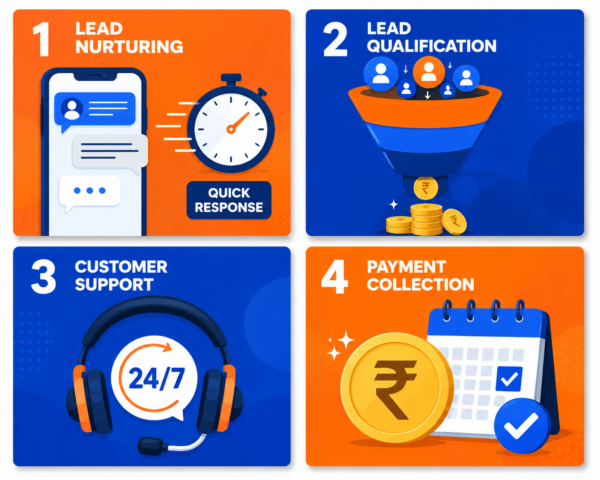
Four Applications Where Voice AI Earns Its Keep
Different industries, but the same four use cases keep showing up as the highest-ROI applications across the board.
Lead Nurturing: The Follow-Up Problem, Solved
Most leads need five to seven contacts before they convert. Sales teams know this and still can’t do it consistently because they have too many leads and too little time. Voice AI runs the nurture sequence first call, second follow-up, and re-engagement without anyone having to remember to do it.
- First contact in under a minute from lead arrival, regardless of time of day.
- Follow-up cadence maintained automatically across days or weeks.
- Every call outcome is logged to CRM without the agent having to type anything.
Lead Qualification: Filtering Before the Human Handoff
This one’s underrated. A Voice AI Platform running a structured qualification call asking about budget, intent, timeline, decision-making authority, and scoring the lead before any human gets involved is genuinely useful. The AI in the Indian customer support context matters here too: the system qualifies in the caller’s language, which meaningfully improves the willingness to engage.
- Every inbound lead gets the same quality qualification conversation.
- High-intent leads escalated to sales within seconds of the call ending.
- Low-quality leads filtered without burning a rep’s afternoon.
Customer Support: The Tier-1 Question Absorber
Voice AI for Customer Support is most useful as a filter. It handles predictable questions, order status, account balance, refund policy, and store timings, so human agents only deal with the calls that actually need a human. The agents aren’t doing less. They’re doing better work.
- Round-the-clock availability, no shift schedule, no Sunday surcharge.
- Handling time on routine queries drops, often by half.
- Frustrated callers detected by sentiment analysis and immediately escalated.
- Every conversation is transcribed and searchable for quality review.
Payment Collection: The Call That Gets Picked Up
There’s an interesting thing that happens with payment reminder calls from AI systems: pickup rates are often higher than from generic bulk SMS. A ringing phone gets attention in a way that a text message doesn’t, especially when the caller ID shows the company name the borrower recognises.
- Personalised calls with the borrower’s name, exact amount due, and due date spoken aloud.
- Payment link sent by SMS mid-call so the borrower can act immediately.
- Smart retry scheduling if the first attempt goes unanswered.
What Actually Changes When You Deploy Voice AI
Benefits sections in tech articles are usually where things go vague. Let’s avoid that.
The Cost Structure Shifts
The economics here aren’t subtle. One AI agent can run parallel conversations at a volume that would take fifteen human agents to match. That’s not an efficiency improvement; it’s a different cost model entirely. And unlike headcount, AI costs don’t spike when someone quits, gets sick, or decides they want a 40% raise.
- Cost-per-call drops substantially compared to human-agent operations.
- No recruitment, onboarding, or attrition costs baked in.
- Monthly costs are predictable, no seasonal budget surprises.
Speed Stops Being a Constraint
Human teams have a ceiling. Voice AI doesn’t. Whether you need to run 800 calls or 800,000 calls this week, the infrastructure handles it the same way. The quality of the 800,000th call is identical to the first. That kind of consistency is practically impossible with human teams at scale.
- Thousands of simultaneous calls without any queuing.
- No degradation in quality during Diwali, end-of-quarter, or any other spike.
- Scale up or down in hours, not hiring cycles.
Data Becomes an Asset
This one sneaks up on people. When every call is recorded, transcribed, and tagged, you end up with a corpus of customer conversation data that’s genuinely useful for product decisions, not just ops. You can see what objections keep coming up, which scripts lead to conversions, and which parts of the funnel are leaking. None of that was visible before.
- Real-time dashboards showing call outcomes, sentiment trends, and conversion rates.
- Keyword tracking across all conversations, no sampling, full coverage.
- Funnel analysis at a level of granularity that human-logged calls can’t provide.
Consistency Becomes the Default
Human agents have off days. They forget steps in the script. They get impatient. The AI doesn’t do any of those things. Every caller gets the same quality of interaction, which matters operationally and matters even more in regulated sectors where deviation from approved scripts has consequences.
- Zero script deviation across millions of calls.
- Automatic full-call recording for compliance and audit.
- Same experience at 2 PM on a Tuesday and 11 PM on a Sunday.
India Specifically: Why Voice AI Lands Differently Here
Global voice AI technology is real. But the gap between ‘works in English for a Western market’ and ‘works across Hindi, Tamil, Marathi, Telugu, Gujarati, and Kannada for a tier-2 Indian city’ is enormous. And it matters enormously.
India is mobile-first and call-first in ways that most developed markets aren’t anymore. A farmer in Rajasthan with a crop loan is not going to resolve a query through a web chat widget. A first-generation home buyer in Nagpur is not going to email their NBFC. But they will pick up the phone. Voice is the channel, and for a huge part of the country, it’s the only channel that actually works.
A Voice AI Platform built specifically for Indian languages isn’t a localisation project. It’s a market access project. Regional language support with real dialect accuracy doesn’t just improve customer experience, it opens up customer segments that were genuinely inaccessible through English-first channels. That’s real revenue, not just improved NPS.
On top of that, the talent economics in India make the business case unusually strong. Skilled call centre staff are expensive relative to margins in BFSI and e-commerce, hard to retain, and increasingly hard to recruit into outbound calling roles. Voice AI absorbs the least desirable parts of that work and lets human agents focus on conversations that need actual human judgment.
Choosing a Platform: What to Actually Verify
Every vendor in this space will tell you they support multilingual, low-latency, enterprise-grade voice AI. Here’s what to actually test before committing.
- Regional language depth: Not Hindi plus a couple of others. Run test calls in Tamil, Telugu, and Marathi. Listen for naturalness, not just word accuracy.
- Latency under load: Response delay under 1.5 seconds feels like a real conversation. Over that, it starts to feel broken. Test this at scale, not in a demo environment.
- Integration reality: ‘We integrate with Salesforce‘ means different things to different vendors. Make sure it’s a real, maintained integration with the specific fields you need, not a generic webhook.
- Escalation logic: How does the system handle what it can’t resolve? A graceful human handoff is a feature. A confused AI spiralling on an unanswered question is a churn event.
- Compliance tooling: Full call recording, searchable transcripts, and audit logs. Non-negotiable for BFSI and healthcare.
- Persona customization: Branded voice, customisable tone, persona consistency. Matters more than people expect once callers start associating the voice with the brand.
Conclusion
I think about my cousin’s team in Pune sometimes when I look at the projections coming out of the voice AI space in India. The work they were doing, three hundred identical calls a day, five days a week, wasn’t bad. It was just badly matched. Skilled people doing something a machine could do better, cheaper, and without burning out.
What makes voice AI interesting right now isn’t the technology itself; the tech has been maturing for years. What’s interesting is that the gap between early adopters and everyone else is finally becoming visible. Companies that have been running voice AI for a year have real data: what scripts convert, what objections keep coming up, and what languages their customers actually respond in. That institutional knowledge compounds in ways that are genuinely hard to catch up on.
India is a particularly interesting market for this because the advantages aren’t just operational, they’re structural. The scale of the customer base, the diversity of languages, the preference for voice over digital self-service in large parts of the country: these all make voice AI not just useful but arguably essential for any business trying to reach customers at a real scale.
That’s the case for moving now rather than waiting for a better moment. There usually isn’t one.