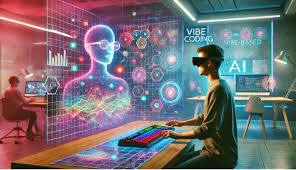
In early 2025, a new buzzword began circulating in developer communities: “vibe coding.” Unlike traditional coding workflows that demand structured planning and syntax mastery, vibe coding focuses on guiding AI with natural language prompts and refining the generated output iteratively. Instead of writing every line from scratch, developers “set the vibe” of what they want—whether that’s a prototype of a mobile app, an experimental UI, or even a full-stack workflow—and let AI tools do the heavy lifting.
For startups and product teams, this trend couldn’t have come at a better time. With rising competition and tight launch windows, companies are exploring faster ways to go from idea to working prototype. Many are partnering with an app development company in Los Angeles or other innovation hubs to adopt AI-first practices like vibe coding, giving them a head start in building MVPs at record speed.
What Exactly Is Vibe Coding?
At its core, vibe coding is an AI-assisted development style that replaces rigid coding steps with a conversation-driven workflow. Instead of switching between documentation, frameworks, and endless lines of code, developers tell the AI what they want in plain English (or another natural language).
For example:
- Build a mobile app login screen with Google and Apple sign-in options.
- Generate a dashboard with real-time metrics from an API feed.
- Refactor this payment integration to use Stripe’s latest SDK.
The AI generates a functional version instantly, and developers then iterate by adjusting prompts, editing the code, or adding context. It’s coding less like writing and more like sculpting—shaping the output until it fits the product vision.
Why Vibe Coding Is Gaining Momentum
Several trends converged to make vibe coding practical in 2025:
- Smarter AI models → Large language models (LLMs) can now handle context, maintain codebases, and even follow style guides.
- IDE integration → AI copilots are no longer browser extensions; they’re embedded in IDEs, CI/CD pipelines, and testing tools.
- Time-to-market pressure → Businesses can’t afford long development cycles. Rapid prototyping is the new competitive edge.
- Low-code/No-code overlap → Non-technical founders already embraced drag-and-drop tools. Vibe coding is the developer-friendly version of that, with more flexibility and control.
The appeal is obvious: vibe coding reduces boilerplate, accelerates MVP creation, and lets teams validate ideas faster.
Key Benefits of Vibe Coding
- Faster Prototyping
Traditional prototyping often takes weeks. With vibe coding, teams can stand up a demo or MVP in hours, not days, which is crucial for fundraising pitches or product-market fit testing.
- Lower Entry Barriers
Developers don’t need to master every library or framework update. Instead, they can describe what they need and let the AI handle compatibility issues.
- Increased Creativity
By eliminating repetitive coding tasks, developers have more mental bandwidth to experiment with features or refine UX. The focus shifts from “how to code” to “what to build.”
- Team Productivity
Even small teams can achieve enterprise-level velocity. A startup hiring app developers in Los Angeles could leverage vibe coding to maximize their output without expanding headcount.
Real-World Use Cases
Vibe coding isn’t just theory—it’s already making its way into real workflows. Here are some practical examples:
Startup MVPs → Founders can describe an app idea in natural language and get a working prototype to showcase to investors.
UI/UX Testing → Designers can spin up interactive prototypes without deep coding knowledge.
Enterprise Automation → Internal tools like dashboards, form processors, or report generators can be built in days.
Educational Tools → Teachers and bootcamps use vibe coding to help students understand coding logic without being bogged down by syntax.
The Risks and Challenges
Despite its promise, vibe coding isn’t a silver bullet. It introduces new challenges that businesses must manage carefully:
- Maintainability → AI-generated code may lack consistency or structure, making long-term maintenance difficult. Teams must enforce code reviews and documentation practices.
- Security → Quick prototypes often skip secure coding standards, creating vulnerabilities. Security audits become non-negotiable.
- Over-Reliance on AI → Developers risk losing problem-solving depth if they rely too much on prompts instead of critical thinking.
- Bias in Models → Since AI outputs reflect training data, bias or inefficiencies can creep into applications unnoticed.
Balancing Speed with Responsibility
The future of vibe coding isn’t about replacing developers—it’s about augmenting them. Skilled teams will use AI as an accelerator while still applying human judgment for architecture, scalability, and compliance.
Companies adopting this workflow should set guardrails, including:
- Code quality checks with automated testing.
- Security-first protocols for prototypes.
- Documentation workflows to keep AI-generated code understandable.
- Prompt engineering best practices to ensure consistent outputs.
What’s next for Vibe Coding?
Looking ahead, vibe coding may evolve into:
Multi-modal prompts → Developers guiding AI with sketches, wireframes, or even voice instructions.
End-to-end pipelines → AI handling design, code, tests, and deployment as a seamless workflow.
Industry-specific copilots → Specialized AI models trained on healthcare, finance, or logistics codebases for more reliable results.
In the near future, vibe coding could become as common as agile or DevOps—a standard methodology teams adopt to keep pace with rapid innovation.
Final Thoughts
Vibe coding marks a paradigm shift in software development. By combining natural language prompting with AI-assisted iteration, it allows teams to go from concept to working prototype faster than ever before. But speed without discipline carries risks. To truly benefit, businesses must balance rapid prototyping with long-term maintainability and security practices.
For startups, product teams, and enterprises alike, vibe coding is more than a trend—it’s the next evolution of how we build. The real winners will be those who learn to harness it responsibly, ensuring that the prototypes of today don’t become the technical debt of tomorrow.