
Artificial intelligence certifications are evolving rapidly as organizations integrate machine learning, automation, and data-driven decision systems into operational environments. By 2026, AI certification exams are expected to place greater emphasis on applied reasoning, governance awareness, model lifecycle management, and responsible AI deployment. As a result, an updated AI certification question bank is not merely a collection of new questions. It represents a recalibration of focus toward modern AI competencies.
Candidates preparing for AI certifications must understand how question banks reflect industry shifts. Updated practice materials increasingly evaluate ethical considerations, model monitoring strategies, regulatory alignment, and deployment scalability. A well-structured question bank, therefore, functions as both a readiness tool and a skills diagnostic instrument.
The Changing Landscape of AI Certification Exams
AI certification frameworks traditionally centered on core machine learning concepts such as supervised learning, neural networks, and statistical modeling. While these remain foundational, recent exam blueprints incorporate broader concerns, including explainability, bias mitigation, and secure model deployment.
Updated question banks for 2026 candidates reflect this transition. Rather than asking for algorithm definitions alone, modern questions frequently present real-world scenarios involving dataset imbalance, regulatory requirements, or production model drift. Candidates must evaluate not only which model fits best, but also whether the solution complies with ethical standards and operational constraints. This shift requires preparation strategies that prioritize conceptual integration over isolated memorization.
Core Knowledge Domains Reflected in Updated Question Banks
An updated AI certification question bank typically spans multiple domains. These domains collectively represent the lifecycle of AI systems rather than isolated technical segments.
| Domain Focus | Key Concepts Evaluated | Competency Expected |
|---|---|---|
| Data Preparation | Data cleaning, feature engineering, bias detection | Analytical preprocessing judgment |
| Model Development | Algorithm selection, training-validation split | Technical model reasoning |
| Deployment & Scaling | Containerization, APIs, cloud-based inference | Operational integration capability |
| Governance & Ethics | Fairness, transparency, accountability | Responsible AI awareness |
| Monitoring & Optimization | Model drift detection, performance tuning | Lifecycle management proficiency |
The presence of governance and monitoring domains indicates the increasing importance of operational AI maturity.
Scenario-Based Evaluation Over Definition Recall
Modern AI certification exams prioritize applied reasoning. Updated question banks include scenario-driven problems that test interpretation under constraints. For example, a question may describe a predictive model experiencing declining accuracy over time. Candidates must identify whether concept drift, data quality degradation, or incorrect retraining intervals are responsible.
This style of questioning encourages lifecycle thinking. Instead of recalling algorithm properties, candidates analyze how systems behave in production environments. Updated question banks mirror this trend by integrating contextual layers within each question.
Effective preparation, therefore, requires mapping each practice question to a specific lifecycle stage rather than studying algorithms in isolation.
Governance and Ethical AI Emphasis
By 2026, regulatory frameworks and organizational policies surrounding AI usage are expected to significantly influence certification standards. Updated question banks incorporate scenarios related to fairness evaluation, bias mitigation techniques, and compliance documentation.
Candidates may encounter questions assessing whether anonymization techniques sufficiently protect user data or whether explainability tools are appropriate for regulated industries. Understanding the relationship between technical design and ethical responsibility is increasingly important. This expanded scope reflects industry demand for AI professionals who combine technical proficiency with governance awareness.
Integration with Cloud and Automation Platforms
AI systems rarely operate independently. They integrate with cloud infrastructure, DevOps pipelines, and data engineering workflows. Updated question banks often test understanding of how AI models interact with cloud-based services, container orchestration platforms, and monitoring tools.
Candidates preparing for AI certifications must understand model deployment pipelines, API endpoints for inference, and logging strategies for performance tracking. Knowledge of containerization principles and infrastructure automation strengthens readiness for these integrated scenarios. Practice materials structured around deployment contexts help candidates visualize real-world implementation pathways.
Reducing Memorization Bias
Repeated exposure to static question sets creates pattern recognition rather than conceptual understanding. Updated question banks address this issue by diversifying scenario phrasing and introducing evolving case studies.
Candidates should approach practice questions analytically. Instead of memorizing correct answers, they should explain the reasoning behind each choice and evaluate why alternative options are inappropriate. This technique reinforces transferable skills and prepares learners for unfamiliar scenarios.
Structured platforms such as CertEmpire sometimes categorize AI certification questions by competency domain rather than topic list, helping learners detect recurring conceptual weaknesses instead of relying on repetition.
Monitoring and Model Drift Awareness
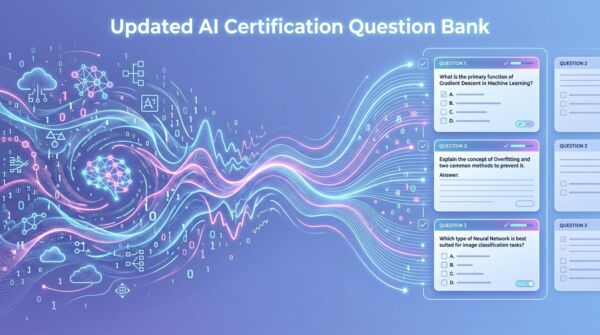
A significant addition to modern AI certification question banks involves model lifecycle monitoring. Questions increasingly assess understanding of concept drift, performance decay, and retraining triggers.
Candidates must differentiate between data drift and concept drift, evaluate monitoring thresholds, and select appropriate retraining strategies. These competencies reflect the operational reality of AI systems in production environments. Preparing for these topics requires reviewing both theoretical definitions and practical monitoring workflows.
Data-Centric Thinking in Updated Exams
AI performance depends heavily on data quality. Updated question banks emphasize data preprocessing, sampling strategies, and evaluation metrics. For example, imbalanced datasets may require specific performance metrics beyond simple accuracy.
Candidates should understand precision-recall trade-offs, confusion matrix interpretation, and cross-validation principles. Modern exam questions frequently integrate these elements within applied business contexts. Data-centric reasoning strengthens adaptability when encountering varied case scenarios.
For structured preparation guidance, review the overview of PMI CAPM practice questions and exam focus areas.
Risk Assessment and Security Considerations
Security and adversarial awareness are increasingly integrated into AI certification content. Questions may assess understanding of data poisoning risks, model inversion attacks, or secure API design.
Updated question banks reflect these evolving risks by incorporating threat-modeling scenarios. Candidates should recognize vulnerabilities in training pipelines and inference endpoints. This risk-based evaluation ensures AI professionals are prepared for real-world security challenges.
Adaptive Study Strategy for 2026 Candidates
To maximize the benefit of updated question banks, candidates should adopt structured study cycles. Begin by identifying domain weaknesses through diagnostic practice sessions. Next, reinforce conceptual gaps with focused reading or lab experimentation.
Simulated exams should be introduced only after domain-level mastery. This progression ensures that mock scores reflect understanding rather than familiarity. Periodic review of ethical guidelines, monitoring practices, and deployment workflows maintains alignment with current certification expectations.
Final Overview
An updated AI certification question bank for 2026 candidates represents more than revised content. It embodies the evolving priorities of artificial intelligence practice, including governance, lifecycle management, security, and deployment integration. Candidates who engage analytically with scenario-based questions develop adaptive reasoning rather than rote recall. Mastery of data-centric thinking, monitoring awareness, and ethical responsibility enhances both certification readiness and professional resilience in a rapidly advancing AI landscape.
For insights on long-term cloud certification strategy, see the detailed guide on future-proofing your career with AWS, Azure, and Google Cloud certifications.
FAQs
1. Why are AI certification exams changing in 2026?
AI certifications now emphasize governance, lifecycle monitoring, and deployment integration due to industry demand for responsible and production-ready AI systems beyond algorithmic knowledge alone.
2. How should I use updated AI question banks effectively?
Analyze each question by mapping it to lifecycle stages and governance considerations. Focus on reasoning patterns instead of memorizing answers to improve adaptability during unfamiliar scenarios.
3. Are ethics and compliance heavily tested in AI certifications?
Yes, modern exams increasingly include fairness evaluation, bias mitigation, and regulatory compliance scenarios to ensure candidates understand responsible AI implementation principles.
4. Do I need cloud knowledge for AI certification exams?
Many AI certifications assess deployment and integration skills. Familiarity with cloud services, containerization, and monitoring frameworks strengthens preparedness for operational AI scenarios.