

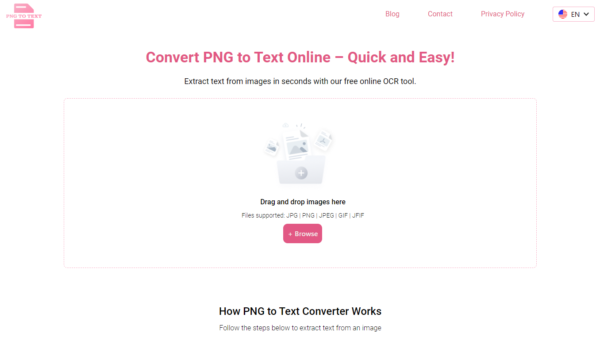
In today’s digital landscape, the ability to convert visual content into editable text has become more valuable than ever. Whether it’s a scanned document, an infographic, or a simple image containing text, users often need a way to turn these static visuals into editable formats. This process is made possible through Optical Character Recognition (OCR) technology. While OCR is widely used to convert various image formats like PNG, JPG, and GIF into text, its applications go far beyond simple conversion.
We’ll explore how OCR is transforming industries, enhancing workflows, and enabling greater accessibility, all while subtly addressing the core functionality of converting PNG to text and other image formats to editable content.
The Evolution of OCR: From Simple Image to Usable Data
OCR has evolved significantly since its early inception. Initially designed to read printed characters from scanned documents, today’s OCR tools use sophisticated algorithms to identify text in various fonts, sizes, and even handwritten styles. This advancement has opened up endless possibilities for extracting text from images, making tools like PNG to text converters indispensable in both personal and professional settings.
With OCR technology, converting images into text is more than just a tool for convenience; it is the gateway to unlocking a vast amount of data previously trapped in visual formats. Businesses, researchers, and students alike use OCR to streamline tasks such as:
-
Automating data entry from scanned forms
-
Digitizing historical documents for research
-
Extracting text from infographics for editing
-
Enabling accessibility features like screen readers for the visually impaired
Enhancing Workflows with OCR in Various Industries
1. The Legal Sector
In the legal profession, professionals frequently deal with mountains of paperwork, from contracts and court filings to affidavits and case studies. Legal teams often need to review, edit, and archive these documents. OCR tools are invaluable for converting scanned documents (in formats like PNG, JPG, and PDF) into searchable and editable text.
Law firms that use OCR-enabled tools can streamline case preparation, quickly search through digitized text, and improve overall efficiency. For example, converting image-based PDF files into text allows lawyers to locate key phrases or terms without manually reviewing pages of content.
2. Education and Research
For educators and researchers, OCR plays a critical role in enhancing productivity. Academic researchers often find themselves dealing with scanned copies of old manuscripts or digitized versions of out-of-print books. By converting these image files into text, researchers can manipulate, quote, and reference content far more easily.
Additionally, OCR enhances accessibility in education, allowing for the conversion of classroom materials into formats suitable for students with disabilities. For example, converting PNG files containing lecture notes into editable text can allow the use of text-to-speech software.
3. Marketing and Content Creation
Marketers and content creators also benefit from OCR when repurposing content. Infographics, presentations, and social media images often contain valuable text that needs to be adapted for various platforms. Instead of manually transcribing this content, OCR tools can extract text from images like PNG files within seconds, enabling content creators to easily reuse text across different media.
4. Healthcare Sector
In healthcare, managing patient information is critical. Hospitals and clinics are digitizing patient records to improve access to medical history, prescriptions, and test results. OCR tools convert scanned medical forms and records into editable text, making it easier for healthcare providers to retrieve and update information. This has resulted in reduced clerical errors, improved patient care, and a streamlined data management system.
The Role of PNG to Text Converters in OCR Technology
While OCR technology can work with many file types, the PNG format is especially popular for text-based images due to its lossless compression, which retains image quality. This makes PNG files ideal for converting images that include fine text details, such as scanned documents, diagrams, and business cards.
Some key benefits of using a PNG to text converter include:
-
High accuracy: Advanced OCR algorithms ensure text is captured with minimal errors, even from complex images.
-
Time efficiency: Automating the text extraction process saves hours of manual transcription work.
-
Accessibility: Text extracted from images can be easily edited, shared, or converted into accessible formats like audiobooks for visually impaired users.
How OCR Technology is Enhancing Accessibility
One of the greatest benefits of OCR technology is its role in making information more accessible. For people with visual impairments, text from images or scanned documents can be challenging to access. OCR tools make it possible to convert visual content, such as PNG files, into text that can then be used with screen readers, Braille displays, or other assistive technologies.
Additionally, OCR tools that support multiple languages help break down language barriers, allowing users to extract and translate text from images in different languages.
Future Trends in OCR Technology
As artificial intelligence (AI) and machine learning continue to develop, OCR technology is becoming even more powerful and precise. AI-powered OCR tools are now capable of recognizing text in images with greater accuracy, especially in complex scenarios where text might be distorted, handwritten, or in non-standard fonts.
Some anticipated trends in OCR include:
-
Real-time OCR integration in mobile apps, allowing users to convert images to text directly from their smartphones.
-
Multi-language support, enabling text extraction from images in various languages without switching tools.
-
Enhanced image analysis, where OCR tools will be able to identify and extract information from non-text elements such as charts or diagrams.
Conclusion
In a world increasingly driven by digital transformation, OCR technology has become a vital tool for converting images into actionable data. While the primary function of OCR tools is to convert images like PNGs into text, their real value lies in their ability to optimize workflows, improve accessibility, and unlock new possibilities across industries.
From legal teams needing to organize case files to marketers repurposing infographics, OCR is a game-changer. As this technology continues to evolve, we can expect even greater accuracy, versatility, and functionality in the years to come. Whether you’re converting PNG to text or utilizing OCR for more advanced purposes, the future is bright for this transformative technology.