
In a world where smartphones, laptops, electric cars, and even household appliances are becoming smarter, it’s easy to take for granted the invisible components that make all of this possible. Among these unsung heroes of modern technology are semiconductors—tiny, yet powerful materials that form the backbone of the entire digital age. From powering the most basic gadgets to enabling complex systems like artificial intelligence (AI) and quantum computing, semiconductors are at the heart of virtually every technological breakthrough of the 21st century.
What Are Semiconductors?
At their core, semiconductors are materials that have electrical properties between those of conductors (like metals) and insulators (like rubber). This unique ability allows semiconductors to control electrical current, making them ideal for use in electronic circuits. Silicon is the most common semiconductor material, but others such as gallium arsenide, germanium, and silicon carbide are also widely used for specific applications.
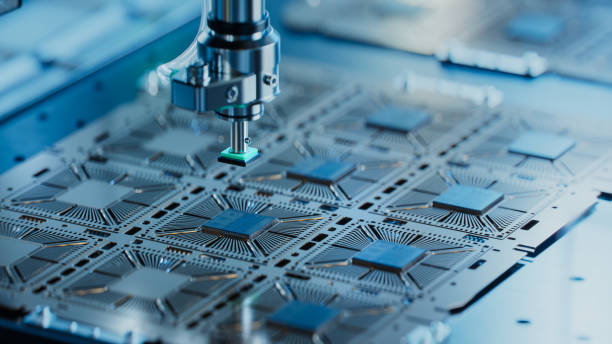
Semiconductors are primarily used to manufacture microchips or integrated circuits (ICs)—the small, flat devices that house thousands, millions, or even billions of transistors, which control the flow of electricity within a system. These tiny transistors serve as the “on” and “off” switches that allow electronic devices to process information, perform calculations, and execute commands.
The Crucial Role of Semiconductors in Big Tech
While semiconductors are small in size, their impact on technology is anything but insignificant. These devices are the building blocks of nearly every major technological innovation, from consumer electronics to cutting-edge fields like AI and autonomous vehicles.
1. Smartphones and Consumer Electronics
Today’s smartphones and consumer electronics are perhaps the most obvious places where semiconductors play a role. The mobile devices we use daily are packed with microchips that control everything from the screen’s touch responsiveness to the camera’s ability to capture high-definition images. The power behind these devices comes from semiconductors—specifically, the processors, memory chips, and graphics units that enable high-speed performance and multitasking.
The constant demand for smaller, faster, and more efficient chips has driven innovations in semiconductor manufacturing. With the advent of advanced fabrication techniques, chips have become exponentially more powerful, enabling the rise of smartphones that are as powerful as early supercomputers.
2. Artificial Intelligence and Machine Learning
The rapid development of artificial intelligence (AI) is largely due to advancements in semiconductor technology and investments in semiconductors development. AI and machine learning algorithms require massive computational power, which is made possible by specialized semiconductors like graphics processing units (GPUs) and tensor processing units (TPUs). These chips are designed to handle the large amounts of data and complex calculations needed for tasks like image recognition, natural language processing, and autonomous decision-making.
AI-driven applications, such as voice assistants, autonomous vehicles, and predictive analytics, rely on highly efficient and fast semiconductor components to process vast amounts of data in real time. As AI continues to evolve, the demand for more advanced chips that can handle increasingly complex models will only grow.
3. Electric Vehicles and Renewable Energy
As the world shifts toward sustainable energy and transportation, semiconductors are playing a critical role in powering electric vehicles (EVs) and enabling renewable energy systems. In EVs, semiconductors control key functions like power management, battery charging, and motor control, ensuring optimal efficiency and performance.
Semiconductors are also vital to solar panels, wind turbines, and other renewable energy technologies. Power conversion systems, which convert energy from the source to usable electricity, rely on semiconductors to ensure smooth operation and energy efficiency. As the demand for clean energy grows, the role of semiconductors in these systems becomes more critical in achieving sustainability goals.
4. Internet of Things (IoT) and Smart Devices
The Internet of Things (IoT)—the network of interconnected devices that communicate and share data—relies heavily on semiconductors. These chips enable the miniaturization of sensors, actuators, and communication modules, allowing devices like smart thermostats, wearable fitness trackers, and connected home appliances to function effectively.
Semiconductors in IoT devices also contribute to improving the efficiency and performance of networks, ensuring low power consumption and seamless data transmission. As the number of connected devices grows, the demand for advanced semiconductor components that can handle more data, higher speeds, and lower power consumption will continue to rise.
5. 5G and Telecommunications
The rollout of 5G networks is another example of how semiconductors enable groundbreaking technological advancements. 5G technology promises to deliver faster internet speeds, lower latency, and greater connectivity, all of which are essential for the future of smart cities, autonomous transportation, and real-time data processing. Semiconductors play a key role in 5G infrastructure, powering base stations, antennas, and network equipment that support ultra-high-speed communication.
In addition, consumer devices such as smartphones, smartwatches, and augmented reality (AR) glasses depend on semiconductors to support the next-generation wireless capabilities of 5G networks. Without semiconductors, 5G would not be possible.
The Global Semiconductor Supply Chain
The global supply chain for semiconductors is an intricate and highly specialized network. Semiconductor manufacturing involves multiple stages, including research and design, fabrication, assembly, and testing. Leading companies like Taiwan Semiconductor Manufacturing Company (TSMC), Intel, Samsung, and Qualcomm dominate the chip production industry, while other players focus on design, such as AMD, Nvidia, and ARM.
The complexity of semiconductor manufacturing is staggering, with state-of-the-art fabrication plants (called fabs) requiring billions of dollars in investment. These facilities use cutting-edge equipment to create microchips with transistors smaller than the width of a human hair. The semiconductor industry is also highly sensitive to geopolitical tensions, as seen in recent supply chain disruptions caused by trade wars, the COVID-19 pandemic, and chip shortages.
Challenges and the Future of Semiconductors
While semiconductors are undoubtedly integral to modern technology, the industry faces several challenges that could impact future growth and innovation. One of the most pressing issues is the increasing difficulty of advancing Moore’s Law, the observation that the number of transistors on a chip doubles approximately every two years. As chip sizes approach the atomic scale, it becomes more challenging to pack more transistors onto a single microchip, leading to the exploration of alternative materials and new chip architectures, such as quantum computing and neuromorphic chips.
Additionally, geopolitical tensions and supply chain disruptions have highlighted the vulnerabilities in the semiconductor ecosystem. As governments around the world recognize the strategic importance of semiconductors, there is a growing push to increase domestic production capabilities and reduce dependence on foreign manufacturers.
Conclusion
Semiconductors may be small, but their impact on modern technology is immense. These tiny components make possible the devices and systems that define our everyday lives, from smartphones to AI-powered machines, electric vehicles, and the IoT. As technology continues to evolve, semiconductors will remain at the forefront, enabling even greater advancements and shaping the future of industries worldwide. Whether it’s through powering the next generation of mobile devices or fueling the rise of AI, the small parts that make up big tech are undoubtedly essential to the world’s continued progress.