
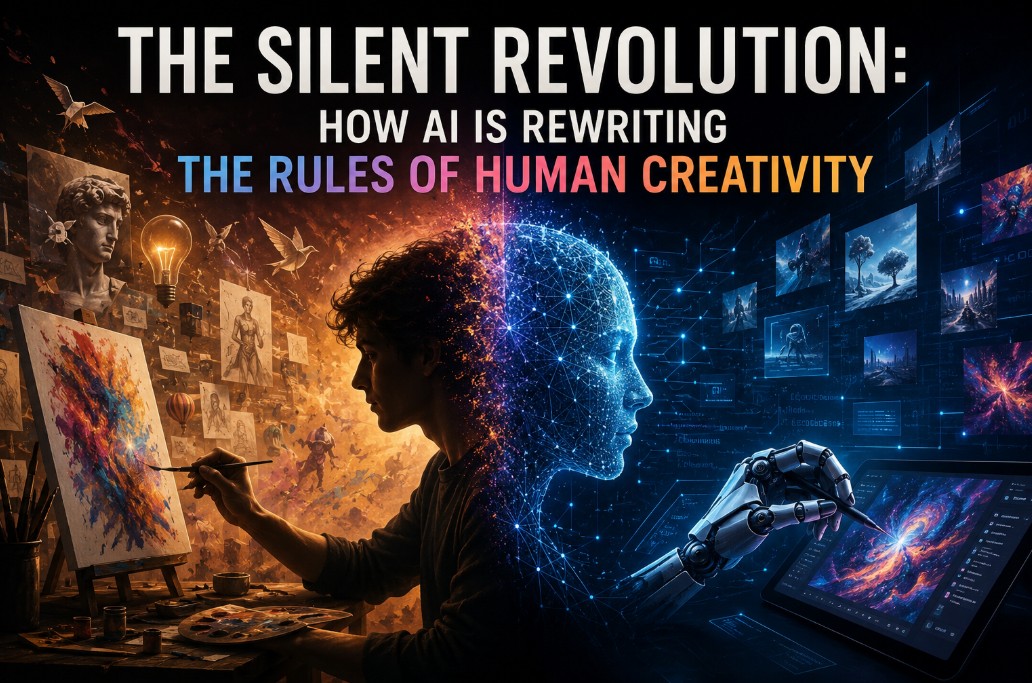
 There is a moment, familiar to anyone who has used a modern generative AI tool, that never quite loses its strangeness. You type a sentence — a description, an idea, a mood — and within seconds something appears on the screen that did not exist before. Not retrieved from a database. Not assembled from a template. Created, from nothing, in direct response to your words.
That moment is happening billions of times a day. And the cumulative effect of all those moments is one of the most significant shifts in the history of human creative expression.
PART ONE: THE IMAGE THAT WRITES ITSELF
How the AI Image Generator Changed Everything
The story of the AI image generator is, at its core, a story about compression. It took centuries of accumulated human artistic knowledge — every painting technique, every photographic convention, every design principle ever documented or demonstrated — and compressed it into a system that anyone can access with a typed sentence.
The earliest versions were curiosities. They produced blurry approximations of reality, dreamlike and often grotesque, interesting more as technical demonstrations than as practical tools. But the pace of development was ferocious. Within a few years, the outputs had crossed a threshold that researchers had assumed was a decade away: they became indistinguishable from human-made work.
Today’s AI image generator operates through a process called diffusion modelling. In simplified terms, the system is trained by taking billions of real images, gradually corrupting them with layers of digital noise until nothing recognisable remains, and then learning — in meticulous, iterative detail — how to reverse that corruption. The result is a model that has internalised the statistical structure of visual reality so deeply that it can reconstruct coherent images from pure noise, guided only by the semantic meaning of a text prompt.
What this means in practice is extraordinary. Type “a rain-soaked Tokyo street at 3am, neon signs reflected in puddles, 35mm film grain, 1980s atmosphere” into a modern AI image generator and you receive not a generic photograph but a composition that understands mood, era, geography, lighting physics, and cinematic convention simultaneously. The system does not look up Tokyo photographs. It synthesises an image that embodies everything the prompt implies — including things the user did not explicitly say.
This sensitivity to implication and context is what separates today’s systems from everything that came before. An AI image generator does not execute instructions. It interprets them.
The Industries That Were Never the Same Again
The commercial adoption of the AI image generator happened faster than almost anyone predicted. The economics were simply too compelling to ignore.
Consider advertising. A global campaign that once required location scouting, talent booking, a photography crew, post-production editing, and weeks of approval cycles can now be prototyped in an afternoon. A creative director can generate fifty visual directions before lunch, identify the three worth developing, and have client-ready concepts by end of day. The AI image generator did not eliminate creative directors — it eliminated the bottleneck between their ideas and their execution.
In e-commerce, the transformation has been equally dramatic. Small businesses that could never afford professional product photography now generate lifestyle imagery, background variations, and seasonal content at will. A candle brand can have its products photographed in a Scandinavian winter cabin, a Moroccan riad, and a Manhattan loft — none of which exist, all of which look completely convincing — for the cost of a monthly software subscription.
Architecture firms use AI image generators to render photorealistic visualisations from early-stage sketches, compressing months of draughting work into days and allowing clients to experience buildings that haven’t yet been designed. Game studios use them to explore hundreds of environmental concepts before committing to art direction. Fashion houses prototype collections digitally, reducing sample production costs and material waste. Publishing teams generate custom editorial illustration in the time it previously took to brief a freelancer.
The thread connecting all of these applications is the same: the AI image generator has decoupled creative ambition from technical execution. You no longer need to be able to draw, photograph, or design to produce professional-quality visual content. You need to be able to think — and to describe what you’re thinking with enough precision and richness that the model can interpret it faithfully.
PART TWO: WHEN STILL IMAGES LEARNED TO MOVE
The Emergence of the AI Video Generator
If the AI image generator represented the first act of a creative revolution, the AI video generator is the second — and it arrives with considerably higher stakes.
Generating video from artificial intelligence is a categorically harder problem than generating still images. A single image requires the model to understand space, light, texture, and composition. A video requires all of that, sustained across hundreds or thousands of individual frames, while simultaneously simulating the physics of motion, maintaining the consistency of objects and characters through time, managing lighting continuity as scenes develop, and producing camera movement that feels purposeful and cinematic rather than random and jerky.
Early AI video generators largely failed at these requirements. They produced seconds of footage that was visually interesting in the way that fever dreams are visually interesting — fluid, strange, internally inconsistent, with objects that morphed unexpectedly and faces that distorted across frames. They demonstrated that AI could produce motion, but not that it could tell a story with it.
That has changed. The current generation of AI video generators can produce multi-minute sequences with consistent characters, photorealistic environments, and camera work that would be unremarkable if it appeared in a Hollywood production. The technical term for the core challenge — temporal consistency — has essentially been solved at the level of short-form content, and is being rapidly solved at longer durations.
The implications are staggering. Every industry that has ever needed moving images — which is to say, nearly every industry — is being forced to reckon with what an AI video generator means for its economics, its workflows, and its workforce.
The New Economics of Moving Images
To understand the scale of disruption the AI video generator represents, consider what video production has historically cost.
A thirty-second television advertisement — the kind that plays during a football match or a primetime drama — might cost anywhere from $500,000 to several million dollars to produce, once you account for the creative agency, the director, the location, the crew, the talent, the post-production house, and the music licensing. That cost has been the primary reason why high-production-value video advertising has been the exclusive domain of large brands with large budgets.
An AI video generator changes this calculation entirely. The same thirty-second advertisement — not a rough mock-up, but a polished, broadcast-quality clip — can now be produced for a fraction of the cost, in a fraction of the time. More importantly, it can be produced in ten variations simultaneously, allowing brands to test different creative approaches, different messaging, and different aesthetic treatments in the time it once took to produce a single version of a single concept.
For independent filmmakers, the AI video generator has dismantled another barrier entirely. Visual effects sequences that previously required six-figure post-production budgets are now within reach of individual creators. A filmmaker can realise a vision that includes environments they cannot physically access, weather conditions they cannot control, and action sequences they cannot safely execute — all rendered by an AI video generator from written descriptions and reference imagery.
The social media landscape is already being reshaped by these capabilities. Creators who once spent hours editing footage to produce a single polished reel can now generate content at a pace that would have been physically impossible a few years ago. News organisations are using AI video generators to produce explainer content and data visualisations in near-real time. Educational platforms are creating personalised instructional videos that adapt to individual learning profiles. The velocity of visual content production across every channel has increased by an order of magnitude.
PART THREE: THE HUMAN QUESTION
What AI Cannot Replace
Every significant technological shift generates two anxieties simultaneously: the fear that the technology will take over, and the gradual discovery that it cannot take over entirely. The AI image generator and the AI video generator are no exception.
The most consistent finding from practitioners across every field that has adopted these tools is that the quality of AI-generated output is directly proportional to the quality of human direction. A vague prompt produces generic results. A richly conceived, carefully articulated prompt — one that communicates not just subject matter but mood, intention, aesthetic sensibility, and narrative purpose — produces work of genuine merit.
This is not a consoling platitude. It is a description of a new kind of creative skill that is both genuinely difficult to develop and genuinely valuable to possess. The ability to communicate creative vision with precision and richness — to translate internal aesthetic intentions into external language that a generative model can interpret faithfully — is a skill that experienced creative professionals are discovering they already possess. Their years of thinking about composition, lighting, narrative, and style have given them a vocabulary that translates directly into effective AI prompting.
The working cinematographer who knows the difference between a Dutch angle and a low-angle shot, and why each produces a different emotional effect, produces fundamentally different results from an AI video generator than someone who simply types “make it dramatic.” The art director who understands colour theory and typographic hierarchy produces fundamentally different results from an AI image generator than someone who types “make it look professional.” Technical and aesthetic knowledge does not become less valuable when AI handles execution. It becomes the primary differentiator.
The Ethical Terrain
Alongside the creative opportunities, the AI image generator and the AI video generator have opened ethical questions that the industry has not yet answered satisfactorily — and that regulators are only beginning to address.
The most fundamental concerns training data. Both technologies were built on datasets containing billions of images and videos created by human artists, photographers, and filmmakers — most of whom did not consent to having their work used for this purpose, and none of whom were compensated for it. Courts in multiple jurisdictions are currently weighing whether this constitutes copyright infringement, fair use, or something in between. The outcome of these cases will shape the legal and commercial landscape for generative AI for decades.
A second concern centres on synthetic media and its relationship to truth. The AI video generator, in particular, has made it trivially easy to produce footage of things that never happened — statements that were never made, events that never occurred, people in places they never were. The same technology that allows an independent filmmaker to produce a convincing action sequence also allows a bad actor to produce a convincing false document. Detection tools are improving, but the generation-detection arms race shows no signs of resolution, and the erosion of confidence in documentary evidence is already measurable in public opinion research.
The labour question is equally live. Stock photography platforms have reported significant revenue declines. Junior illustrators and motion graphics artists face a market in which AI can approximate their output at negligible cost. These are not hypothetical future harms — they are present realities experienced by real workers who have seen the economic basis of their profession shift beneath them in a matter of years.
None of these concerns negates the genuine value that the AI image generator and the AI video generator have created. But they resist the technologist’s temptation to treat disruption as inherently positive and to leave the costs of that disruption to be absorbed by whoever happens to be standing in the way.
PART FOUR: WHERE THIS ENDS
The Horizon
The current capabilities of AI image generators and AI video generators — impressive as they are — almost certainly represent an early chapter rather than a mature technology. The trajectory is clear, and it points consistently in one direction: greater capability, lower cost, wider access, and faster production.
Several developments on the near horizon deserve attention.
Real-time generation — the ability to produce AI images and video frames instantaneously in response to live input — is moving from experimental to practical. This will transform interactive media, gaming, and live broadcasting in ways that are difficult to fully anticipate but easy to recognise as significant. Imagine a video game whose environments are generated in real time in direct response to player behaviour, or a live broadcast that can illustrate breaking news with AI-generated footage as events unfold.
The generation of feature-length video — coherent, character-consistent, narratively structured films produced from text descriptions — remains technically out of reach, but the distance is shrinking. The same capability improvements that took AI video generators from two-second clips to two-minute sequences are continuing, and there is no obvious theoretical ceiling below feature length.
Personalisation at scale — the ability to deliver different versions of the same creative content to different audiences, tailored by preference, location, language, and context — will be one of the most commercially significant applications of both technologies. The AI image generator and the AI video generator will allow brands to produce not one advertisement but ten thousand variations of an advertisement, each optimised for a specific audience segment, at the cost of producing one.
And regulatory frameworks, currently lagging behind the technology in almost every jurisdiction, will mature. The rules governing AI-generated content — around disclosure, attribution, data rights, and synthetic media — will take shape over the next five years and will significantly influence how these technologies develop and who benefits from them.
A Final Thought
Every generation has its technology that was going to end art, creativity, and the need for human imagination. Photography was going to make painting obsolete. Cinema was going to kill theatre. Television was going to destroy cinema. The internet was going to make professional writing impossible.
None of these things happened, because the anxiety misunderstood the nature of creative value. The introduction of a new tool does not eliminate the human need for vision, meaning, and emotional resonance — it changes what is required to express them, and it changes who is capable of expressing them.
The AI image generator and the AI video generator are the latest and most powerful iterations of this pattern. They have handed extraordinary creative leverage to anyone with a clear idea and the language to describe it. They have made things possible that were previously impossible, and affordable that were previously out of reach.
What they cannot do is decide what is worth making, or why, or for whom. That remains — as it has always remained — irreducibly human.
And that, perhaps, is the most important thing to understand about this particular revolution: it has not replaced the artist. It has simply given the artist new tools, and made being an artist available to far more people than ever before.