
Artificial intelligence is entering a new phase of enterprise adoption. Earlier AI systems primarily focused on predictive analytics, chatbots, and process automation. However, the latest innovation, autonomous AI agents is enabling organizations to automate far more complex and multi-step workflows.
These agents can plan tasks, make decisions, interact with software tools, and continuously adapt based on new information. As a result, businesses across industries are rethinking how operations, customer service, and digital processes can be managed with minimal human intervention.
This article explains what autonomous AI agents are, how they work, and how businesses are using them to automate complex workflows at scale.
What Are Autonomous AI Agents?
An autonomous AI agent is a software system that can independently perform tasks, make decisions, and execute actions to achieve specific objectives.
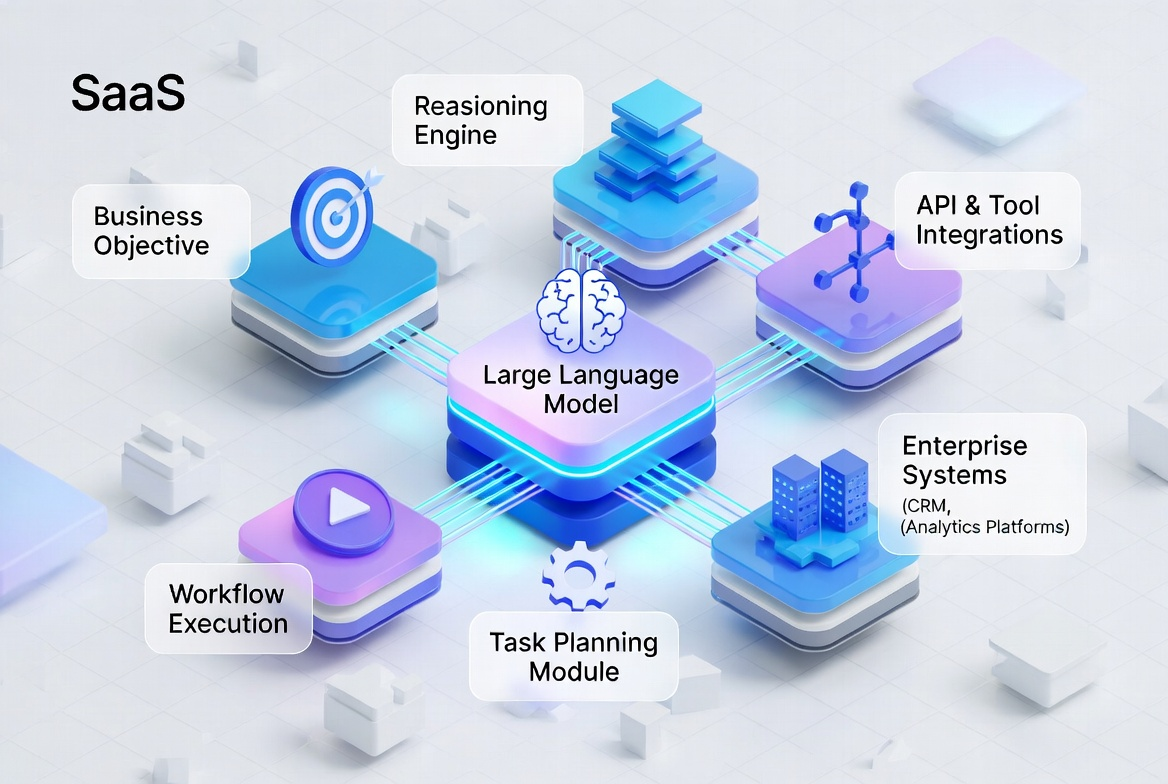
Unlike traditional automation tools that rely on rigid rule-based scripts, AI agents combine several advanced technologies:
-
large language models (LLMs)
-
machine learning algorithms
-
workflow orchestration engines
-
API integrations with enterprise tools
-
contextual reasoning capabilities
These components allow AI agents to operate in dynamic environments and adapt their behavior as conditions change.
For example, a customer support AI agent can analyze incoming queries, access company knowledge bases, generate accurate responses, escalate complex issues, and update CRM systems—all without human supervision.
This level of autonomy significantly expands the possibilities of business automation.
Why Autonomous AI Agents Are Gaining Momentum
Several technological and market factors are accelerating the adoption of autonomous AI systems.
1. Advances in Large Language Models
Large language models provide the reasoning and natural language understanding required for intelligent decision-making.
These models can:
-
interpret complex instructions
-
analyze contextual data
-
generate human-like responses
-
plan multi-step actions
This capability enables AI agents to operate in environments that previously required human judgment.
Organizations investing in AI Development Services are increasingly integrating LLM-based reasoning into enterprise automation systems.
2. Growing Demand for Operational Efficiency
Businesses are constantly looking for ways to reduce operational costs while improving service quality.
Autonomous AI agents help achieve this by automating repetitive and knowledge-based tasks such as:
-
customer support responses
-
report generation
-
data analysis
-
workflow coordination
-
internal knowledge retrieval
According to several industry reports, automation technologies could contribute trillions of dollars to global productivity by the end of this decade.
AI agents represent the next stage of this automation evolution.
3. Integration With Enterprise Technology Stacks
Modern businesses operate on complex digital infrastructure consisting of multiple applications and data systems.
Autonomous AI agents can connect with enterprise platforms through APIs and automation frameworks, including:
-
CRM systems
-
ERP software
-
data warehouses
-
analytics platforms
-
collaboration tools
This integration allows agents to perform actions across multiple systems while maintaining consistent workflow execution.
Companies that invest in LLM Development Services often build custom AI agents designed specifically for their existing technology stack.
Key Capabilities of Autonomous AI Agents
Autonomous agents are more powerful than traditional automation tools because they combine multiple capabilities into a unified system.
1. Goal-Based Task Planning
AI agents begin by interpreting an objective.
For example:
“Generate a weekly performance report for the marketing team.”
The agent can then break the task into several steps:
-
collect campaign data
-
analyze key performance indicators
-
generate visual insights
-
produce a formatted report
-
deliver the report via email or collaboration tools
This planning capability enables complex workflow execution without predefined scripts.
2. Contextual Reasoning
Autonomous agents use contextual reasoning to determine the most appropriate actions.
For instance, if an agent is assisting with customer service, it can:
-
review customer history
-
analyze previous interactions
-
check product information
-
determine the appropriate response
This approach results in more accurate and personalized outcomes.
3. Tool and API Integration
AI agents can interact with external tools and software systems through API connections.
Common integrations include:
-
CRM platforms
-
payment systems
-
cloud databases
-
scheduling tools
-
analytics dashboards
This capability allows agents to perform real-world actions instead of simply generating text responses.
4. Continuous Learning and Improvement
Many AI agent systems include feedback loops that help improve performance over time.
These loops analyze:
-
user corrections
-
workflow outcomes
-
task success rates
-
operational efficiency
The system then adjusts its behavior to improve future decision-making.
Organizations building custom solutions through AI Agent Development Services often design specialized feedback mechanisms tailored to their operational needs.
Real-World Business Applications
Autonomous AI agents are already being used across several industries to automate complex workflows.
Customer Support Automation
Customer service operations involve large volumes of repetitive interactions.
AI agents can automate tasks such as:
-
answering customer queries
-
resolving product issues
-
updating support tickets
-
escalating complex cases
This significantly reduces response times and operational costs.
Marketing Campaign Management
Marketing teams rely on multiple tools and data sources to manage campaigns.
AI agents can streamline these workflow by:
-
monitoring campaign performance
-
analyzing engagement metrics
-
generating optimization recommendations
-
automating report generation
This allows marketing professionals to focus on strategic decision-making rather than routine data analysis.
Financial Operations
Financial departments handle numerous data-driven processes, including reconciliation, reporting, and compliance monitoring.
Autonomous agents can assist with:
-
transaction analysis
-
anomaly detection
-
financial reporting automation
-
compliance monitoring
These systems improve both efficiency and accuracy in financial operations.
Software Development Workflows
In software engineering environments, AI agents can support development teams by automating several tasks:
-
code review suggestions
-
bug detection
-
documentation generation
-
testing workflows
When integrated with development platforms, AI agents can significantly accelerate product development cycles.
Architecture of an Autonomous AI Agent System
Developing an effective AI agent platform requires a modular and scalable architecture.
Typical components include:
1. LLM Reasoning Layer
This layer processes natural language instructions and generates reasoning-based decisions.
It interprets goals and determines the steps required to achieve them.
2. Task Planning Engine
The planning module converts objectives into structured workflows.
It defines task sequences, dependencies, and execution logic.
3. Tool Integration Layer
This layer enables communication between the AI agent and external systems.
It manages:
-
API connections
-
data retrieval
-
command execution
-
system interactions
4. Memory and Context Management
AI agents require contextual memory to maintain continuity during multi-step tasks.
This memory system stores:
-
previous actions
-
conversation context
-
workflow states
-
relevant data points
5. Monitoring and Governance Layer
Enterprise-grade AI systems require oversight mechanisms to ensure reliability and compliance.
This layer provides:
-
activity monitoring
-
performance tracking
-
access control
-
audit logging
Such governance systems are essential for deploying AI agents in regulated industries.
Challenges and Considerations
While autonomous AI agents offer significant advantages, businesses must address several implementation challenges.
Reliability and Accuracy
AI agents must operate with high reliability, particularly in critical business workflows.
Organizations should implement:
-
validation mechanisms
-
human oversight
-
error-handling protocols
Data Security and Privacy
Since AI agents interact with sensitive data, security frameworks must include:
-
encryption protocols
-
access control systems
-
regulatory compliance mechanisms
This is particularly important for industries such as finance, healthcare, and legal services.
Infrastructure Requirements
Autonomous AI systems require scalable infrastructure capable of handling:
-
large language model processing
-
data integration pipelines
-
real-time workflow execution
Cloud-based AI infrastructure is commonly used to support these requirements.
The Future of Autonomous Business Operations
The adoption of autonomous AI agents is expected to grow significantly over the next decade.
Industry analysts predict that businesses will increasingly deploy AI agents to manage complex digital operations across departments.
Future advancements may include:
-
multi-agent collaboration systems
-
fully automated enterprise workflows
-
AI-driven decision support systems
-
intelligent digital employees
These developments could transform how organizations structure their workforce and operational models.
Conclusion
Autonomous AI agents represent a major advancement in business automation. By combining large language models, workflow orchestration, and enterprise system integration, these intelligent systems can perform complex tasks that previously required human coordination.
Businesses are already leveraging these technologies to automate customer support, financial operations, marketing analytics, and software development workflows. However, successful implementation requires careful planning, scalable infrastructure, and strong governance frameworks.
Organizations that invest in advanced capabilities such as AI Development Services, LLM Development Services, and AI Agent Development Services will be better positioned to build intelligent automation systems that drive long-term operational efficiency.
As AI technologies continue to evolve, autonomous agents are likely to become a foundational component of the modern digital enterprise.