


Here’s a question worth sitting with: when was the last time your leadership team actually rewrote how it makes decisions, instead of just adding a new dashboard to look at? Most leadership books were written for a slower world, one where change happened once a decade, maybe twice if an industry was unlucky. That world is basically gone. AI cycles move in months now. Sometimes weeks. And the leaders actually pulling ahead aren’t the ones with the shiniest roadmap slide. They’re the ones who quietly rewired how their organization thinks and decides, usually without ever calling it a “transformation” in a town hall.
So, what does a real leadership playbook for AI-driven organizations actually look like? Not a checklist. Definitely not a slide with five bullets about “embracing innovation.” I’ve sat through enough of those to know they change nothing. It’s a shift in how leadership operates, day to day, decision by decision.
I’ve watched this play out in a fair number of boardrooms, and a pattern keeps showing up. Companies that stumble on AI adoption rarely stumble because of the tech. They stumble because leadership treated AI like a project. Start date. Budget line. End date, eventually. A project ends. A capability doesn’t or shouldn’t, if leadership actually lets it grow instead of boxing it into a quarter.
Why Traditional Leadership Models Fall Short
Command-and-control leadership runs on one quiet assumption: the person at the top knows more than the systems underneath them. AI breaks that, pretty cleanly. A well-trained model can process an insurance claim faster than a regional manager reviewing it line by line. It can catch fraud patterns a compliance officer might miss on a rushed Friday afternoon. It can route a customer call more accurately than a supervisor with fifteen years on the floor. Uncomfortable to say out loud in some rooms. It should be, honestly, that discomfort is basically a signal flare telling you which assumptions are overdue for retirement.
An AI adoption strategy that survives contact with real operations needs leaders doing three things at once. Setting direction without pretending to have every answer. Handing judgment to systems where that genuinely makes sense. And still, this is the part people skip: holding the organization accountable when something goes sideways. Not an easy balance. Most leaders lean too far in one direction and spend a review meeting six months later wondering why the rollout stalled.
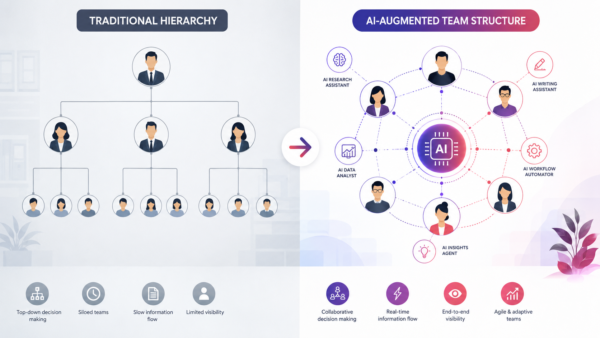
The Four Pillars of an AI-Driven Leadership Playbook
1. Vision That’s Specific, Not Aspirational
“We want to be an AI-first company.” Okay. That sentence means absolutely nothing to someone answering calls on the floor at 6 pm. What actually works, and I’ve watched this play out across BFSI and NBFC clients more than once now, is naming the exact friction point AI is supposed to remove. Cut loan processing from five days to same-day. Bring call handling time down by 40%. Not “significantly.” Not “meaningfully.” Forty percent, written down, argued about in the next review. Vague vision statements get quietly forgotten by the time the next quarter rolls around. Specific ones get fought over, and eventually, hit.
2. Talent Strategy Built Around Augmentation, Not Replacement
There’s a lazy narrative going around that AI leadership is basically code for headcount cuts. In practice, it’s the opposite, at least for the organizations getting real value out of this; they’re reskilling existing teams to supervise, audit, and fine-tune AI systems instead of handing out pink slips. A collections team in Pune doesn’t need to manually dial a thousand numbers a day anymore. What they need is the judgment to read an escalation flag coming out of a voice AI system and know, quickly, when to step in themselves.
This part of the job is uncomfortable. It’s also not optional.
- Say plainly which roles are shifting from “doing” the work to reviewing it
- Fund reskilling before the rollout, not six months in, once teams are already frustrated and half-trusting the system
- Set timelines that match reality; six months running old and new systems side by side is normal, not a red flag
- Reward the managers who transition their teams well. Not just the ones who hit an adoption number on some dashboard nobody outside IT looks at
3. Governance That Doesn’t Strangle Speed
A lot of Indian enterprises trip up right here. Between RBI guidelines for BFSI players, the DPDP Act’s data localization and consent rules, and whatever internal risk committee exists to add another layer of caution, governance can turn into the thing that kills momentum before it ever gets going. Good AI leadership builds governance alongside deployment. Not as a gate sitting further down the road, waiting to block everything that got built without it.
In practice, that tends to mean:
- A cross-functional AI review board: legal, compliance, tech, business, same-room meeting weekly, not once a quarter
- Clear escalation paths for the edge cases an AI system genuinely can’t resolve alone
- Documented audit trails for every automated decision that touches a customer directly. Loan approval. Insurance claim. Credit line. Regulators ask, eventually. They always do.
- Pre-approved use-case templates so nobody’s reinventing the compliance wheel for every single new deployment
Some organizations just hand this whole problem to outside Digital Strategy Consulting firms and call it solved. Results there are, honestly, mixed at best. The frameworks that come back often look sharp on paper but were never stress-tested against how a team actually operates on a Tuesday morning with three fires already going. What holds up under real pressure tends to be co-built with the people who’ll actually live inside it, not handed down from a slide deck.
4. Culture That Treats Failure as Data
AI systems get things wrong. Especially early on, and especially in ways nobody fully predicted in the pilot. A voice AI agent might mishear a strong regional accent. A recommendation engine might surface something completely off-base for what the customer actually wanted. Leaders who punish these early stumbles out loud, in front of a team, in a review meeting they end up teaching people to hide problems instead of flagging them. Leaders who treat mistakes as expected data, logged and reviewed and fixed, build organizations that get better faster than the competitor still arguing about the same unresolved error every single quarter.
What This Actually Looks Like
Take a mid-sized NBFC I’ve followed for a while now. They rolled out a conversational AI system for loan collections, across six languages, roughly a year back. Day one was not smooth. It never is, not for something this ambitious. What actually made the rollout work wasn’t the technology; it was leadership setting a 90-day tolerance window up front, publishing weekly error logs where anyone could see them, and rewarding the ops team for flagging failure patterns instead of sweeping them under the rug. By month four, resolution rates had climbed past the old manual baseline. That gap, between the messy rollout and the eventual payoff, is exactly where most leadership playbooks quietly fall apart. The ones that make it through are built for the messy middle, not the clean pilot demo shown off at the town hall.
Common Mistakes Leaders Make
- Treating AI as an IT initiative rather than a business transformation that operations leadership actually owns end to end
- Underinvesting in change management; adoption curves are steep, and nobody warned middle managers how rough the transition would actually feel
- Chasing every new model release instead of just committing to one stable architecture for a year, minimum
- Ignoring multilingual and regional realities; a playbook built for a Bengaluru headquarters doesn’t automatically work in a branch office in Lucknow, not without translation and then some
- Measuring success by adoption rate alone, without ever checking whether the experience got better for the customer, or the employee, on the other end of it
Measuring What Actually Matters
Most dashboards built around AI rollouts are tracking the wrong things. Adoption percentage. Ticket volume. Uptime. All operational. All telling you the system is running; none of it tells you whether it’s actually working the way it’s supposed to.
A sharper leadership scorecard looks more like this:
- Time-to-resolution shift: How much faster is the real outcome for the customer, not just the automated middle step
- Error correction speed: How fast does a flagged mistake get fixed and folded back in, instead of sitting in some backlog for three weeks
- Employee confidence: Do frontline teams trust the AI’s recommendations enough to actually act on them, or are they quietly working around the system when nobody’s watching
- Escalation quality: When the AI hands a case to a human, is that handoff clean, or does the human basically start over from zero anyway
None of this shows up on a standard product analytics dashboard. It takes leadership actually asking, in a review meeting, something beyond “is it live yet.” That’s a habit, more than a report. And it’s usually the difference between a rollout that plateaus right after the pilot and one that keeps quietly getting better a year in.
Building the Muscle, Not Just the Plan
A leadership playbook for AI-driven organizations isn’t a document you write once and file away somewhere nobody opens again. It’s closer to a muscle. One that gets stronger through repeated, deliberate use across quarters, not a single strategy offsite with decent catering and a nice view. The leaders who actually get this right treat every AI deployment as a small experiment in how their organization learns and holds itself accountable when things go wrong, which they will. That’s a harder job than signing off on a vendor contract. It’s also the only version of AI leadership that genuinely compounds, instead of resetting every time a new tool shows up promising to change everything again.