
The World Economic Forum expects data entry clerk roles to fall 34% by 2030, one of the steepest declines in its survey of more than a thousand global employers. The figure is accurate, but the conclusion many people draw from it misses what is actually happening. The volume of manual data entry is declining. The need for human judgment is not.
Consider what happens when an automated document pipeline goes live. A system processes 100,000 invoices and clears 92,000 without human intervention. The remaining 8,000 go into a review queue because something is unclear, damaged, contradictory, or unfamiliar. A person has to resolve those cases when the system cannot make a confident decision. Once approved, the answer can go straight into a payment run. There may be no second person checking it.
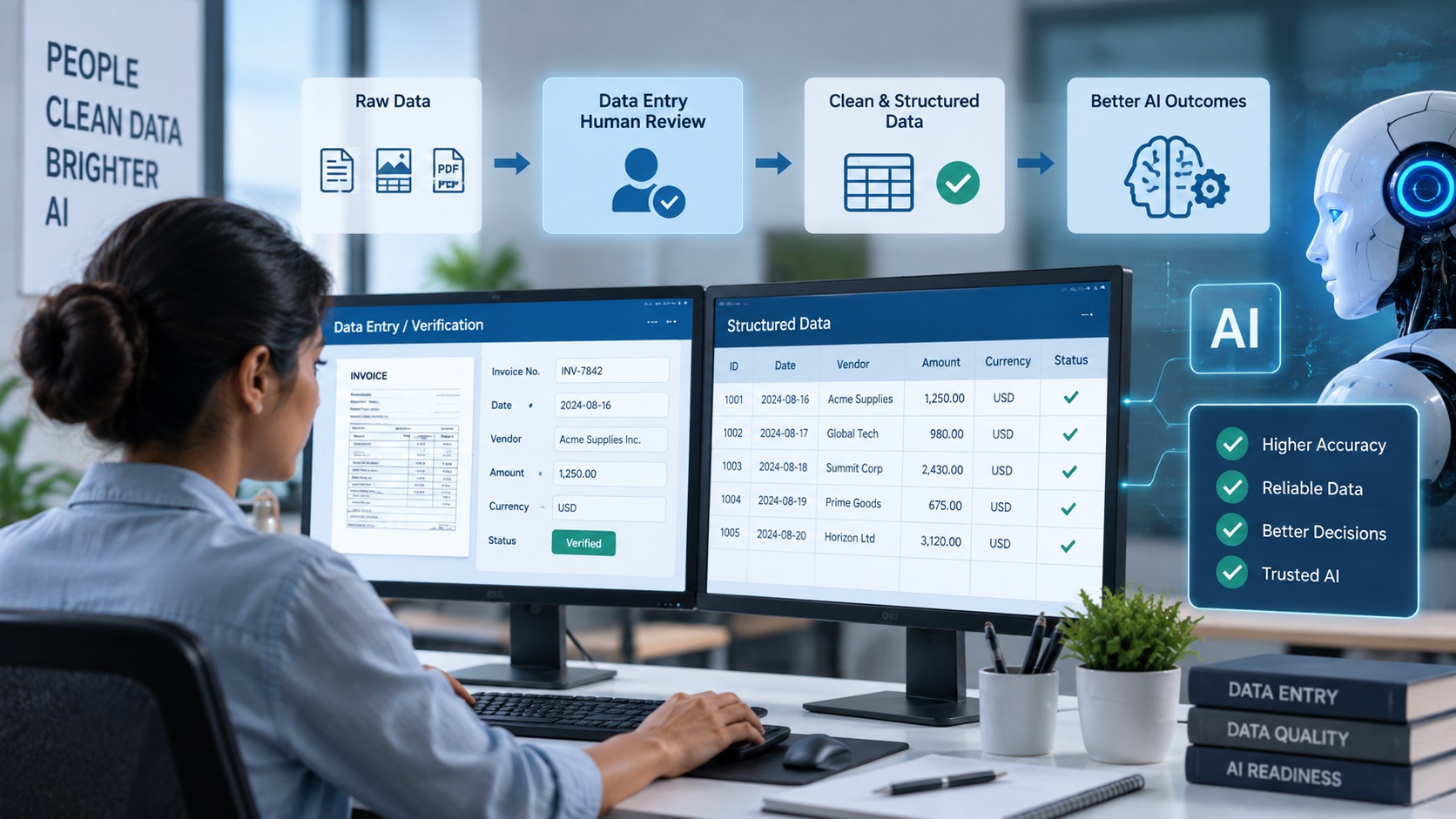
That is no longer simple clerical work. It is a quality control function within an automated process.
Automation Took the Easy Half
Manual data entry once covered the entire process. Much of that work was routine. Documents had clean scans, familiar layouts, known vendors, and values that appeared where the system expected them. Optical character recognition and document models have taken over much of this work, and the economics continue to favor automation. Stanford’s AI Index recorded inference costs falling 280-fold in under three years. Processing a routine record is becoming extremely inexpensive.
What automation has not made cheaper is deciding what an ambiguous record actually means.
The cases left behind tend to have the same kinds of problems. A handwritten note may override a printed total. A vendor may submit an invoice in a layout the system has never seen. Two identifiers in the same document may point to different entities. A checkbox may contradict information entered in a free-text field.
Resolving these cases requires more than reading the document. Someone has to know which information takes priority and why. That decision comes from policy, context, and domain knowledge, not from the pixels on the page.
Automation also changes how reviewers gain experience. When people handled routine records alongside difficult ones, they gradually learned the patterns and quirks of different document types. A new reviewer might process hundreds of ordinary invoices before encountering an unusual case. That natural training ground largely disappears when automation handles the routine work.
Training therefore has to replace what experience once provided.
The review queue has changed as a result. Instead of spending most of the day checking straightforward records, reviewers now see cases the system could not resolve on its own. The number of records may be smaller, but each case requires more judgment. The cost of getting one wrong is also higher because there may be no second review before the decision moves downstream.
Error Interception Is the Output
Many contracts still measure data entry work through throughput. They look at records processed per hour, cost per thousand records, or accuracy against a keying standard. Those measures made sense when the main task was transcription and the main risk was a typing mistake.
The risk is different now.
An exception handler who accepts a plausible but incorrect value has not simply made a data entry error. They have allowed a defect to enter a ledger, affect a claim decision, or influence a shipment. Speed alone cannot show whether that happened.
Four measures better reflect how the work operates today:
- Error interception rate: The share of genuinely defective records that a reviewer catches. This should be measured using a seeded control set rather than relying only on self-reported accuracy.
- False escalation rate: How often clean records are sent to a higher review tier. A high rate may indicate that reviewers are being overly cautious, which adds unnecessary cost and slows the process.
- Resolution consistency: Whether different reviewers reach the same decision when faced with the same ambiguous case. Consistency matters because inconsistent decisions can create unreliable downstream data.
- Correction yield: How many resolved exceptions become useful training examples that improve automated confidence on later batches.
Seeded controls are especially important. Known-bad records can be added to the live queue at a low rate, allowing teams to see how often reviewers identify them. A self-reported quality score tells you whether a process was followed. A seeded control set tells you whether reviewers actually detected the problem.
That detection is the value of the function.
Why Data Entry Services Sit Inside the Model Loop
Every exception resolved by a person represents a real example of something the automation struggled to understand. These cases can become valuable training data because they show exactly where the system needs to improve.
Yet many operations do not capture that information.
A reviewer enters the correct value, the record moves forward, and the reason for the correction disappears. Months later, the same vendor may submit another invoice in the same unfamiliar format. The system fails in the same way because nobody recorded what went wrong the first time.
Closing this loop requires a few deliberate steps. The corrected value should be stored with a reason code that explains the type of failure. The original machine output should remain available alongside the human correction, so the difference can be measured. Those examples should then feed into retraining or rule updates on a defined schedule.
The same information can also improve confidence thresholds.
Teams often set confidence cutoffs during implementation and rarely revisit them. At that point, they may not have enough information about how the system performs in real operating conditions. Once reviewer decisions are captured, those thresholds can be adjusted based on actual evidence.
If reviewers rarely overturn a particular field, the system may be sending too many cases for review. If reviewers frequently overturn it, the system may be allowing poor results to pass without enough scrutiny. Neither problem can be addressed properly unless the organization knows what reviewers are changing.
Reason codes are another important part of the process. A label such as “corrected” provides very little information. Codes such as “layout unseen,” “handwriting illegible,” “conflicting identifiers,” or “policy exception” tell engineering teams what kind of problem needs to be addressed. They also take very little time for a reviewer to assign.
This changes the role of a data entry service provider.
The output is not simply a correctly populated field. It is the corrected field and the information explaining why the machine got it wrong. That diagnosis gives the automation a chance to improve.
The Oversight Requirement Nobody Budgeted
In regulated processes, this approach is more than a useful operating practice. It can also be part of the oversight requirement.
The European Union’s Artificial Intelligence Act requires effective human oversight for high-risk AI systems. That includes giving people the ability to understand an output, disregard it, and intervene when necessary. Areas such as credit decisions, employment screening, insurance claims, and access to essential services can fall within this framework.
That requirement affects how an exception queue should be designed.
- Reviewers need enough information to challenge the system. A screen that shows only the extracted value makes it easy to approve an incorrect result. Reviewers should be able to see the source document, the confidence score, and the rule or condition that caused the case to be flagged.
- Overrides need a recorded reason. If an automated decision is reversed, an audit should be able to establish why. That explanation needs to exist in the system rather than depend on someone’s memory.
- Reviewers need the authority and knowledge to act. Human oversight is ineffective if the reviewer cannot stop a process or lacks the domain knowledge needed to identify an incorrect answer.
- Work targets must leave enough time for review. If reviewers are given unrealistic case quotas, genuine oversight becomes impossible. A policy requiring human review does not mean much if the operating model does not give reviewers enough time to perform it properly.
Other regulations and industry requirements may also apply. Health data, for example, brings HIPAA requirements around access controls and audit trails. Payment card information comes with its own standards. A data entry company working with these types of processes needs appropriate access segregation, retention limits, and record-level activity logs.
These are increasingly basic requirements, not optional extras.
Buying the Function Rather Than the Headcount
Organizations that outsource data entry services often begin with a cost comparison. The problem is that the comparison can focus on the wrong things. If the request for proposal emphasizes throughput and price, it may overlook the judgment required to handle exceptions.
The questions should instead focus on how the provider manages that judgment:
- How are reviewers trained on the client’s decision rules, and how is that training updated when policies change?
- What happens when a reviewer cannot resolve a case, and how quickly can they get an answer?
- Are reason codes captured, and can the client access that information as data rather than only through a monthly report?
- How is agreement between reviewers measured, and what results has the provider achieved on similar work?
- How much experience do reviewers have with comparable processes and domains?
Domain knowledge can matter more than scale. A reviewer who has worked with freight documentation for two years may recognize a bill of lading discrepancy almost immediately. A generalist may enter the information correctly but fail to notice the discrepancy. Both records can pass a basic validation check, but only one reviewer has prevented a potential claim.
Volume commitments can also create problems.
Exception queues are rarely steady. A wave of vendor onboarding, a regulatory form change, or a scanner replacement can suddenly produce a large number of unfamiliar cases. A contract based on guaranteed monthly volume may encourage providers to keep reviewers busy when demand is low and rush through cases when demand spikes.
That is the opposite of what an exception-handling process needs.
Capacity commitments combined with a clear quality floor can work better than volume commitments tied to speed targets.
Reviewer retention matters for the same reason. In a transcription operation, high turnover mainly creates additional training costs. In an exception-handling operation, turnover also removes accumulated judgment and domain familiarity. That loss can appear as declining consistency months before anyone connects it to staff turnover.
Give the Role Its Real Name
The uncomfortable part of the WEF projection is that it accurately describes the old version of the job. Transcription is declining. But the work that has replaced much of it inside automated pipelines has not been given a new name.
As a result, it continues to carry the old metrics, job expectations, and budget assumptions.
That mismatch has real consequences. Organizations may staff exception queues at clerical rates, measure reviewers by speed, and discard the corrections they make. They then wonder why automated accuracy stops improving or why audit issues continue to appear.
The people handling these exceptions are often the last control before an automated decision becomes a customer’s problem.
Modern data entry services increasingly serve as the quality layer within automated pipelines. Measuring this work by keystrokes or records processed misses the part that matters most.
Experienced providers structure document exception handling around error interception, reason-coded corrections, and oversight that can stand up to an audit.
There is a simple question organizations can ask about their own exception queues: when a reviewer resolves a difficult case, where does that answer go?
If the answer is nowhere, the process is losing valuable information. The automation cannot learn from the correction; the same problem is likely to return, and the exception queue may look much the same next year.