
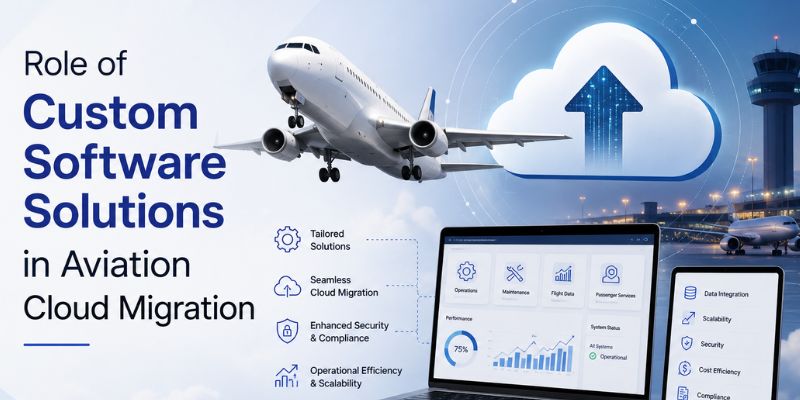
The aviation industry is undergoing a massive digital transformation. As airlines, airports, aircraft maintenance providers, and aviation service companies generate increasing volumes of operational and customer data, traditional IT infrastructures are struggling to keep pace with modern business requirements.
This is where custom software solutions play a crucial role. By addressing the unique operational, security, compliance, and integration challenges of aviation enterprises, custom software helps organizations migrate to the cloud smoothly while maximizing the benefits of cloud technologies.
In this article, we explore the role of custom software solutions in aviation cloud migration and how they help aviation businesses achieve long-term digital transformation success.
Understanding Cloud Migration in Aviation
Cloud migration refers to the process of moving applications, databases, workloads, and IT resources from traditional on-premise infrastructure to cloud-based environments.
For aviation organizations, cloud migration may involve transferring:
- Flight operations systems
- Passenger service platforms
- Reservation and ticketing systems
- Aircraft maintenance applications
- Airport management systems
- Cargo tracking platforms
- Crew management solutions
- Operational analytics platforms
The goal is not merely to change infrastructure but to create a more agile, scalable, and data-driven ecosystem that supports future growth and innovation. To achieve this successfully, many organizations collaborate with an aviation software solutions company that understands the industry’s unique operational requirements and can develop customized migration strategies.
However, aviation environments are unique. Systems often operate continuously and must remain available at all times.
Why Standard Migration Approaches Often Fall Short?
Many generic migration frameworks are designed for traditional enterprises with relatively straightforward IT environments. Aviation organizations, on the other hand, operate within a highly interconnected ecosystem involving airlines, airports, government authorities, maintenance providers, and third-party vendors.
Several challenges make cloud migration more complex in aviation:
1. Legacy System Dependencies
Many aviation organizations still rely on decades-old software systems that perform critical operational functions. These systems may lack compatibility with modern cloud architectures.
2. Strict Regulatory Compliance
Aviation companies must comply with industry regulations regarding safety, data security, operational continuity, and passenger information management.
3. Complex Data Integration
Multiple systems exchange data continuously across different departments and stakeholders. Maintaining data consistency during migration is essential.
4. High Availability Requirements
Operational downtime can result in significant financial losses and service disruptions. Migration strategies must prioritize business continuity.
Because of these challenges, organizations increasingly turn to custom software solutions to bridge the gap between legacy infrastructure and modern cloud platforms while carefully evaluating factors such as aviation software development cost to ensure long-term scalability and operational efficiency.
Importance of Custom Software Solutions
Custom software solutions are specifically designed to meet the operational requirements of individual organizations. Unlike off-the-shelf products, they provide flexibility, adaptability, and scalability tailored to unique business processes.
In aviation cloud migration projects, custom software serves as a critical enabler by helping organizations modernize infrastructure without disrupting core operations.
[A] Seamless Legacy System Modernization
One of the biggest obstacles to cloud migration is dealing with legacy systems that cannot be moved directly to cloud environments.
Custom software solutions help organizations:
- Analyze legacy applications
- Rebuild outdated functionalities
- Modernize software architecture
- Create cloud-compatible interfaces
- Minimize operational disruptions
Instead of replacing mission-critical systems entirely, businesses can gradually modernize them through customized migration frameworks.
[B] Facilitating Secure Data Migration
Aviation organizations manage enormous amounts of sensitive information, including:
- Passenger records
- Flight schedules
- Operational data
- Maintenance logs
- Employee information
Any compromise during migration can lead to security vulnerabilities and compliance risks.
[C] Enhancing System Integration Across Aviation Ecosystems
The aviation industry depends on interconnected systems that exchange information in real time.
Examples include:
- Reservation systems
- Airport management platforms
- Aircraft maintenance software
- Flight planning tools
- Baggage tracking systems
- Customer service applications
Cloud migration becomes challenging when these systems operate on different technologies and communication protocols.
[D] Supporting Regulatory Compliance and Security Requirements
Security and compliance are among the most critical considerations in aviation technology initiatives.
Aviation organizations must adhere to numerous regulations involving:
- Data protection
- Passenger privacy
- Operational safety
- Cybersecurity standards
- International aviation requirements
Cloud migration projects must account for these obligations from the beginning.
[E] Improving Operational Efficiency Through Automation
Cloud migration offers opportunities to automate many operational processes that previously required manual intervention.
Custom software solutions can automate:
- Data synchronization
- System monitoring
- Resource allocation
- Maintenance scheduling
- Operational reporting
Automation reduces administrative workloads while improving consistency and accuracy.
For aviation organizations handling large-scale operations, these efficiencies contribute significantly to cost savings and operational performance improvements.
[F] Enabling Scalable Infrastructure for Future Growth
The aviation industry experiences fluctuating demand patterns influenced by travel seasons, market conditions, and global events.
Traditional infrastructure often struggles to accommodate sudden increases in workload.
Cloud environments provide scalability, but organizations need software architectures capable of leveraging these capabilities effectively.
Custom software solutions help businesses:
- Scale applications dynamically
- Optimize cloud resource utilization
- Manage growing data volumes
- Support expanding customer bases
This flexibility enables aviation companies to respond quickly to changing business requirements.
[G] Leveraging Advanced Analytics and Artificial Intelligence
Modern aviation organizations increasingly rely on data-driven decision-making.
Cloud migration provides access to advanced technologies such as:
- Artificial intelligence
- Machine learning
- Predictive analytics
- Real-time monitoring
- Big data processing
Custom software solutions help integrate these technologies into operational workflows.
[H] Strengthening Disaster Recovery and Business Continuity
Business continuity is essential in aviation.
Unexpected outages can affect:
- Flight schedules
- Passenger services
- Operational communications
- Airport activities
Cloud environments provide robust disaster recovery capabilities, but organizations require tailored strategies to ensure effectiveness.
Custom software solutions support:
- Automated backups
- Failover mechanisms
- Recovery workflows
- Real-time monitoring
- Incident response management
These capabilities improve resilience while minimizing operational disruptions.
[I] Reducing Long-Term Operational Costs
Although cloud migration requires initial investment, it can generate substantial long-term savings.
Custom software solutions help optimize cloud usage by:
- Eliminating redundant resources
- Automating processes
- Improving system performance
- Enhancing resource allocation
This results in:
- Lower infrastructure expenses
- Reduced maintenance costs
- Increased operational efficiency
- Better return on investment
By aligning cloud environments with specific business requirements, organizations avoid unnecessary expenditures associated with generic solutions.
Future Trends Shaping Aviation Cloud Migration
As aviation technology continues to evolve, several emerging trends are influencing cloud migration strategies.
These include:
► Hybrid and Multi-Cloud Architectures
Organizations are increasingly distributing workloads across multiple cloud providers to improve flexibility and resilience.
►AI-Driven Operations
Artificial intelligence will play a larger role in flight operations, maintenance management, and customer service.
► Digital Twins
Cloud-powered digital twin technology will enable real-time simulation and monitoring of aircraft and airport operations.
► Edge Computing
Processing data closer to operational environments will improve responsiveness and reduce latency.
Custom software solutions will remain essential for integrating these innovations into aviation ecosystems effectively.
Conclusion
Cloud migration has become a strategic priority for aviation organizations seeking greater agility, scalability, and operational efficiency. However, the complexity of aviation environments requires more than standard migration approaches.
Custom software solutions play a pivotal role in ensuring successful cloud adoption by addressing legacy system modernization, data security, regulatory compliance, system integration, automation, and scalability challenges.
They enable organizations to migrate critical workloads safely while maintaining operational continuity and preparing for future technological advancements.
As the aviation industry continues its digital transformation journey, businesses that invest in tailored software solutions will be better positioned to maximize the benefits of cloud technology, improve operational performance, and deliver superior experiences to passengers and stakeholders alike.