
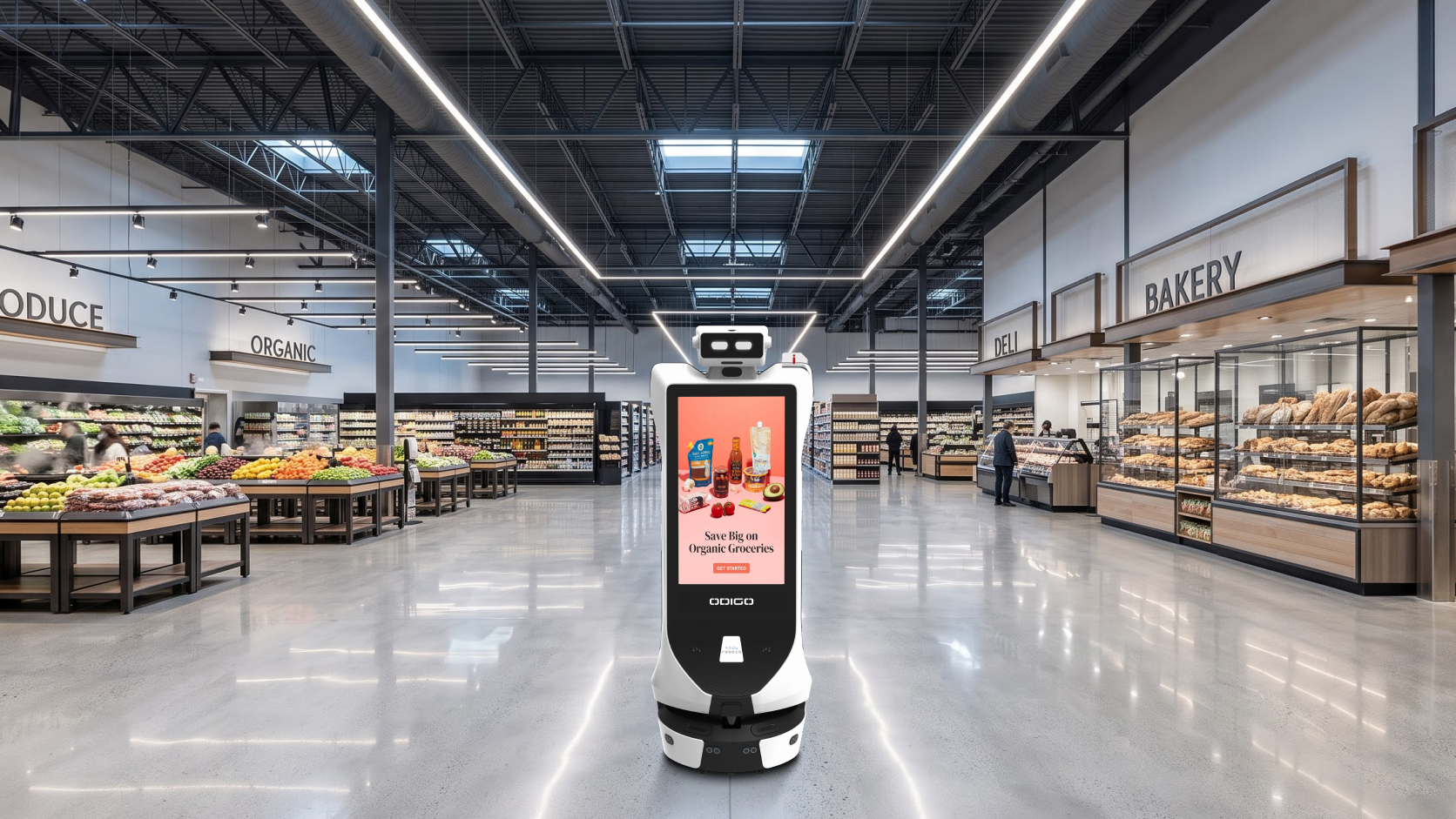
Shoppers expect physical stores to be easier to navigate, faster to understand, and more responsive when they need help. A customer may enter a supermarket knowing exactly what they want but still spend time searching for the correct aisle. Another shopper may notice a promotion but have no idea where the featured product is located.
A robot assistant can help reduce this friction.
Instead of replacing store employees, customer-facing robotics can support routine interactions such as product discovery, wayfinding, promotional engagement, information access, and human handoff.
ODIGO from Kody Robots is positioned around this customer-facing opportunity. It brings mobility, digital interaction, shopper assistance, and advertising into one connected service experience.
The future of shopper assistance is therefore not about removing people from stores. It is about giving shoppers additional ways to get help while employees remain focused on situations that require experience, judgment, and personal service.
What Is a Robot Assistant in Retail?
A robot assistant is a customer-facing service robot designed to help people complete defined tasks inside a physical environment.
In retail, those tasks can include finding products or departments, accessing store information, navigating to destinations, discovering promotions, or requesting help from employees.
The category sits between static digital tools and traditional human service.
A kiosk can provide information from one location. A store employee can deliver flexible and personal assistance. A mobile robot assistant adds structured digital support across approved areas of the store.
An AI Robot Assistant can add another layer by using AI-supported interactions to understand requests and guide shoppers toward an appropriate next action.
A robotic assistant works best as a support system. Routine interactions can be handled through technology while people remain responsible for exceptions, recommendations, complaints, and situations requiring judgment.
Why Is Shopper Assistance Ready for a New Model?
Retail spaces are becoming increasingly complex.
Large stores can contain thousands of products, multiple departments, seasonal areas, promotions, service counters, and changing layouts.
At the same time, shoppers have become accustomed to digital convenience. They expect information quickly and want physical shopping to feel easier.
They want to know:
Where can I find this product?
Which department should I visit?
How do I get there?
What promotions are available?
Where can I find someone who can help?
A robot assistant creates another way to answer these questions.
The objective is not to force every customer to use robotics. The stronger model provides multiple service channels and allows shoppers to use the one that suits the situation.
What Are the Main Robot Assistant Functions?
The most valuable robot assistant functions are closely connected to real shopper needs.
Product and Destination Discovery
A customer may know exactly what they need but not where it is located.
A robot assistant can provide an interactive point for product or destination discovery. Once the shopper identifies what they are looking for, the system can support the next part of the journey.
That next step might be location information, guidance, promotional content, or human support.
This reduces the need for shoppers to walk through several aisles simply to find the right starting point.
Wayfinding
Directions are helpful. Guided navigation can make them more useful.
A mobile system can support shoppers moving through approved mapped areas instead of requiring them to remember directions from a fixed directory.
The customer journey can follow a simple sequence:
Search → Select Destination → Navigate → Arrive
This becomes particularly useful in supermarkets, big retail stores, shopping malls, exhibitions, and other large physical environments.
Store Information
Employees frequently receive repeat questions about locations, services, promotions, or basic store information.
A robot assistant can support approved and configured information through an interactive interface.
The technology should still recognize its limits. If reliable information is unavailable or the question requires judgment, the interaction should move toward a person.
Promotional Engagement
Advertising and assistance often meet during the same shopping journey.
A customer may notice an offer and immediately want to know where the featured product is located.
This creates an opportunity to connect promotion with action.
Instead of ending with exposure, a promotional interaction can lead toward additional information, product discovery, navigation, or employee assistance.
Human Handoff
Human handoff is one of the most important robot assistant functions.
Some requests are structured and predictable.
Others are not.
Product recommendations, complaints, exceptions, accessibility requests, safety concerns, and complex service questions still require people.
The strongest model is simple:
Technology handles structured repetition. People handle judgment, trust, and exceptions.
How Does ODIGO Change the Shopper Journey?
ODIGO brings several related customer-facing interactions into one mobile experience.
Instead of requiring a shopper to find one screen for information, another system for navigation, and an employee for additional assistance, ODIGO can support a connected journey.
That journey may look like:
Question → Information → Wayfinding → Engagement → Human Assistance
This is an important distinction.
ODIGO does not need to perform every type of retail automation to provide value. Its role is stronger when it remains focused on the shopper-facing experience.
Kody Robots can therefore position ODIGO around the moments where shoppers need information, directions, engagement, or access to staff.
Why Does Mobility Matter for Shopper Assistance?
Mobility separates a mobile robot assistant from a static kiosk.
A kiosk waits for shoppers to find it.
A mobile system can operate within approved areas where customer questions and interactions naturally occur.
Consider a large supermarket.
A customer may start near the entrance, walk into a grocery aisle, notice an offer, search for another category, and later need help reaching a service counter.
The customer journey keeps moving.
A mobile assistance platform can remain relevant across more of that journey.
Mobility is not valuable simply because a machine can move. It becomes valuable when movement allows assistance to appear at more useful customer touchpoints.
ODIGO as an Interactive Advertising Robot
ODIGO can also be positioned as an interactive advertising robot for customer-facing retail environments.
Static digital signage remains useful for entrances, service areas, checkout zones, and other fixed locations.
Mobile advertising creates another option.
Promotional content can move through selected zones instead of remaining tied to a single sightline. Depending on the campaign strategy, businesses can use different areas or times for different promotional experiences.
The biggest difference is the next action.
A shopper who notices an advertisement may want to explore the offer, scan a QR code, locate the related category, or request assistance.
An interactive advertising robot can connect the advertising message with those next steps.
This makes mobile advertising more closely connected to shopper assistance.
Static Kiosk, Single-Function Robot, or ODIGO?
Different technologies solve different customer problems.
| Option | Best suited for | Customer experience |
|---|---|---|
| Static kiosk | Fixed information and directories | Shopper goes to one location |
| Single-function customer robot | One defined service interaction | Focused on a narrow task |
| ODIGO | Assistance, wayfinding, engagement, advertising, and handoff | Connected mobile journey |
A static kiosk may be appropriate when one known information point is enough.
A single-function solution can work when the retailer needs one specific capability.
ODIGO becomes more relevant when several closely related customer-facing interactions need to work together.
What Are the Main Robot Assistant Benefits?
The strongest robot assistant benefits are not about replacing staff. They are about making common interactions easier.
Easier Product Discovery
Shoppers gain another way to access product or destination information without searching the store independently.
More Consistent Assistance
Configured information can be delivered consistently across repeated customer requests.
Better Use of Employee Time
Routine questions can be supported through technology while employees focus on requests requiring experience or judgment.
Assistance Across More Areas
A mobile robot assistant can support selected customer zones instead of remaining tied to one information desk.
Advertising With a Next Step
Promotional content can lead naturally into engagement, navigation, or human assistance.
More Measurable Interactions
Depending on the deployment, retailers can evaluate searches, navigation requests, campaign interactions, QR engagement, and staff handoffs.
These robot assistant benefits become more meaningful when the deployment starts with a clear shopper problem.
How Does AI Support Business Automation?
An AI robot assistant for business automation should not be understood as technology that independently controls every customer interaction.
Its role is more practical.
AI can support request understanding, information retrieval, interaction flow, and navigation decisions while the business retains control over the information, operating zones, content, and escalation process.
This creates a balanced automation model.
The system helps with repeatable interactions.
Employees remain responsible for complex service.
An AI robot assistant for business automation can therefore support consistency without removing the human layer that makes customer service trustworthy.
Where Can ODIGO Create Value?
Several practical robot assistant examples show where the model can fit.
Supermarkets
Customers may need product discovery, aisle guidance, promotional information, or employee assistance.
ODIGO can support these connected shopper interactions.
Retail Stores
A robot assistant can help customers find areas, access information, engage with campaigns, and request additional assistance.
Shopping Malls
Large spaces create frequent wayfinding needs. Visitors may need directions to stores, amenities, events, or service areas.
Exhibitions and Events
Visitors regularly ask where booths, halls, registration counters, facilities, or activities are located.
A mobile assistance point can support these repeat questions while staff focus on higher-value conversations.
Corporate and Public-Facing Spaces
Visitors may need destination information or basic reception guidance before connecting with the appropriate person.
Across these robot assistant examples, one principle remains consistent: robotics works best when it solves a clear and repeatable customer problem.
How Should Businesses Measure Success?
A robot assistant should be measured by what customers accomplish, not simply by how many people look at it.
Novelty can create interactions without necessarily improving service.
Businesses should instead ask:
Did shoppers find what they needed?
Did navigation reach the intended destination?
Was a routine question resolved?
Did a campaign produce a meaningful interaction?
Did the customer reach a staff member when necessary?
Relevant metrics can include successful searches, navigation requests, promotional engagement, QR scans, human handoffs, uptime, and customer feedback.
The measurement framework should always connect back to the original business objective.
Why Human Employees Remain Essential
The future of shopper assistance is hybrid.
A person asking where an aisle is has a structured request.
Someone asking which product best fits a specific need may require expertise.
A shopper raising a complaint needs empathy and judgment.
A customer dealing with an unexpected issue may need authority that software cannot provide.
That is why a robot assistant should support employees rather than compete with them.
The strongest retail experience combines the consistency of technology with the adaptability of people.
Why Kody Robots Is Focused on Shopper Assistance
Kody Robots is positioning ODIGO around a clearly defined customer-facing opportunity.
The aim is not to make one robot represent every category of retail automation.
ODIGO has a stronger role when focused on shopper assistance, navigation, promotional engagement, advertising, and human handoff.
For retailers, that creates a clearer business case.
The question becomes:
Can this platform make the shopper journey easier?
Kody Robots can be evaluated around how well ODIGO fits store layouts, mapped destinations, customer traffic, promotional strategies, information workflows, and employee handoff processes.
This gives Kody Robots a practical role in the future of customer-facing robotics.
Why Consider Kody Robots and ODIGO?
At the bottom of the funnel, businesses need to move from understanding the technology to evaluating a real deployment.
Kody Robots can be considered by retailers and other businesses looking for mobile customer-facing assistance.
Kody Robots positions ODIGO around a connected group of shopper needs: information access, product or destination discovery, navigation, advertising, engagement, and human support.
Businesses evaluating Kody Robots should test ODIGO inside their actual environment.
Can first-time customers understand the interaction?
Does the system fit naturally within visitor traffic?
Is store information maintained accurately?
Does the promotional experience add value?
Can an employee take over easily when needed?
For Kody Robots, success should be measured through a better customer journey rather than the novelty of having robotics in the venue.
What Does the Future of Shopper Assistance Look Like?
The future will not depend on one interface.
Some shoppers will use mobile apps.
Others will use signage or kiosks.
Some will immediately ask an employee.
Others may choose a robot assistant.
The strongest customer environments will give people several useful routes to assistance.
ODIGO fits into that future as a mobile digital touchpoint that can support people across different stages of the physical journey.
For Kody Robots, this makes robotics part of customer-experience strategy rather than a standalone attraction.
Frequently Asked Questions
What is a robot assistant?
A robot assistant is a customer-facing service robot that can support structured interactions such as information access, destination discovery, navigation, engagement, advertising, and human handoff.
Is ODIGO only an advertising robot?
No. ODIGO can be positioned around advertising together with shopper assistance, wayfinding, interactive engagement, and access to employees.
Can a robot assistant replace retail employees?
No. A robot assistant is better suited to structured and repeatable interactions. Employees remain essential for recommendations, complaints, judgment, safety, exceptions, and complex service.
Where can businesses use ODIGO?
ODIGO can be positioned for supermarkets, retail stores, shopping malls, exhibitions, corporate environments, and other customer-facing spaces where visitors need information, navigation, or engagement.
What should retailers measure?
Retailers can measure successful searches, navigation journeys, promotional interactions, QR engagement, staff handoffs, uptime, and customer feedback based on the deployment objective.
How is ODIGO different from a static kiosk?
A static kiosk remains in one location. ODIGO adds mobility, allowing customer assistance, navigation, advertising, and engagement to operate across selected mapped areas.
Conclusion
Shopper assistance is moving toward a more connected model.
A robot assistant can help customers find information, navigate physical spaces, engage with promotions, and reach employees when human expertise is required.
ODIGO gives Kody Robots a focused way to connect these interactions.
Its strongest role is not replacing people or attempting to automate every retail activity. The opportunity is simpler: reduce friction between a shopper’s question and the next useful action.
When robotics achieves that goal, it becomes part of the customer experience rather than simply another piece of technology on the floor.