
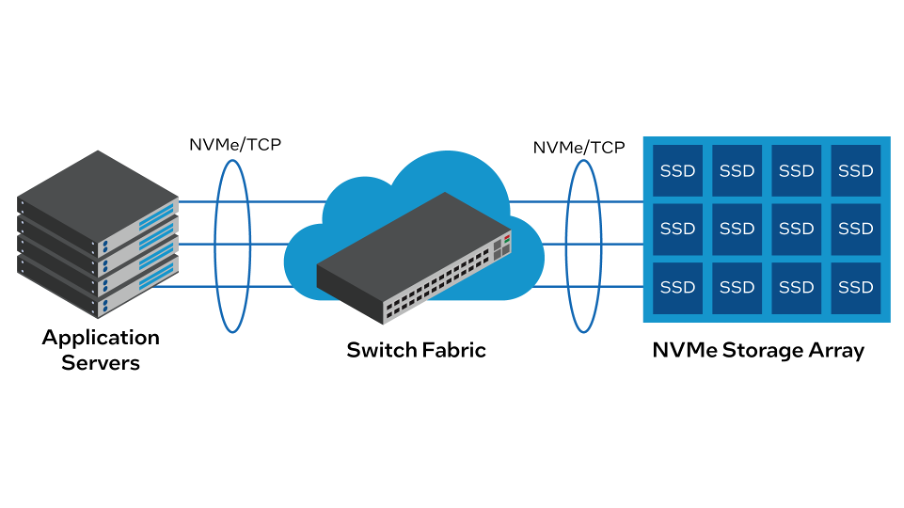
Modern IT infrastructure demands have intensified to the point where high-speed, efficient storage solutions remain essential. The three main drivers behind enterprise adoption of newer protocols include cloud-native applications, data-intensive workloads, and real-time analytics that extend traditional storage capabilities beyond their limits. The NVMe over TCP technology merges the speed performance of NVMe with the accessibility and standard IP networking functionality.
The article extensively analyses NVMe over TCP principles while examining its structural design elements, practical advantages, and rising adoption by modern data centers and business infrastructure deployments.
Understanding NVMe and Its Evolution
Non-volatile memory Express (NVMe) is a storage protocol engineered uniquely for performance-driven solid-state drives (SSDs). The protocol presents maximum performance by harnessing SSD capabilities since it operates differently from traditional protocols, SATA and SAS, which target spinning disk mechanisms. The system supports deep queue operations simultaneously, reducing data transfer delays and delivering faster data access across multiple queues.
Data centers’ migration from hard drives to SSDs created an urgent need for a protocol to maximize flash storage potential. NVMe emerged to provide applications with its optimized command set and expandable architecture for intensified performance requirements. Because NVMe was created to work with direct-attached storage (DAS), it faces limitations in applications that need networked storage environments. NVMe over Fabrics (NVMe-oF) was established due to this limitation, allowing NVMe benefits across multiple network transport options.
The Emergence of NVMe over TCP
NVMe over Fabrics (NVMe-oF) is a solution that enables NVMe commands to transmit data over network fabrics, delivering quick remote storage access. The first adaptation of NVMe-oF included RDMA over Converged Ethernet (RoCE) and Fibre Channel as specialized transport methods that demanded exclusive hardware and complicated configurations, thus creating barriers to mass adoption.
NVMe/TCP solves storage connectivity problems by integrating NVMe commands within TCP/IP protocol packets. NVMe functions across existing Ethernet networks by eliminating the requirement for specialized hardware and protocols. The NVMe/TCP network protocol uses standard TCP/IP messaging to link NVMe protocols with traditional IP network features, enabling numerous organizations to tap into fast storage solutions.

How NVMe over TCP Works
The NVMe over TCP system works by encapsulating NVMe commands into TCP packets, which enables NVMe host-to-storage device data exchange over standard IP networks. Multiple essential components compose the NVMe over TCP implementation process.
- NVMe Command Set: The NVMe Command Set remains intact as TCP segments transmit it to maintain functional and consistent storage operations.
- TCP Transport: The NVMe commands receive TCP packet wrapping, which enables their movement through the Ethernet network infrastructure without requiring any network changes. The encapsulation mechanism provides compatibility with present network systems and makes integration possible without difficulties.
- Queue Management: Multiple queues help the Queue Management system handle parallel I/O operations more efficiently.
The adaptive architecture lets businesses implement fast NVMe storage solutions across their present network framework, simplifying implementation and minimizing expenses.
Benefits of NVMe over TCP
The implementation of NVMe over TCP brings numerous positive benefits to contemporary IT infrastructures:
High Performance
NVMe/TCP delivers quick storage access alongside high throughput for standard network environments, thus providing an effective solution to modern data-intensive applications. NVMe operates efficiently along with TCP/IP networks to give organizations storage performance equivalent to direct-attached systems and infrastructure flexibility. Senders experience exceptional operating speed, particularly when they have time-sensitive applications like high-performance databases that need quick data retrieval, real-time analytics, and machine learning programs.
Cost-Effective Deployment
The main benefit of NVMe/TCP is that it enables operation through standard Ethernet networks without needing dedicated hardware systems. The deployment protocol enables affordable deployment operations and simplifies implementation, expanding storage performance accessibility to businesses regardless of size. Using standard networking equipment enables organizations to lower operational expenses for maintenance and support alongside upgrades while attaining adaptable high-speed storage.
Scalability and Flexibility
Seamless scalability defines NVMe/TCP from the ground up since it enables companies to add more storage resources without complexity. Companies can enhance their network’s storage capabilities through NVMe device additions without requiring extensive system recoding. The ability to handle changing workloads depends on this flexibility because IT infrastructure needs to adjust its operations automatically to meet developing requirements. The storage expansion through NVMe/TCP achieves seamless growth at lower costs and uninterrupted service.
Simplified Management
The operation of NVMe/TCP over standard TCP/IP networks lets IT teams simplify storage management and integration processes to manage their storage resources better. The familiar set of tools and standard protocols enables administrators to handle their infrastructure easily while bypassing the need for training in specific areas. Less complex management allows faster troubleshooting and operational efficiency and reduces administrative costs, creating a smooth and economical approach to high-performance storage management.
Implementing NVMe over TCP
The implementation of NVMe over TCP requires attention to various factors, both for peak operational performance and system reliability:
Network Infrastructure
Standard Ethernet networks remain suitable for NVMe/TCP operations; however, optimization of the network infrastructure might be needed to reach peak performance levels. The installation requires networks with adequate bandwidth, low latency, and minimal packet loss. Quality of service (QoS) policies and network segmentation are needed to manage high-speed storage access performance.
Storage Devices and Hosts
Every NVMe storage device needs identical compatibility standards for operation with host systems. Organizations must confirm that their hardware supports NVMe/TCP functionality with proper drivers and that the correct firmware has been installed. String updates and following industry standards both improve system compatibility and operational performance.
Security Considerations
Every networked storage solution requires secure protocols for protecting data while it travels through networks and rests permanently. Organizations protect their data from unauthorized access and breaches through encryption protocols, access controls, and periodic security assessments. It is best practice to combine current network security systems with storage security implementation within the central IT defensive framework.
Conclusion
NVMe over TCP adoption is at the initial stage of its implementation. The increasing vendor support for the protocol, alongside tool improvement, will likely make NVMe over TCP the default standard for enterprise storage networks. Organizations have gained access to fast NVMe performance without proprietary barriers using the established TCP/IP framework for scalability.
NVMe over TCP represents a core technology underpinning the next-generation development of IT infrastructure capabilities.