
Why Adaptive AI Architecture Matters Now
Enterprises are moving beyond static artificial intelligence systems. Traditional AI models, while effective at launch, often degrade over time as data patterns shift, customer behavior evolves, and market conditions change. This limitation has accelerated interest in Adaptive AI, an approach that enables AI systems to continuously learn, optimize, and respond to change without frequent manual intervention.
An adaptive AI architecture is not a single model or tool. It is a carefully designed ecosystem of data pipelines, learning mechanisms, feedback loops, governance layers, and deployment infrastructure that together allow AI systems to evolve in production. For enterprises, this architecture is increasingly becoming the foundation for long-term ROI from AI investments.
What Makes Adaptive AI Different from Traditional AI Systems
Traditional AI architectures follow a linear lifecycle: collect data, train a model, deploy, and retrain periodically. This approach works well in stable environments but struggles in real-world enterprise scenarios where data distribution changes constantly.
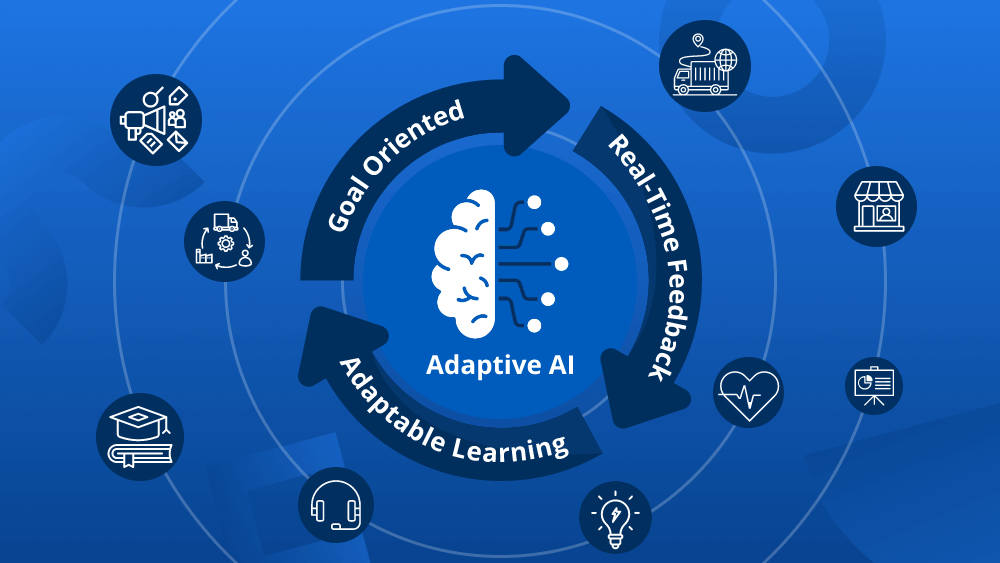
Adaptive AI architecture is designed for continuous intelligence. Models learn from new data streams, adjust decision logic in near real time, and improve outcomes through feedback. According to Gartner, by 2026, organizations using adaptive AI systems are expected to outperform competitors by more than 25% in operational efficiency due to faster decision cycles and improved accuracy.
This shift requires rethinking architecture at a fundamental level, starting with how data flows, how models learn, and how decisions are validated.
Data Ingestion and Real-Time Data Pipelines
At the core of any adaptive AI architecture is data. Unlike static AI systems that rely heavily on historical datasets, adaptive systems must process continuous, real-time data from multiple sources.
Enterprise-grade adaptive AI development architectures typically include streaming data pipelines that ingest structured and unstructured data from transactional systems, IoT devices, customer interactions, logs, and third-party platforms. These pipelines must support low latency, high throughput, and strong data quality controls.
Without reliable real-time data ingestion, adaptive AI systems lose their ability to respond to change. This is why enterprises increasingly invest in cloud-native data platforms and event-driven architectures as the backbone of adaptive AI.
Continuous Learning and Model Updating Mechanisms
One of the defining components of adaptive AI architecture is continuous learning. Instead of waiting for scheduled retraining cycles, adaptive models update themselves incrementally as new data becomes available.
This capability is enabled through techniques such as online learning, reinforcement learning, and incremental gradient updates. In enterprise use cases like fraud detection or demand forecasting, continuous learning can improve model accuracy by 10–30% compared to batch-trained models, according to multiple industry benchmarks.
In adaptive AI development, continuous learning must be carefully controlled. Enterprises design guardrails to ensure models learn from high-quality signals and avoid drift caused by noisy or biased data.
Feedback Loops for Self-Optimization
Adaptive AI systems improve because they can observe the outcomes of their own decisions. Feedback loops connect model predictions with real-world results, enabling systems to refine behavior over time.
For example, in customer engagement platforms, adaptive AI can analyze whether recommendations lead to conversions, churn reduction, or engagement. These outcomes feed back into the system, helping it optimize future decisions.
A well-designed feedback loop is not automatic by default. Enterprise architectures must explicitly define what constitutes success, how outcomes are measured, and how feedback is incorporated into learning pipelines. This layer is essential for making adaptive AI measurable and accountable.
Model Monitoring, Drift Detection, and Performance Analytics
Adaptive AI does not mean uncontrolled AI. As models evolve, enterprises must continuously monitor performance, bias, and reliability.
Model drift detection is a critical architectural component. Data drift occurs when input data changes, while concept drift happens when the relationship between data and outcomes evolves. Adaptive AI architectures include monitoring systems that detect these shifts early and trigger corrective actions.
Advanced monitoring frameworks track accuracy, confidence scores, fairness metrics, and latency in production. Enterprises that implement robust monitoring see significantly fewer AI failures and reduced operational risk, especially in regulated industries such as finance and healthcare.
MLOps and Automated Deployment Pipelines
Scalability is impossible without automation. Adaptive AI architectures rely heavily on MLOps practices to manage model versioning, testing, deployment, and rollback.
Automated pipelines allow enterprises to deploy updated models safely and consistently across environments. This reduces human error and ensures that improvements from continuous learning reach production quickly.
In adaptive AI development, MLOps is not optional. It is the operational layer that enables adaptive systems to function reliably at enterprise scale, often supporting hundreds of models across multiple business units.
Decision Intelligence and Human-in-the-Loop Controls
While adaptive AI systems are increasingly autonomous, enterprises still require human oversight. Decision intelligence layers help translate model outputs into business actions while maintaining transparency and control.
Human-in-the-loop mechanisms allow experts to review high-risk decisions, correct errors, and provide feedback that improves future learning. This is especially important in domains like credit scoring, healthcare diagnostics, and compliance-sensitive workflows.
Adaptive AI architectures that balance automation with human judgment tend to achieve higher trust, faster adoption, and better long-term outcomes.
Security, Governance, and Compliance Layer
As adaptive AI systems continuously evolve, governance becomes more complex. Enterprises must ensure that learning processes comply with internal policies, regulatory requirements, and ethical standards.
Security controls protect data pipelines, models, and APIs from unauthorized access. Governance frameworks define who can modify models, approve deployments, and audit decisions. Compliance mechanisms ensure alignment with regulations such as GDPR, HIPAA, and industry-specific standards.
In mature adaptive AI development programs, governance is embedded into the architecture rather than treated as an afterthought.
Scalable Infrastructure and Cloud-Native Foundations
Adaptive AI architectures require elastic infrastructure capable of scaling with data volume and computational demand. Cloud-native environments, containerization, and distributed computing frameworks are commonly used to support this scalability.
Enterprises increasingly adopt hybrid or multi-cloud strategies to balance performance, cost, and regulatory constraints. Scalable infrastructure ensures that adaptive AI systems remain responsive even during demand spikes or data surges.
This infrastructure flexibility directly impacts ROI, enabling enterprises to expand adaptive AI use cases without rebuilding core systems.
Measuring Business Impact and ROI
An adaptive AI architecture is only successful if it delivers measurable business value. Enterprises track ROI through improved decision accuracy, reduced operational costs, faster response times, and enhanced customer experiences.
Organizations implementing adaptive AI development effectively report improvements such as reduced fraud losses, higher conversion rates, optimized inventory levels, and better forecasting accuracy. These gains compound over time as models continue to learn and optimize.
The architecture itself becomes a strategic asset, supporting continuous innovation rather than one-time AI deployments.
Conclusion: Building Adaptive AI for Long-Term Enterprise Advantage
Adaptive AI is redefining how enterprises use artificial intelligence. By moving from static models to continuously learning systems, organizations gain resilience, agility, and sustained performance improvements.
A robust adaptive AI architecture integrates real-time data pipelines, continuous learning, feedback loops, monitoring, MLOps, governance, and scalable infrastructure into a unified system. Adaptive AI development is not just a technical upgrade; it is a strategic transformation that enables enterprises to respond to change faster than competitors.
For organizations investing in AI today, building an adaptive architecture is the key to turning innovation into long-term business value.