
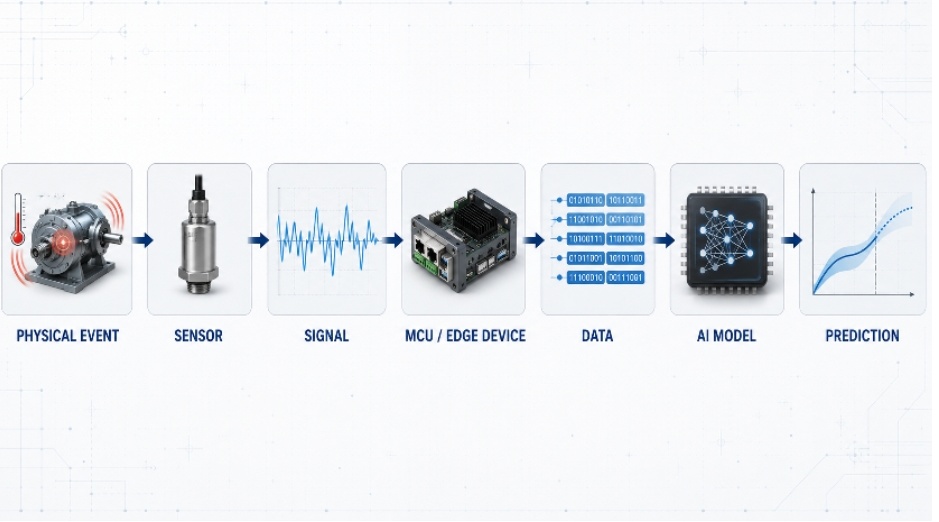
AI models depend on data, and sensor-based AI depends on measurements from the physical world. Before information reaches a cloud platform, data pipeline, or machine-learning model, a sensor must first capture a real event. Its mounting, openings, protection, and surrounding hardware can all influence this process. For selected thin metal parts around sensing systems, chemical etching provides a manufacturing option for creating precise apertures, screens, shims, contacts, and other detailed components.
Good data science therefore starts before the dataset exists.
How Sensor Data Reaches an AI Model
An IoT system usually begins with a physical condition.
It may measure:
- Temperature.
- Pressure.
- Vibration.
- Light.
- Humidity.
- Motion.
- Sound.
- Electrical current.
The sensor converts that condition into an electrical signal.
A microcontroller or edge device then processes the signal before sending data to a local system or cloud platform.
The complete chain may look like:
Physical Event → Sensor → Signal Processing → Edge Device → Data Pipeline → AI Model → Prediction
Every stage can affect the final result.
Data scientists often focus on the later stages, but errors can begin much earlier.
Data Quality Starts Before the Dataset
Machine-learning projects commonly deal with missing values, outliers, noise, labeling errors, and inconsistent sampling.
In IoT systems, however, some problems may begin at the sensor itself.
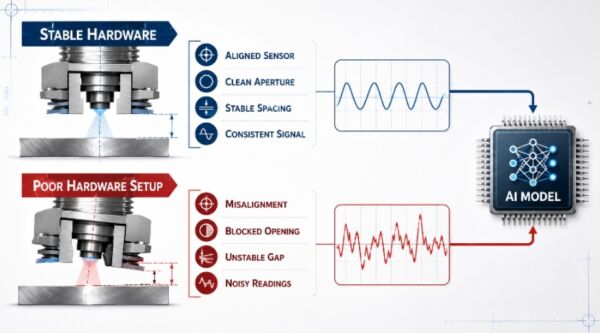
A sensor may be mounted at the wrong angle. An environmental opening may become blocked. Mechanical vibration may change its position. Airflow around a sensing element may be inconsistent.
These physical conditions can affect the signal before software begins cleaning or analyzing the data.
This does not mean hardware is responsible for every data-quality problem.
Calibration, electronics, sampling rate, communication, preprocessing, and model design are also important.
The key point is simple: the dataset begins with a physical measurement.
Precision Apertures Around Sensors
Many sensing systems need controlled physical openings.
An optical sensor may need a defined aperture. An air or pressure sensor may need access to the surrounding environment. A microphone requires an acoustic opening.
Thin metal aperture plates can include:
- Small holes.
- Narrow slots.
- Optical openings.
- Alignment features.
- Mounting holes.
- Complex outer profiles.
Their purpose is not to improve the AI model directly.
Instead, they help define how the sensing hardware interacts with the physical environment.
Metal Screens for Sensor Protection
Some IoT sensors need exposure to air, sound, or another physical input while still requiring protection around the opening.
Fine metal screens can provide controlled open areas around sensing or electronic modules.
A screen may include hundreds of repeated holes or slots together with its external mounting profile.
Design variables can include:
- Aperture size.
- Hole shape.
- Open area.
- Material.
- Thickness.
- Outer geometry.
These screens can help protect internal hardware from larger particles or accidental contact while maintaining access to the environment.
They should not automatically be treated as high-efficiency filters. Their exact function depends on the sensor and complete device design.
Why Sensor Alignment Matters
Physical position can also influence measurement quality.
Consider a vibration sensor mounted on industrial equipment. If its mounting condition changes, the signal may no longer represent the same mechanical behavior.
Optical systems can also be sensitive to alignment between the sensor, aperture, light source, and target.
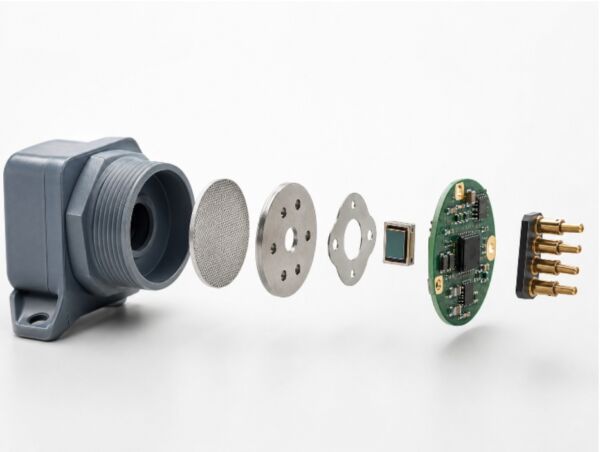
Precision metal shims can help control gaps, mounting height, and component position within a sensor assembly.
A custom shim may contain mounting holes, internal openings, slots, or irregular outer profiles.
The shim does not make the sensor accurate by itself. It is one mechanical component that can support consistent assembly geometry.
Where Chemical Etching Fits
Chemical etching, also known as photochemical etching, removes selected areas from a thin metal sheet.
The metal is cleaned and coated with a light-sensitive photoresist. Digital artwork defines the required component geometry.
After exposure and development, an etchant removes the unprotected material.
The process can create:
- Fine apertures.
- Repeated holes.
- Narrow slots.
- Grids.
- Sensor plates.
- Thin shims.
- Contacts.
- Complex outer profiles.
Because no cutting tool presses directly against the sheet, the process avoids direct mechanical cutting force during profile creation.
Digital phototooling also allows engineers to revise many component geometries without creating a new hard stamping die for every design change.
From Physical Noise to Model Error
A useful way to think about IoT data is to trace a problem through the complete system.
Imagine a sensor that is mounted inconsistently.
That physical variation may change the signal.
The signal enters the data pipeline, where it may appear as additional noise or unexplained variation.
The machine-learning model then has to separate useful information from that variation.
The chain becomes:
Physical Inconsistency → Sensor Variation → Noisier Data → Harder Pattern Detection → Less Reliable Prediction
This does not mean every noisy dataset can be fixed through better hardware.
But it shows why engineers and data scientists should understand how the data was physically generated.
Predictive Maintenance Is a Good Example
Predictive maintenance systems often combine several sensors.
A machine may use:
- Vibration sensors.
- Temperature sensors.
- Pressure sensors.
- Current sensors.
- Acoustic sensors.
These devices generate time-series data that can be analyzed for unusual patterns.
An AI model may identify changes that suggest bearing wear, overheating, imbalance, or another developing problem.
But the analytics system assumes that the measurement conditions are reasonably consistent.
If a sensor becomes loose, blocked, poorly aligned, or physically damaged, the resulting change may reflect the sensing setup rather than the machine itself.
That makes hardware condition part of the wider data-quality discussion.
Precision Hardware Cannot Fix Bad Data Science
Better sensor hardware does not solve every analytics problem.
It cannot correct:
- Poor calibration.
- Incorrect sampling rates.
- Weak labeling.
- Sensor drift.
- Communication errors.
- Bad feature engineering.
- Model overfitting.
The correct approach is system-level thinking.
Reliable IoT analytics requires sensing hardware, electronics, communication, data engineering, and machine learning to work together.
Better AI Starts With Understanding the Data Source
AI systems often appear to begin with datasets.
In sensor-based applications, they actually begin with the physical world.
Something must be measured before it can become a data point.
Precision apertures, screens, shims, contacts, and other small components form only one part of that process. Their role is to support the physical structure around sensing hardware.
Chemical etching can manufacture selected thin metal components with detailed openings, repeated patterns, and complex flat geometries.
For data scientists working with IoT systems, the broader lesson is more important: before asking what a model can learn from the data, understand how that data was physically created.