
The shift from paper-based to digital workflows has brought significant improvements in efficiency and organization for businesses. However, one of the most common challenges faced during this transition is converting physical documents into usable, structured data. Simply scanning a document doesn’t always solve the problem it’s the ability to extract accurate, actionable data from scanned documents that counts. Intelligent Document Processing (IDP) addresses this challenge by automating the capture, extraction, and categorization of data from scanned documents, turning them into structured, digital assets ready for use across systems.
With Intelligent Document Processing, businesses can eliminate manual data entry, improve data accuracy, and unlock the full potential of digital transformation. Whether you’re handling invoices, contracts, medical records, or forms, IDP can transform the way you process documents and leverage the valuable information within them.
The limitations of traditional document scanning
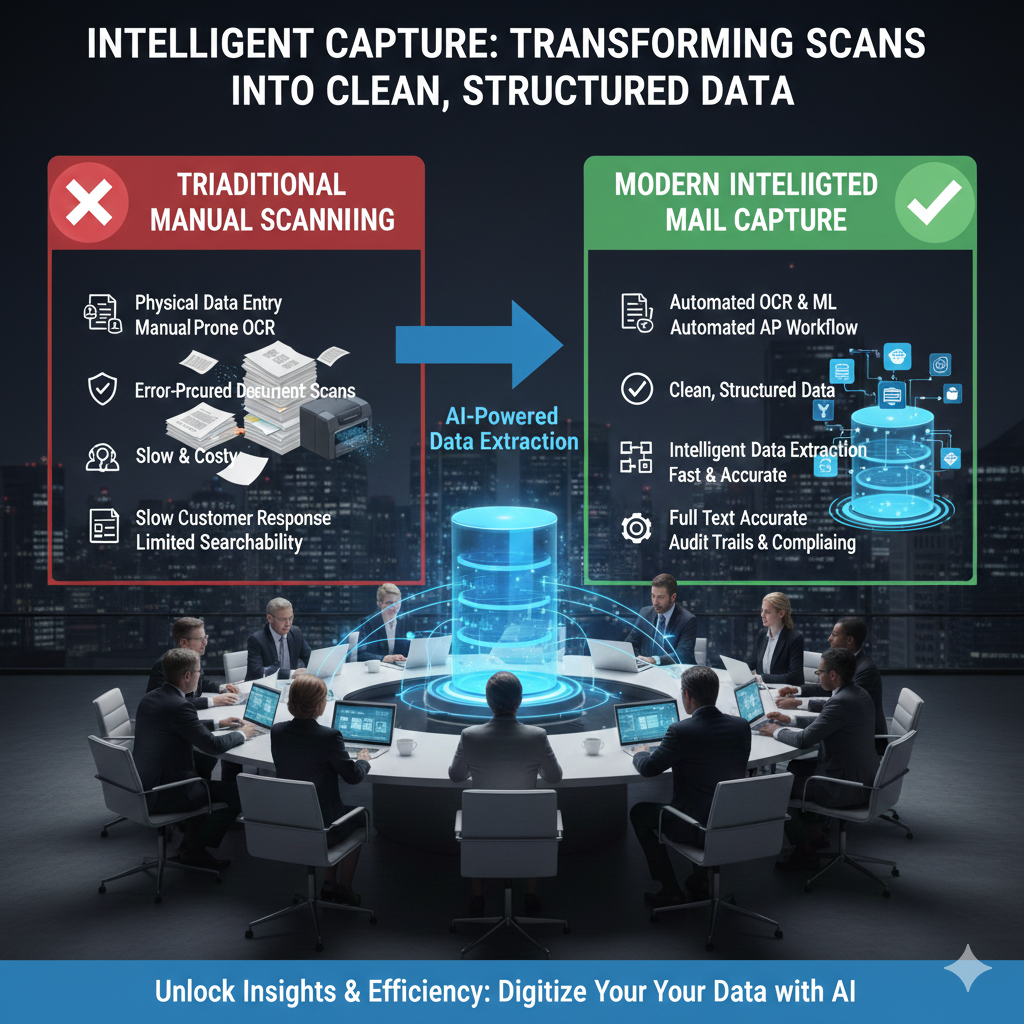
Traditionally, scanning paper documents was just the first step in digitizing information. While scanning converted paper into digital images, it didn’t turn those images into structured data that could be processed, analyzed, or integrated into other systems. Businesses often faced several challenges:
- Manual data entry: After scanning documents, employees still had to manually extract data from them (e.g., entering invoice numbers, dates, totals, etc.) into relevant systems, which was time-consuming and error-prone.
- Unstructured data: Scanned documents were typically saved as images or PDFs, with no way to extract or use the data within them. This unstructured format made it difficult to automate workflows.
- Inconsistent formats: Documents varied in format, layout, and content, making it hard to create a universal process for extracting information from every document.
- Slow processing: The reliance on manual processing slowed down document turnaround times, affecting everything from invoice approvals to customer service responses.
While scanning was a step toward digital, it didn’t solve the bigger problem of transforming scanned data into useful, structured information. This is where Intelligent Document Processing comes in.
How Intelligent Document Processing captures and extracts structured data
Intelligent Document Processing (IDP) goes beyond traditional scanning by using advanced technologies like Optical Character Recognition (OCR), machine learning (ML), and Natural Language Processing (NLP) to capture, classify, and extract data from scanned documents in a structured format. Here’s how it works:
1) Optical Character Recognition (OCR) for text extraction
OCR technology plays a central role in IDP by converting text from scanned images or PDFs into machine-readable text. While traditional OCR was limited to basic character recognition, modern Intelligent Document Processing uses advanced OCR, which is enhanced with machine learning and AI, to extract not just text but also key data points.
For example, instead of simply recognizing the text on an invoice, modern OCR can identify important fields like:
- Invoice number
- Invoice date
- Total amount
- Vendor name
This allows businesses to automate the extraction of these key data points, reducing the need for manual entry and improving the speed and accuracy of processing.
2) Data extraction and classification
Once the text is extracted, Intelligent Document Processing uses machine learning models to understand the context and structure of the document. IDP systems are trained to recognize different types of documents, such as invoices, contracts, purchase orders, or medical forms, and extract the relevant data accordingly.
For instance:
- Invoices: Extract relevant fields such as vendor details, amount due, and payment terms.
- Contracts: Identify clauses, dates, signatures, and renewal terms.
- Medical forms: Extract patient names, medical codes, and treatment details.
IDP uses pre-configured rules or AI-powered algorithms to understand the layout and structure of the document, ensuring that all relevant data is captured accurately and consistently. This eliminates the need for manual review and ensures that data is extracted according to predefined rules.
3) Validation and accuracy
One of the key benefits of Intelligent Document Processing is its ability to validate extracted data. IDP systems can cross-check extracted information against existing databases or predefined rules to ensure its accuracy.
For example:
- If an invoice is being processed, the system can automatically verify that the total amount matches the sum of the individual line items.
- A contract’s effective date can be cross-referenced against the document’s approval date to ensure there are no discrepancies.
This validation step helps to prevent errors and ensures that the data is reliable before being sent to the next stage in the workflow.
4) Integration with downstream systems
Once documents are processed and the data is extracted, Intelligent Document Processing systems integrate seamlessly with downstream business systems like Enterprise Resource Planning (ERP), Customer Relationship Management (CRM), or Document Management Systems (DMS).
For example:
- Processed invoices can be automatically entered into the AP system, triggering approval workflows.
- Contracts can be stored in the central document repository, tagged with relevant metadata for easy retrieval.
- Medical records can be uploaded directly to a healthcare management system, updating patient files in real-time.
This seamless integration enables faster decision-making, reduces manual intervention, and eliminates the need for duplicate data entry.
The real-world impact of Intelligent Document Processing
The implementation of Intelligent Document Processing has had a transformative impact on businesses across various industries. Here’s how it can help in real-world scenarios:
- Invoice processing: Businesses can automate the capture and validation of invoice data, speeding up the accounts payable process, improving vendor relationships, and reducing payment delays. Companies that have adopted IDP for invoice processing have seen processing times cut in half and error rates reduced by up to 90%.
- Legal document management: Law firms and legal departments can automatically extract relevant data from contracts, case files, and agreements, speeding up document review and improving contract compliance. Legal teams can focus on more strategic work, while repetitive document processing tasks are handled by automation.
- Healthcare records: Healthcare providers can streamline patient intake forms and medical records by automating the extraction of critical patient data, reducing manual errors, and improving patient care. IDP also ensures compliance with healthcare regulations by automatically organizing and archiving patient records in a structured format.
Conclusion
Intelligent Document Processing revolutionizes how businesses handle scanned documents by turning them into structured, actionable data. By leveraging advanced technologies like OCR, machine learning, and AI, organizations can automate document processing, reduce errors, and improve overall efficiency. From invoice processing to legal document management and healthcare records, Intelligent Document Processing has a wide range of applications that can significantly enhance productivity and reduce manual work.
For businesses looking to scale their document processing operations, investing in Intelligent Document Processing is a smart move. It not only saves time and reduces errors but also enables better decision-making by ensuring data is accurate, structured, and ready for use at any stage in the workflow.