

Did you know that RPA bots can perform tasks 4-10 times faster than humans?
Organizations are adopting RPA faster to change their operations, and with good reason too. Many businesses still implement RPA randomly and miss out on its full potential. Success depends on finding the right processes that truly fit automation needs.
RPA projects typically deliver 20-30% cost reduction and 30-50% return on investment. These impressive results come from careful planning. The best automation candidates are processes with high transaction volumes that run daily or weekly and need substantial manual work. Companies often choose customer onboarding and invoice processing to cut waiting times and reduce repetitive tasks. Many organizations also rely on RPA consulting services to design scalable automations that improve accuracy, reduce costs, and enhance overall operational efficiency.
You’ll learn the key factors to identify RPA-ready processes in this piece – from evaluating their structure and stability to calculating potential ROI. Understanding process discovery basics will help you maximize automation benefits and avoid common pitfalls, whether you’re new to automation or expanding your existing RPA initiatives.
The Automation Landscape: RPA, IA, and AI
Image Source: World Lifestyler
Organizations need to know the range of automation technologies to streamline operations and implement successful processes. Different but related technologies make up the automation landscape. Each serves a unique purpose based on task complexity and data requirements.
Defining automation clusters
The automation technologies fall into three distinct clusters based on their capabilities and sophistication level: Robotic Process Automation (RPA), Intelligent Automation (IA), and Artificial Intelligence (AI). Each cluster shows a different level of technological advancement in the automation trip.
RPA forms the foundation of the automation pyramid. Software robots or “bots” execute rule-based tasks by copying human actions in digital systems. These bots work with applications like humans do. They click buttons, enter data, and navigate interfaces without making decisions beyond their programmed instructions.
Intelligent Automation combines RPA with cognitive capabilities as we move up the sophistication ladder. IA blends RPA with technologies like machine learning and natural language processing to handle complex tasks that involve semi-structured data. This combination creates systems that execute tasks and learn to adapt over time.
Artificial Intelligence stands at the most advanced level and simulates human intelligence and decision-making processes. AI operates on data and probability, unlike RPA which follows instructions. It recognizes patterns and makes decisions in dynamic environments. AI represents the “thinking” component, while RPA embodies the “doing” aspect of automation.
Where RPA fits in the automation spectrum
RPA holds a strategic middle ground between simple scripting tools and complex custom software development in the automation continuum. Organizations can automate processes without investing in expensive system integrations or complete redevelopment.
High-volume, repetitive tasks with structured data inputs showcase RPA’s strengths. These include processes like invoice processing, data entry, and customer onboarding. The technology creates value by:
- Execute tasks 4-5 times faster than human workers
- Reduce cost by 35-65% for onshore process operations
- Provide investment recovery in as little as 6-9 months
The first RPA implementations typically bring cost savings and ROI of 30-200%, making it an attractive starting point for automation initiatives. In spite of that, RPA has clear limitations—it cannot handle unstructured data or make cognitive decisions beyond its programmed rules.
When to use RPA vs IA or AI
The nature of the process being automated largely determines the right automation technology choice. These key differentiators will help make your decision:
Use RPA when:
- Tasks involve structured, digitized data with clear rules
- Processes are repetitive and high-volume
- Systems are stable with minimal changes
- Quick implementation and ROI are priorities
- Processes follow well-laid-out, consistent rules
Use Intelligent Automation when:
- Processes require handling both structured and unstructured data
- Tasks need more sophisticated decision-making capabilities
- You need to extend automation to processes previously out of reach
- Greater resilience and adaptability are required
- Solutions need to improve over time through learning
Use AI when:
- Complex cognitive decisions are needed
- Tasks involve understanding language, images, or unstructured content
- Predictive capabilities or pattern recognition are required
- Processes need systems that can learn and adapt to new situations
Many organizations now implement these technologies together. This approach, called hyperautomation, uses RPA for task execution, while AI handles interpretation and decision-making. Deloitte reports show organizations scaling intelligent automation have achieved a 27% reduction in costs from their implementations.
Organizations can maximize their automation initiatives’ effectiveness by matching the right technology to each specific process requirement through proper process discovery and technology selection.
Key Characteristics of RPA-Ready Processes
Image Source: Quietfluence
Success rates depend heavily on choosing the right processes for RPA implementation. RPA-ready processes have unique traits that set them apart from regular business operations. Companies need to spot these characteristics during the discovery phase to get the best results from their automation projects.
Structured data and readable inputs
Digital automation runs on structured data—information in standardized formats. RPA works best with clearly defined inputs that follow set patterns and rules. Companies should target processes that:
- Employ data in fixed, digital formats such as Excel spreadsheets, CSV files, or databases
- Have predefined inputs with consistent formatting
- Use readable electronic documents like PDFs, Excel files, Word documents, or XML
Standard RPA tools can’t understand unstructured content like handwritten notes, images without text recognition, or free-form text. Tasks with unstructured data need extra technologies like Optical Character Recognition (OCR) or Intelligent Automation components. One automation expert calls attempts to automate processes with varying unstructured data formats the “worst scenario for automation”.
Stable systems with minimal changes
System stability serves as the life-blood of RPA-ready processes. Bots rely on consistent user interfaces and system behaviors defined during development. The best candidates for RPA implementation include:
- Mature processes that stay mostly unchanged
- Systems without major updates or replacement plans within the next year
- Processes with well-laid-out, documented standard operating procedures
Teams should be careful about automating processes that change often. Bot updates to match system changes cost more and can hurt the ROI of automation projects. Stable, well-defined processes create better chances for successful RPA deployment.
Processes with measurable ROI
The most important factor – RPA-ready processes must show clear business value. Research shows companies get an average ROI of 250% from RPA investments, usually within six to nine months. Companies that follow best practices see even better results—380% average ROI.
Strong ROI potential comes from processes that:
- Need lots of repetitive tasks that take up employee time
- Take at least two full-time employees to manage
- Have tasks where accuracy improvements bring significant value
- Come with established KPIs to measure automation benefits
Cost savings drive many companies to try RPA first, but they find other valuable benefits too. A recent industry survey ranked productivity improvement first, moving employees to higher-value work second, and cost reduction third.
Fannie Mae, a U.S. government-sponsored mortgage provider, built reusable RPA components to make their automation more efficient and easier to maintain. FBMC Benefits Management automated their report generation, which used to take 60% of employees’ workdays, and achieved 99% accuracy.
Smart organizations take baseline measurements before implementation. This creates a clear picture to compare with post-implementation results, showing real ROI and supporting future automation investments.
Evaluating Process Fit: 7 Key Criteria
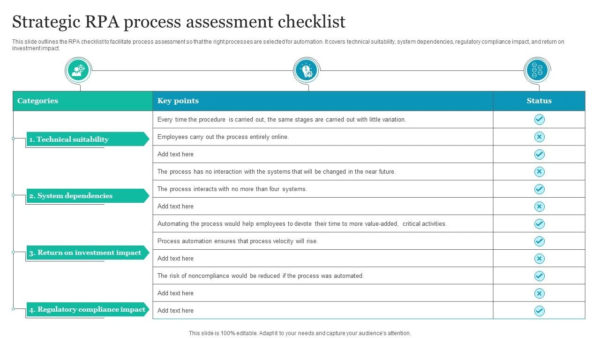
Image Source: stephenallenmenswear
A systematic framework helps identify ideal automation candidates. Organizations that succeed use specific criteria to review processes suitable for RPA implementation. These seven criteria are the foundations of finding and selecting the right processes.
1. Manual and repetitive nature
Processes that need minimal human judgment yet take up a lot of employee time make the strongest candidates for RPA implementation. RPA runs on copying human actions in digital systems. This makes it perfect for tasks where employees follow the same steps repeatedly. Teams should focus on processes where workers do the same actions many times each day, such as data entry, report generation, or processing transactions.
2. High frequency and volume
A process’s frequency and volume directly affect automation ROI. Daily or weekly processes offer more value opportunities than monthly or yearly ones. Tasks with high transaction volumes save more time, making them ideal candidates. Without doubt, tasks that run often with substantial volume lead to better efficiency and cost savings through automation. Teams should target processes with high daily or weekly execution rates to get the most from their automation investment.
3. Standardized input formats
RPA bots work best with standardized, readable electronic inputs. The best automation candidates use structured data sources like Excel spreadsheets, Word documents, XML files, or readable PDFs. Processes that need data extraction from consistent formats allow reliable automation. Teams can implement Optical Character Recognition (OCR) technology before RPA deployment if inputs vary or include unstructured data. Input format standardization plays a key role in successful automation.
4. Rule-based decision making
Clear, well-defined rules make processes excellent RPA candidates. RPA runs on explicit “if-this-then-that” logic programmed into automation workflows. Rule-based processes need straightforward decisions with predictable outcomes based on specific conditions. Tasks that need extensive judgment, creativity, or emotional intelligence don’t fit RPA’s capabilities. Teams should prioritize tasks where decisions follow clear, documented rules with minimal subjective interpretation.
5. Low exception rate
Exception rates play a crucial role in automation success. Simple bot programming and maintenance work better with processes that have few variations or special cases. Each exception needs extra handling logic that increases development complexity and might reduce automation efficiency. The best processes have exceptions in fewer than 10-15% of transactions. Lower exception rates lead to reliable automation performance and less maintenance.
6. Process maturity and stability
Mature, stable processes create the most reliable foundation for RPA implementation. These processes come with well-documented procedures, clear ownership, and established performance metrics. The process should stay relatively unchanged going forward since frequent changes need constant bot updates. Teams should check how long the current process has run without major changes and confirm no big system updates are planned. Stable processes cost less to maintain and make RPA solutions last longer.
7. Clear business value or ROI
Measurable business value stands as the final criterion. Teams should focus on processes where automation delivers clear benefits—lower costs, better accuracy, faster processing, or improved compliance. Successful RPA implementations usually target processes that need at least two full-time employees to manage. Teams can calculate potential ROI by comparing implementation costs with projected savings from better efficiency, fewer errors, and improved throughput. Process discovery tools help find valuable automation opportunities by analyzing task frequency, complexity, and current resource use.
Real-World Use Cases Across Departments
Ground applications show how the right processes deliver substantial returns through RPA implementation. Looking at successful use cases in departments of all sizes reveals practical ways to apply selection criteria and measure automation outcomes.
Finance: invoice processing and reconciliation
Finance departments achieve remarkable gains through RPA implementation. RPA bots extract invoice details, match them against purchase orders, and route documents automatically for approval. This streamlined workflow cuts processing time by a lot. Many organizations report up to 80% reduction in processing costs. Tasks that take humans 10-15 minutes are now completed by RPA in under two minutes with better accuracy.
Account reconciliation gives another valuable chance to automate. RPA bots handle this critical function by:
- Checking for incoming bank statements automatically
- Downloading and extracting file content
- Reconciling statements against ledger entries
- Flagging exceptions for accountant review
Financial institutions have seen great success with these implementations. One organization automated its payment transfer process. The processing time dropped from 10 minutes per request to about 20 seconds. On top of that, bots execute three-way matching between invoices, purchase orders, and receipts. This prevents duplicate or incorrect payments and reduces financial risks.
HR: employee onboarding and data updates
HR departments utilize RPA to revolutionize employee onboarding from a paper-heavy process to a smooth experience. RPA speeds up account creation, system access provisioning, and data management without infrastructure changes.
Automation affects onboarding efficiency remarkably. Santander, to name just one example, reduced employee onboarding time by 85% through RPA implementation. Their digital workers tell relevant departments about new employees automatically. They gather required information, set up accounts, and run compliance checks. The whole ordeal now takes just two days instead of six weeks.
HR teams use RPA beyond onboarding for ongoing employee data management. Bots update changing personnel information from various sources. This gives departments access to current and accurate data always. RPA also handles time-consuming tasks like payroll processing, benefits administration, and learning management. HR professionals can now focus on strategic initiatives rather than administrative work.
Customer service: onboarding and ticket routing
Customer service operations benefit greatly from process automation, especially when quick response times and accurate information management matter. RPA bots streamline customer onboarding. They create accounts, verify information, and distribute welcome materials automatically. Customers get faster service with fewer errors.
Ticket routing presents another valuable automation opportunity. RPA systems analyze incoming customer messages, extract key information, and classify tickets based on set criteria. Bots assign appropriate tags, prioritize urgent issues, and route tickets to support teams or agents. Customers get help faster without long waiting times.
Customer service automation brings more benefits. RPA bots retrieve information from systems instantly instead of making customers wait while agents gather data. These digital assistants connect all communication channels and collect detailed customer data in unified dashboards. Agents cut call resolution time and reduce service costs. Support staff can focus completely on customer interaction rather than administrative tasks.
Organizations in finance, HR, and customer service functions keep finding ideal RPA candidates through careful process discovery and selection. These deliver measurable value while letting employees focus on strategic work.
Challenges in Process Selection and Mitigation
RPA implementation poses substantial challenges even with carefully selected processes. Automation projects can go off track without proper handling, despite their promising ROI potential. Organizations need to know common roadblocks to develop effective solutions.
Process complexity and exceptions
RPA projects for complex processes with many variations can get pricey and time-consuming. Only 3% of organizations have scaled their RPA initiatives successfully. This low success rate stems from teams underestimating how complex these processes are. Bots often break when processes have too many exceptions. This leads to high maintenance needs and lower returns.
The facts are clear – automating faulty or ineffective processes brings no real value. Using different automation approaches for the same process across departments wastes resources and makes scaling difficult. Here’s how to reduce these challenges:
- Use process discovery tools to study workflows and spot exception patterns
- Focus on stable, rules-based processes where exceptions stay below 10-15%
- Split complex integration tasks into smaller, manageable pieces
IT dependencies and system changes
System changes affect RPA bots significantly. Yes, it is true that even small updates to enterprise applications can completely disrupt automation workflows. Many organizations don’t see this sensitivity coming during their process discovery phase, which creates ongoing maintenance issues.
Here are some effective strategies:
- Design resilient bots that use APIs instead of UI scraping when possible
- Set up detailed monitoring dashboards to catch failures early
- Create clear integration workflows and process maps to show system interactions
Lack of stakeholder alignment
RPA initiatives often fail because IT and business teams don’t work well together. Research shows that resistance to change is the third biggest problem companies face when starting automation programs. This gap typically happens when RPA begins as a business project and IT joins too late.
These strategies help build better alignment:
- Run RPA as a company-wide program rather than a single department’s experiment
- Create strong partnerships between IT and business teams with shared responsibility
- Help employees understand how RPA reduces manual work without taking away jobs
- Keep a decision log that shows context, choices, and known limits
Organizations can improve their chances of successful RPA deployment by addressing these challenges early and developing targeted solutions.
Getting Started with Process Discovery
Image Source: Janus Web3
A successful RPA implementation starts with finding the right processes. Organizations used manual methods to identify automation opportunities in the past. Now, new technologies revolutionize this crucial first step.
Manual observation vs automated process discovery
Process discovery relied on stakeholder brainstorming, direct observation, and employee interviews. These approaches helped identify potential automation candidates but had inherent limitations. They were subjective, expensive, time-consuming, and failed to capture process variations between employees. Automated process discovery now utilizes machine-learning tools to identify key business processes objectively. It records variations and prioritizes automation opportunities. This analytical approach reduces costs and risks while boosting performance and quality.
Using process mining and task mining
Process mining and task mining work together as complementary technologies to provide complete process discovery. Process mining pulls data from system event logs and creates visualizations of organizational processes. Organizations can find process models, compare actual processes with ideal ones, and improve existing models with performance or cost information. Task mining studies how humans execute processes by recording their interactions. It analyzes repetitive actions and creates bots to automate those actions. Task mining captures desktop-level activities that include keystrokes and clicks. This reveals inefficiencies that don’t show up in system logs.
Choosing the right tools for your business
The selection of process discovery tools depends on your integration needs with RPA initiatives. Process discovery leads to straightforward automation, while process mining needs additional RPA integration. You should review if you need to identify both visible and invisible processes. Process discovery finds user activities that differ from standard procedures. Your tools should provide practical information needed to implement high-impact changes. The best solutions come with privacy-enhanced features that automatically redact sensitive information before data leaves your network.
Conclusion
The right process selection for RPA implementation plays a key role in automation success. Companies that take a strategic approach to process discovery see substantially better results than those automating without proper planning. This piece looks at the key traits that make processes right for RPA – structured data inputs, rule-based decision making, high frequency, low exception rates, and process stability all lead to winning implementations.
RPA creates impressive value with proper application. Companies typically cut costs by 20-30% and see 30-50% return on investment from well-executed RPA projects. These results come from smart process selection rather than random automation attempts. Finance teams streamline invoice processing, HR teams accelerate employee onboarding, and customer service operations boost ticket routing through carefully picked automation candidates.
Notwithstanding that, challenges pop up even with ideal process selection. System changes can throw off bot functionality, and complex processes might need too much maintenance. Getting stakeholders to line up often becomes tricky. Companies need to tackle these hurdles head-on through complete planning and working across teams.
The rise from manual observation to automated process discovery marks another big step forward. Process mining and task mining tools now provide evidence-based ways to spot automation opportunities that cut down on guesswork and save time compared to old methods. These tools catch process variations and inefficiencies that might stay hidden otherwise.
Finding the sweet spot is what makes RPA implementation work – processes with high transaction volumes, clear rules, few exceptions, and measurable ROI. Companies should start small with stable, well-documented processes before moving to trickier automation projects. This step-by-step approach maximizes automation benefits while steering clear of common pitfalls, helping businesses tap into the full potential of RPA.
FAQs
1. What are the key characteristics of processes suitable for RPA?
Processes ideal for RPA are typically rule-based, repetitive, high-volume, and involve structured data. They should have a low exception rate, be stable with minimal changes, and demonstrate clear business value or ROI. Tasks that are manual, computer-based, and involve interactions with multiple applications are strong candidates for automation.
2. How can organizations identify processes for automation?
Organizations can identify automation candidates by looking for repetitive, high-frequency tasks that consume significant employee time. They should evaluate processes based on their complexity, standardization, and stability. Automated process discovery tools, including process mining and task mining, can objectively analyze workflows and prioritize automation opportunities based on data-driven insights.
3. What challenges might arise when selecting processes for RPA?
Common challenges include underestimating process complexity, dealing with high exception rates, managing IT dependencies and system changes, and lack of stakeholder alignment. Organizations may also struggle with automating inefficient processes or implementing RPA across different departments inconsistently. Mitigation strategies involve thorough analysis, stakeholder education, and collaborative planning between IT and business teams.
4. What is Forrester’s “Rule of Five” for RPA?
Forrester’s Rule of Five is a guideline for identifying suitable RPA candidates. It suggests looking for tasks with fewer than five decisions made, five applications accessed, and 500 clicks. This rule of thumb helps organizations focus on simpler, more straightforward processes that are likely to yield successful automation outcomes.
5. How does RPA compare to other automation technologies like AI and IA?
RPA excels at rule-based, repetitive tasks with structured data, while AI handles more complex cognitive decisions and unstructured data. Intelligent Automation (IA) combines RPA with AI capabilities for handling semi-structured data and more sophisticated decision-making. Organizations should choose the appropriate technology based on the specific process requirements, data types involved, and desired outcomes.