
Raising money in 2026 is a different game than it was two years ago. The “fund the vision” era that defined startup investing from 2020 to 2022 is firmly in the past. After the correction, investors have become a lot more disciplined, median seed rounds have also shrunk in size while expectations for early traction have gone up sharply. Pre product raises are almost gone unless you are a repeat founder with a clear track record.
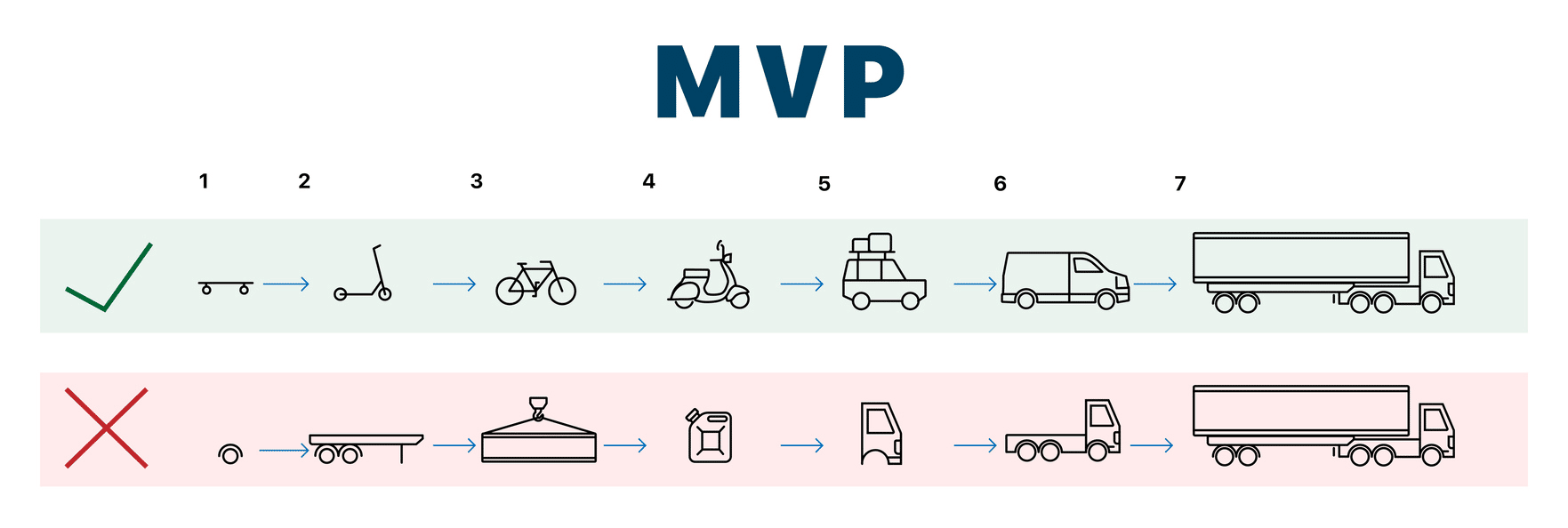
So what this means in practice is that your MVP now has to do more work than ever before. It can’t just indicate, yes, a problem exists. It has to prove that the solution performs, that real users actually enjoy it and keep coming back, and increasingly that AI is truly part of the product in a way that creates real competitive leverage, not just a marketing label pasted on top.
The bar for what counts as a fundable MVP is up now. And the startups that are actually getting through it, are mostly the ones that were deliberate about what they put together, how they put it together, and who they recruit along the way. This guide walks through what that tends to look like in 2026, from the very first validation conversation to the point you step into a pitch meeting, with something investors can not ignore.
Why AI Is Now Baseline, not a gimmick
In 2026 investors are not impressed if you say “AI” like it’s a shiny feature. They have watched too many teams duct tape a chatbot onto a dashboard, then claim they are an AI company. What they want instead is AI that sits inside the structure of the product experience, so the whole thing feels clearly stronger, quicker, or harder to replicate than the alternatives.
This distinction changes how founders should think about building, I mean really think. Working with an experienced MVP development company in USA that understands this shift is the difference between building something that looks AI-powered in a demo and building something that actually does, quietly, day one. The former gets polite rejections, and the latter gets term sheets. Or at least it has a much better chance to, because the story tracks reality.
The good news is that access to world-class AI infrastructure has never been more democratized. The question is no longer whether you can integrate AI into your MVP, it’s more whether you are doing it in a way that creates real value and real moats. That takes careful MVP product development decisions made early, not AI features stapled on after the core product is already in place.
Step 1: Start with Discovery, Not Development
The most common mistake founders make when they’re building investor-targeted MVPs, is starting with development, when they should be starting with questions. Before any single screen is designed or a line of code is written, the most important work happens inside a structured discovery process, and yeah it sounds basic but it’s usually skipped.
MVP Discovery & Validation is the way you pressure-test your central assumptions against reality. It means speaking with real prospective users, laying out their present workflow with detail, spotting where the pain is most intense, and then choosing the one crucial hypothesis your MVP has to prove.
This phase should settle three questions, with real clarity.
- Who exactly is the user, and what does their current day look like without your product?
- What is the one thing your MVP needs to do better than any existing alternative?
- What evidence would convince an investor that product-market fit is within reach?
Agencies offering quality MVP development services in Texas, and honestly across the US more and more they lead with structured discovery workshops before any build talk really begins. If a possible partner wants to jump straight into development, without that phase it can be a signal worth noticing and yes paying attention to
Step 2: Prototype before You Build
One of the most investor-friendly moves a founder can make is arriving with a working prototype, not another pitch deck loaded with mockups. MVP prototyping does two big jobs: it makes the team decide on real product details early, not later. And it gives investors something tangible they can touch and interact with which shows you understand your users at a more granular level.
Modern AI powered MVP development and prototyping goes beyond simple clickable wireframes. The best agencies now tend to ship functional prototypes that actually have live AI behavior, meaning genuine responses coming from real models, not fake placeholders. That way investors can feel the intelligence layer, not just be told a story about it. It changes the whole discussion from “could this work” to “look, it already does.”
Key things a strong AI MVP prototype should show, more or less:
– The core user flow, from the entry point to the main value moment, in under three clicks, without weird detours.
– AI behavior in context, where the model reacts to realistic inputs, like real people would type or select.
– Edge case handling too, so you can see what happens when the AI is wrong or uncertain, and the team has planned for that.
– Speed and responsiveness, because latency is one of the most credibility destroying factors in live demos.
Step 3: Build AI into the architecture, not onto it
This is where early technical decisions tend to echo the longest. If someone tries to retrofit AI into a pre-existing architecture, performance usually gets wobbly , costs can climb, and maintainability often turns into a chore. In contrast, when products are built with AI as a first-class architectural thing, they tend to scale cleaner and with less financial pain.
A solid AI MVP Development Partner designs the data model, API layout, and the infrastructure so the AI layer is considered from the start. In reality this usually looks like :
Vector databases for semantic search and context retrieval integrated into the data architecture right away
Prompt management systems versioned and checked like actual code, not handled in a casual ad hoc way
Inference cost controls that are built in before scale forces them to become urgent
Fallback logic for cases where AI outputs are unreliable , so the experience degrades gracefully instead of failing in plain sight
Feedback loops that collect user behavior data in a form ready for future model fine-tuning
This is exactly the kind of architectural discipline that separates a credible MVP software development engagement from a rushed build, you can feel it in the code too. It’s also the gap investors increasingly notice when they bring in a technical advisor to check whether your codebase is truly fundable
Real-World Use Cases : What investor-ready AI MVPs look like
Knowing what actually gets funded helps you calibrate what your MVP needs to prove, early. Here are the AI-first MVP categories drawing the most investor attention in 2026:
Vertical AI agents — These are tightly scoped AI tools that automate a single high value workflow for a specific professional group, legal contract review, clinical documentation, freight dispatch, code security auditing. Investors like them because the TAM is clear, and the use case is not fuzzy.
AI enhanced B2B SaaS tools, the existing workflow categories (CRM, project management, HR systems) are being rebuilt with AI as the core, not bolted on top. The whole pitch is like “10x better than the incumbent, because it thinks.”
Data to insight products, these take in messy unstructured business data and then surface cleaner, operationally ready intelligence. They’re especially strong for logistics, finance, and healthcare, where the inputs are often chaotic and the decisions need to be sharp.
AI native marketplaces, platforms where the AI does the matching, pricing, or quality control in ways that make the whole marketplace much more efficient than alternatives that are mainly run by humans.
Compliance and governance tools, in regulated industries the AI helps companies satisfy complicated requirements faster and with fewer mistakes than manual processes. Generally high willingness to pay, longer contract terms, and solid retention.
In each case, the MVP job is not to create the whole vision, it’s more like to prove that the AI actually works for the main use scenario, that real users find it valuable enough to come back, and that the technical foundation can grow.
Why your development partner tells more than you think
Investors don’t only look at your product. They also read the judgment you’ve shown while building it. Picking a custom MVP development partner with proven AI know-how can mean you understand the technical intricacy of what you’re creating. It also suggests you chose the right shortcuts (moving quickly on validated assumptions) instead of the bad ones (skipping checks, or taking reckless architectural corners), you know.
An established mvp app development company, with a portfolio of funded ai products also brings something a bit less tangible but still genuinely useful: pattern recognition. They’ve watched what gets funded and what does not, and in the process they’ve learned which technical decisions will be asked about during due diligence. More importantly, they tend to know how to make the responses strong, clear, and consistent.
AI driven mvp development done right is collaborative. The best engagements involve the founders’ domain expertise together with the agency’s technical and product experience, and both sides are actually invested in the outcome, not only delivery. Sometimes you end up building momentum because the decisions are aligned early, not after.
The investor ready AI MVP checklist
- Before you walk into a pitch meeting, make sure your mvp can say yes to each of these:
- Does the ai solve one specific, high value problem for a clearly defined user?
- Can the ai behavior be shown live, not just described in slides?
- Is the architecture designed for scale, not just optimized for a demo?
- Do you have actual user data, even if it’s just a small cohort, that proves the product does work?
- Can you walk through, in a clean and believable way, how the AI engine produces a defensible advantage versus the current options?
- Is the data plan readable to someone else too, meaning where the training data comes from, and how the model gets better over time, not just once?
- Has a technical partner with real AI experience validated your architecture already, not just a review note?
Final Thought
Building an Minimum Viable Product that investors fund in 2026 isn’t about building more, it’s about building the right thing, with the right AI architecture, backed by the right evidence, and delivered with the credibility that comes from choosing a development partner who has done this before.
The startups getting funded are the ones that treated their MVP not as a prototype to be abandoned, but as a strategic proof point , sharp and well-built, and difficult to dismiss
With the right MVP development company in the USA beside you, that is exactly what yours can be.