
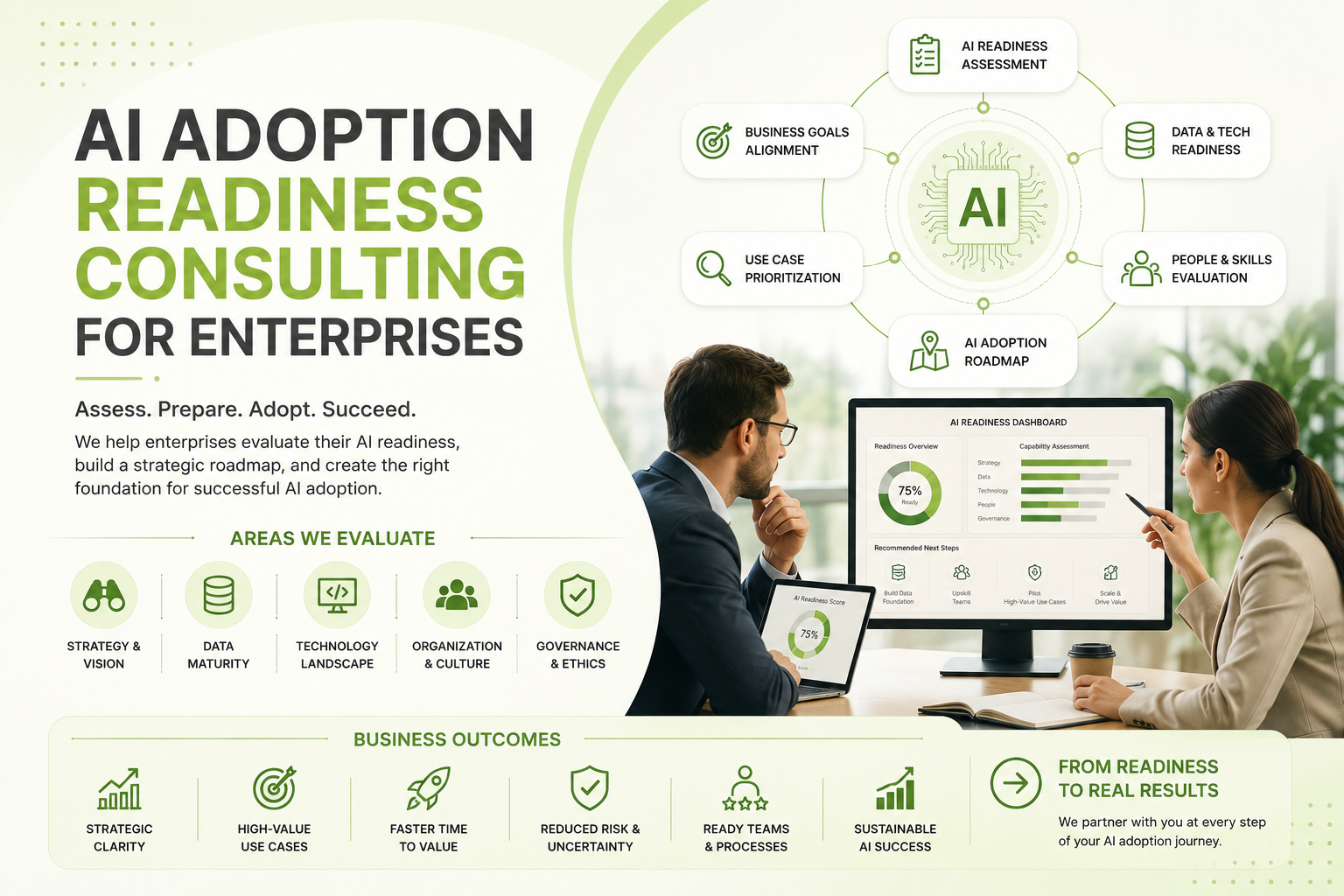
Artificial intelligence is no longer an experimental technology for enterprises. Organizations across manufacturing, financial services, healthcare, retail, logistics, and other industries are investing in AI to automate operations, improve decision-making, and create competitive advantages.
However, many AI initiatives fail—not because the technology is inadequate, but because organizations are not prepared to implement it successfully. Challenges such as poor data quality, unclear business objectives, fragmented infrastructure, governance gaps, and lack of executive alignment often delay or derail AI projects.
This is where AI Adoption Readiness Consulting for enterprises plays a critical role. Before investing in AI development, enterprises need a structured assessment of their business readiness, technical capabilities, data maturity, and implementation priorities.
This guide explains what AI adoption readiness consulting involves, why it matters, and how organizations can prepare for successful AI transformation.
What Is AI Adoption Readiness Consulting?
AI Adoption Readiness Consulting is a structured engagement that evaluates an organization’s ability to successfully implement and scale artificial intelligence.
The goal is to answer questions such as:
-
Is the organization ready for AI?
-
Which business problems should AI solve first?
-
Is the available data suitable for AI?
-
What technology gaps exist?
-
What governance policies are required?
-
What implementation roadmap should be followed?
Rather than jumping directly into development, readiness consulting helps organizations reduce risk and maximize the return on AI investments.
Why AI Readiness Matters
Many enterprises launch AI initiatives without first evaluating their organizational readiness.
Common consequences include:
-
AI projects that never move beyond a Proof of Concept (POC)
-
Low user adoption
-
Data integration challenges
-
Poor model performance
-
Compliance and governance risks
-
Budget overruns
-
Limited business value
A readiness assessment identifies these challenges early, allowing organizations to address them before implementation begins.
Key Components of AI Adoption Readiness Consulting
1. Business Readiness Assessment
Consultants evaluate:
-
Strategic business objectives
-
Executive sponsorship
-
Organizational priorities
-
Digital transformation maturity
-
Current business processes
The objective is to ensure AI initiatives align with measurable business outcomes.
2. AI Discovery Workshop
An AI Discovery Workshop brings together business leaders, technical teams, and operational stakeholders to identify and prioritize AI opportunities.
Typical workshop activities include:
-
AI opportunity mapping
-
Business process analysis
-
Use case brainstorming
-
Value assessment
-
Feasibility evaluation
-
ROI estimation
The outcome is a prioritized list of AI initiatives.
3. Data Readiness Assessment
Enterprise AI depends on reliable data.
The assessment evaluates:
-
Data quality
-
Data accessibility
-
Data governance
-
Integration readiness
-
Master data consistency
-
Security and privacy
Organizations often discover that improving data quality delivers immediate business benefits—even before AI deployment.
4. Technology Readiness
Consultants review the existing technology ecosystem, including:
-
ERP systems
-
CRM platforms
-
Data warehouses
-
Cloud infrastructure
-
APIs
-
Security architecture
-
Identity management
This ensures AI solutions can integrate smoothly with enterprise systems.
5. AI Use Case Prioritization
Not every AI idea should become a project.
Organizations should prioritize use cases based on:
-
Business value
-
Technical feasibility
-
Data readiness
-
Implementation effort
-
Time-to-value
-
Strategic alignment
High-impact, low-complexity initiatives often deliver the fastest ROI.
6. Governance and Risk Assessment
Responsible AI requires governance.
Readiness consulting typically covers:
-
Regulatory compliance
-
Model governance
-
Explainability
-
Human oversight
-
Security controls
-
Ethical AI practices
-
Audit requirements
This is particularly important in highly regulated industries.
7. AI Roadmap Development
The final deliverable is a phased AI implementation roadmap.
A roadmap generally includes:
-
Priority use cases
-
Timeline
-
Resource requirements
-
Technology recommendations
-
Budget estimates
-
Success metrics
-
Implementation phases
This roadmap becomes the organization’s blueprint for AI adoption.
Benefits of AI Adoption Readiness Consulting
Organizations that invest in readiness consulting often experience:
-
Faster AI implementation
-
Lower project risk
-
Better executive alignment
-
Improved data quality
-
Higher AI adoption rates
-
Stronger governance
-
Faster return on investment
-
Better prioritization of AI initiatives
Industries That Benefit Most
AI readiness consulting supports organizations across many industries, including:
Manufacturing
-
Predictive maintenance
-
Production planning
-
Quality inspection
-
Shop floor AI assistants
Financial Services
-
Fraud detection
-
Loan underwriting
-
KYC and AML automation
-
Risk management
Healthcare
-
Clinical documentation
-
Patient engagement
-
Revenue cycle automation
Retail
-
Demand forecasting
-
Inventory optimization
-
Customer personalization
Why Choose Intellectyx for AI Adoption Readiness Consulting?
Intellectyx helps enterprises move confidently from AI strategy to production by combining consulting expertise with hands-on implementation experience.
Its structured approach includes:
-
AI Readiness Assessments
-
Data Readiness Evaluations
-
AI Roadmap Development
-
AI Proof of Concept (POC)
-
AI MVP Development
-
AI Agent Development
-
AI Copilot Development
-
Enterprise AI Deployment
Using the IX Agentic AI Accelerator Framework, Intellectyx helps organizations reduce implementation risk, accelerate delivery, and scale AI across business operations.
Best Practices for Enterprise AI Readiness
Before launching an AI initiative, organizations should:
-
Align AI with business strategy.
-
Identify measurable success metrics.
-
Assess data quality and accessibility.
-
Prioritize high-value use cases.
-
Establish governance and security policies.
-
Involve business and technical stakeholders.
-
Start with a focused AI Proof of Concept.
-
Plan for long-term scaling and continuous improvement.
Final Thoughts
Successful AI adoption starts long before the first model is deployed. Organizations that evaluate their readiness, prioritize the right opportunities, and build a structured implementation roadmap are far more likely to achieve measurable business outcomes.
AI Adoption Readiness Consulting provides the foundation for enterprise AI success by aligning business strategy, technology, data, and governance before development begins.
Whether you’re exploring AI for the first time or scaling existing initiatives, investing in readiness consulting can significantly reduce implementation risk and accelerate your journey from strategy to production.