
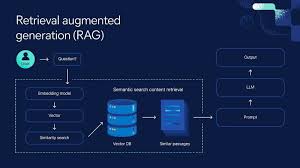
As enterprises move beyond experimental AI pilots, a new class of systems is taking center stage agentic AI systems. These systems don’t just respond to prompts; they plan, reason, retrieve information, and take action across enterprise workflows. However, building agentic AI that enterprises can actually trust requires more than large language models alone.
This is where Retrieval-Augmented Generation (RAG) becomes foundational. RAG provides the knowledge grounding, accuracy, and governance that agentic AI systems need to operate reliably at enterprise scale.
In this blog, we break down how Retrieval-Augmented Generation powers agentic AI systems, why it is essential for enterprise adoption, and how organizations are architecting these systems for real-world deployment.
Why Enterprises Are Shifting Toward Agentic AI Systems
Traditional AI systems are reactive by design. They answer questions, generate text, or classify data but they don’t independently drive outcomes. Enterprises now want AI systems that can:
- Understand business objectives
- Break goals into executable tasks
- Retrieve relevant internal knowledge
- Interact with enterprise systems
- Continuously improve decisions
Agentic AI systems meet these expectations. They behave more like digital operators than assistants, making them highly valuable in complex enterprise environments.
The Core Limitation of LLM-Only Agentic Systems
While large language models enable reasoning and natural language understanding, they introduce serious limitations for enterprise agentic AI:
- No inherent access to proprietary enterprise data
- High risk of hallucinations
- Lack of explainability
- Difficulty enforcing data access policies
For enterprises operating in regulated or high-stakes environments, these limitations are unacceptable. Agentic AI systems must base decisions on verified, enterprise-controlled data not probabilistic knowledge.
What Retrieval-Augmented Generation Adds to Agentic AI
Retrieval-Augmented Generation enhances agentic AI systems by enabling them to retrieve relevant information at runtime from trusted enterprise sources before generating outputs or executing actions.
In agentic systems, RAG enables:
- Context-aware reasoning grounded in internal data
- Dynamic knowledge access across multiple repositories
- Source-backed decisions for auditability
- Reduced hallucinations and improved accuracy
Without RAG, agentic AI lacks enterprise credibility. With RAG, it becomes operational.
How RAG Powers Each Stage of an Agentic AI System
Agentic AI systems are not single models they are orchestrated systems. RAG plays a role at every stage.
1. Goal Understanding and Task Planning
Agents retrieve historical workflows, policies, and documentation to understand how similar goals were handled in the past.
2. Knowledge Retrieval
This is where rag application development is critical. Agents query vector databases, document stores, APIs, and structured systems to retrieve the most relevant context.
3. Reasoning and Decision-Making
The AI model reasons over retrieved information rather than relying on static training data.
4. Action Execution
Agents use retrieved operational data to interact with CRMs, ERPs, analytics platforms, and internal tools.
5. Feedback and Learning
Results are logged and retrieved later, improving future decisions.
Enterprise Architecture for Agentic AI with RAG
At scale, enterprises implement RAG-powered agentic AI using layered architectures:
- Data layer: Enterprise documents, databases, APIs
- Retrieval layer: Vector databases with domain-specific embeddings
- Agent layer: Task planning, tool calling, decision logic
- Model layer: LLMs constrained by retrieved context
- Governance layer: Logging, access control, monitoring
Designing this architecture correctly often requires collaboration with a specialized RAG Development Company experienced in enterprise environments.
The Role of a RAG Development Company in Enterprise Agentic AI
As enterprises scale agentic AI initiatives, internal teams often face challenges related to performance, governance, and integration. A RAG Development Company helps enterprises:
- Design domain-optimized retrieval pipelines
- Choose and tune embedding models
- Implement secure, role-based data access
- Optimize latency and relevance at scale
- Integrate agentic systems with enterprise software
This ensures agentic AI systems are not just intelligent but production-ready and enterprise-safe.
Why Agentic AI Requires Specialized Development Services
Agentic systems are fundamentally different from chatbots or standalone AI models. Enterprises rely on artificial intelligence agent development services to manage:
- Multi-agent orchestration
- Workflow-aware decision logic
- Tool and API integration
- Human-in-the-loop controls
- Failure handling and escalation
These services ensure that autonomy is intentional, measurable, and governed, not uncontrolled.
Enterprise Use Cases Enabled by RAG-Powered Agentic AI
Enterprises are already deploying RAG-powered agentic systems across critical functions:
Customer Support and Operations
Agents retrieve customer history, contracts, and policies to resolve issues or assist human agents.
Finance and Compliance
Agents retrieve regulatory guidelines, transaction data, and risk frameworks to support audits and monitoring.
Knowledge Management
Agents continuously retrieve and synthesize internal knowledge across departments.
IT Operations
Agents retrieve logs, documentation, and runbooks to diagnose incidents and recommend actions.
In every case, RAG ensures decisions are grounded in enterprise-approved data sources.
Governance, Security, and Compliance at Enterprise Scale
Agentic AI systems introduce new governance challenges. Enterprises must ensure:
- Controlled access to sensitive data
- Full traceability of agent decisions
- Alignment with regulatory requirements
- Clear accountability for automated actions
RAG strengthens governance by ensuring every decision can be traced back to retrieved enterprise knowledge.
Measuring Business Impact of RAG-Powered Agentic AI
Enterprises adopting agentic AI systems with RAG report measurable benefits such as:
- Faster operational decision-making
- Reduced dependency on manual workflows
- Improved accuracy and consistency
- Better utilization of internal data assets
- Lower long-term operational costs
These outcomes make agentic AI a strategic investment, not an experimental technology.
The Road Ahead: Agentic AI as an Enterprise Operating Layer
RAG-powered agentic AI systems represent a shift from isolated AI tools to enterprise-wide intelligence layers. Future systems will:
- Coordinate multiple agents across functions
- Continuously retrieve and update knowledge
- Execute end-to-end workflows autonomously
- Collaborate with humans in real time
Enterprises that invest early in robust RAG architectures will be best positioned to scale agentic AI responsibly.
Final Thoughts
Agentic AI systems promise autonomy, efficiency, and intelligence but only when grounded in enterprise reality. Retrieval-Augmented Generation provides that grounding, enabling agents to reason and act based on trusted data rather than assumptions.
By investing in rag application development, partnering with an experienced RAG Development Company, and leveraging artificial intelligence agent development services, enterprises can build agentic AI systems that are scalable, compliant, and ready for real-world impact.