
Artificial intelligence is changing the game completely in terms of human-technology interaction, and JavaScript coders are becoming the unrecognized main actors of this shift. Although Python has been the leader in the AI field for a long time, JavaScript is still managing to secure a decent spot for itself, eventually leading the AI development process to a more open and less biased one, and at the same time, giving the smart functions to the hands of billions of people through their web browsers. It is a transformation that is affecting the whole lifecycle of AI applications in terms of building, deploying, and using.
If you are thinking about the AI adoption in your company or might be considering the hiring of AI experts, then one should not ignore the fact that the role of JavaScript in this area is very crucial for being in the competition in 2025.
The Current State of AI Development
The progressive technology of AI has finally come upon a very crucial turning point. Research carried out by the industry projected that the total value of the worldwide AI market would exceed $190 billion by 2025, with the main factors driving this growth being machine learning and generative AI. From chatbots that handle customer service to recommendation engines that tailor user experiences, AI is penetrating every sector.
In the past, AI development was mainly the domain of people with skills in Python, deep learning, and lots of computing power. This raised the difficulty level for many developers and companies that wanted to use AI features. However, now the JavaScript developers are rewriting the story by using the language’s worldwide use and easiness to make AI development more open and practical.
Why JavaScript is a Game-Changer for AI Development
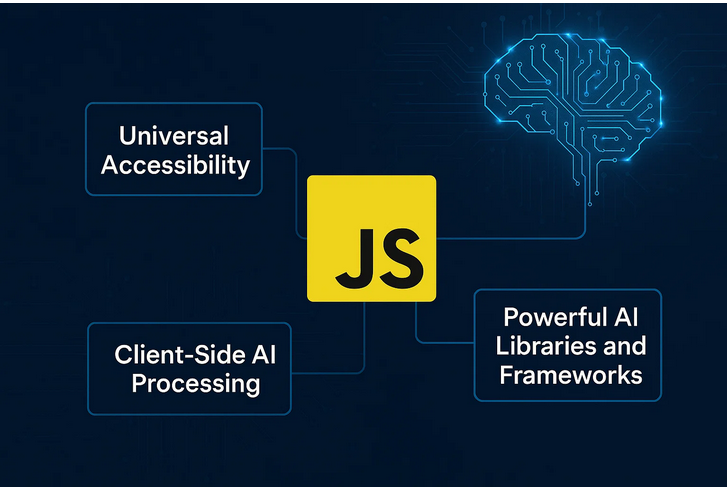
1. Universal Accessibility
JavaScript still holds the title of the most widely used programming language, as it is already mastered by millions of developers all around the globe. This huge developer community indicates that the AI capabilities can be adopted in the current web applications without the need for the teams to get accustomed to completely new tech stacks. Developers speaking the same language and using the same tools mean a significant reduction in AI development’s entry barrier.
2. Powerful AI Libraries and Frameworks
JavaScript ecosystem is now on the same level as Python in terms of available robust AI libraries due to its maturity. TensorFlow.js makes it possible for developers to create and implement machine learning models in the JavaScript language completely, no matter if they are doing it in the browser or on Node.js servers. There is also Brain.js for neural network functionalities and ML5.js that offers a user-friendly interface for creative AI applications.
3. Client-Side AI Processing
One of the most impressive things about AI powered by JavaScript is that it can run models directly in the users’ browsers. This method brings forth several benefits, such as cutting down server expenses, enhancing privacy as the information stays on the user’s device, faster response time for live apps, and the possibility of offline use after the model has been uploaded.
Key Innovations JavaScript Developers Bring to AI
JavaScript developers are not only transferring present AI functions but also coming up with new ways and techniques for the whole scenario of developing intelligent applications:
Real-Time AI in the Browser
JavaScript makes it possible for AI models to work inside web browsers and this gives people the idea of instant and responsive web experiences. The applications can do the tasks of image categorization, processing human languages and even coming up with creative contents without involving the server at all. For instance, JavaScript developers have realized and made available to the public a very sophisticated real-time system of human pose detection, a multilingual translation tool that works in no time, and a drawing application that recognizes and completes artworks as they are created by the user.
This has been and will continue to be a great change and the very good thing for people worldwide no matter in what field they are. Users of online shopping sites can try on clothes virtually and all the processing is done in the browser and no data transmitted back and forth which could compromise privacy is not analyzed in any way in the case of medical applications and in the case of students the feedback on their work can be instantaneous.
Lightweight and Optimized AI Models
JavaScript developers are not just rolling out large models in the end; they are working like pros and cutting down to size and yet still giving good performance AI models that also work on a slow hardware device. Such optimization is very critical for the users who work on mobile devices and it is the only way of ensuring that AI functionalities are there for all device users. To give an example, TensorFlow.js has various tools for model optimization and quantization that can shrink model sizes by as much as 75% while keeping the same level of correctness.
Democratizing AI Development
By allowing people to work with AI via JavaScript, developers are making the technical thresholds that have always kept the majority of people from machine learning gone. ML5.js is a typical example of this with user friendly and intuitive APIs to let even those with almost no AI background create elegant applications. This user-friendliness has immediately and immensely
Real-World JavaScript AI Applications
There are several remarkable projects that give us a glimpse into the future of AI with JavaScript developers:
1. Teachable Machine
A tool from Google called Teachable Machine lets people create personalized machine learning models in browsers without any programming experience. The application, which is based on the TensorFlow.js platform, shows the potential of JavaScript to allow the AI training process in an easier way, opening up possibilities for non-technical persons e.g. teachers, artists, and business people to come up with custom AI models for their specific needs through the use of technology.
2. PoseNet and Body Tracking
A machine learning model called PoseNet that is fully browser-compatible can predict human poses instantly with the help of JavaScript. Thus far, developers have appropriated this technology to make apps for counting fitness repetitions, making games that allow players to use body movements as controls, and making resources for the physically challenged who now can interact with the computers through gestures.
3. Voice-Controlled Applications
The pairing of JavaScript’s Web Speech API with machine learning models results in highly advanced voice control systems that operate entirely on the client side. The result is that developers are working on voice-activated note-taking apps, hands-free navigation systems, and voice-based search interfaces that do not require sending audio data to external servers.
Challenges and Future Prospects
JavaScript has been a major player in the development of AI but still has some difficulties to overcome:
Performance Considerations
JavaScript cannot match Python in terms of raw computational performance for training up large models. The complex and demanding nature of deep learning tasks often necessitates the GPU´s parallel processing power while such access is mostly limited to Python environments. Nevertheless, new innovations like WebGPU are bridging this gap by providing a standardized way for JavaScript to use GPU acceleration in the browser, while also raising important considerations around device security when executing AI workloads directly on user devices.
The Road Ahead
The outlook for JavaScript in AI development is bright. WebAssembly (WASM) is providing JS apps with almost the same performance as native apps, thus requiring browser-based working with AI problems of even high computational power. Edge computing is creating more opportunities for deploying AI models based on JavaScript closer to the users, and the JavaScript AI ecosystem is still growing which means better tools and libraries are always coming up.
JavaScript is the path of least resistance for the businesses that want to inject AI capabilities into their operations. They can hire JavaScript developers exclusively who will then incorporate AI functionalities into the existing web applications without needing a separate team of AI specialists. Consequently, this strategy leads to reduced costs, faster development periods and the possibility of running a lot of testing with AI features in a short time.
Conclusion
JavaScript programmers are making a paradigm shift in AI development by making it more accessible, fast, and friendly. They have made it possible to have a new generation of intelligent applications that were previously thought to be either impossible or impractical through browser-based AI processing, cross-platform capabilities, and a zeal for machine learning.
JavaScript’s role in the future of AI will be more pronounced as the latter continues its evolution. Be it your first AI feature or the scaling of your existing intelligent application, JavaScript will always be there as a powerful and accessible platform for you to give your users the AI capabilities. The change is all around us already, and JavaScript developers are the ones who are taking us to this thrilling future.
If you are looking to integrate AI features into your applications or optimize your AI development process, then you hire developers who are well-versed in these modern tools. With the appropriate expertise, your group can easily integrate AI into your current frameworks, thereby enhancing user experiences and speeding up the project’s success.