
Looking from a shopper’s perspective, their journey isn’t linear. Earlier, if the person had to buy anything, they would go to the nearby market and purchase the article. Besides, the shops were also limited. But times have changed today, especially with the dawn of digitalization. Shoppers can choose from online marketplaces like Amazon and eBay, brand websites, and social media sites.
Given such plenty of options, customers often jump between platforms and channels before making a purchase. They discover a product through a social media ad, research it on a comparison site, and complete the purchase in a physical store. And most businesses struggle to provide experiences that are consistent across these touchpoints.
That’s because managing each channel alone doesn’t help. Marketers miss opportunities to engage customers due to data decay and inconsistent messaging. What’s even worse is that customers notice all these gaps!
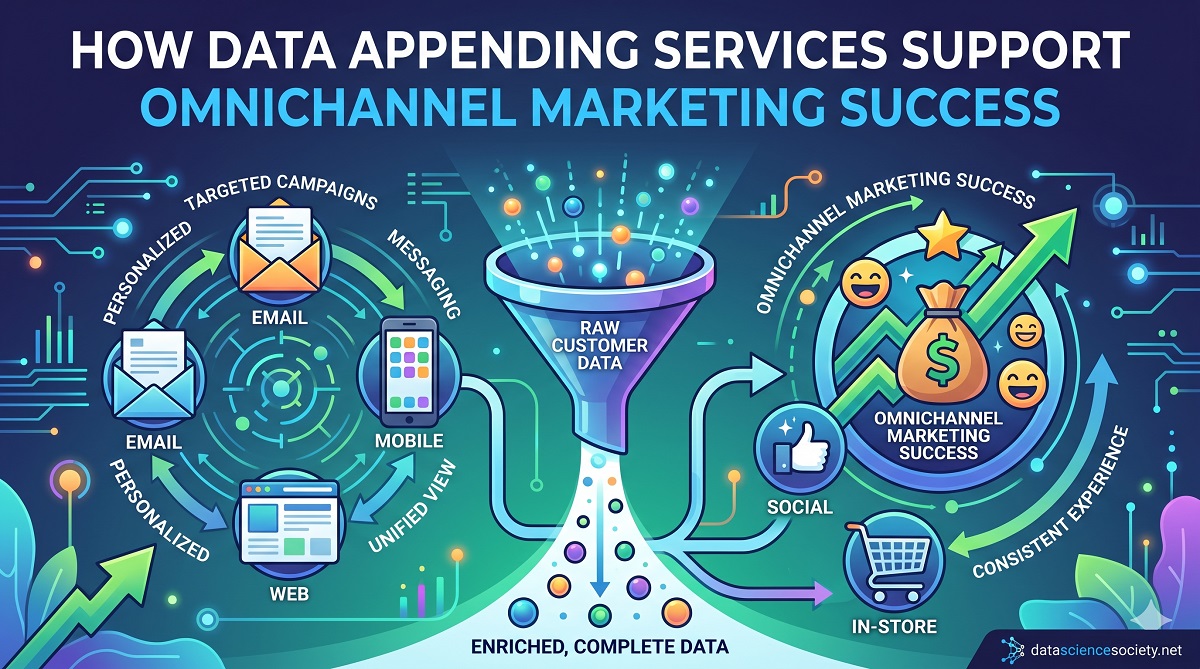
So, the key is to not only embrace omnichannel marketing but also excel in it. And the result of this is a whopping 287% increase in company sales. But achieving this level of impact is not a piece of cake. It requires more than just being present on multiple platforms. It depends on a strong data foundation to connect all the dots of the customer’s journey. That’s where data appending services enter, helping brands move from disconnected experiences to consistent and personalized ones.
Why Is Providing Consistent Omnichannel Experiences So Challenging?
While the consumers have multiple options to explore, this variety of touchpoints poses a challenge for businesses. They struggle to deliver a consistent experience across different channels. Let’s take a closer look at the roadblocks businesses face on their journey to omnichannel excellence:
1. Disconnected Customer Data
Customer data is often stored in different systems, such as CRMs, email platforms, mobile apps, and social media tools. What further worsens the situation is that each of these systems works in isolation. Thus, it becomes difficult to view the detailed picture. For instance, a customer’s in-app activity may never reach the store associate they speak to in person. As a result, the service feels disconnected and personalization falls short!
2. Delays in Real-Time Data Sync
In the age of 5G internet, customers expect instant responses. But the problem lies in real-time data sync. When this doesn’t happen, businesses can’t keep up with their customers’ expectations. A customer might receive a promotional email days after they’ve already made a purchase or be offered a discount on an item they’ve already bought. This damages trust and lowers engagement.
3. Incomplete View of the Customer Journey
Shoppers want every penny spent to be worth it. Thus, they often research online and purchase the product in-store. Even though many customers follow this pattern, businesses still can’t track their full journey. Optimizing campaigns becomes difficult without this visibility. Furthermore, stakeholders cannot allocate budgets effectively. As a result, business owners end up guessing what works and what doesn’t!
4. Inconsistent Brand Experiences
Customers aren’t much concerned about “channels”; they care about experiences. Imagine receiving a highly personalized email, only to be met with generic service at the store. This disconnect frustrates customers. And in the worst-case scenario, they may switch to other options.
5. Poor Data Quality
Incomplete contact information and duplicate records paired with outdated preferences are the elements that make it impossible to create relevant experiences. Besides, there are many reasons for data to be outdated. Some of these include people relocating, switching devices, and changing emails. In the absence of regular updates, a brand’s personalization efforts often fall flat! Even worse, they push away the audience brands are trying to connect with.
6. Difficulty Measuring What Works
Traditional models become unhelpful when leads interact with multiple channels. Was it the social media ad, the product rating, or the email offer that closed the deal? Without clarity, marketers can’t measure ROI or make smart decisions about where to invest.
Given all these challenges, it becomes next to impossible to deliver consistent experiences across multiple touchpoints. But the good news is that data appending can help fill the void. Wondering how? Let’s explore this in the next section.
How Does Data Appending Bridge the Gaps in Omnichannel Marketing?
A data appending company helps businesses connect the dots. By enriching and unifying customer data across systems, they enable timely, more relevant, and personalized interactions. The bonus point is that speed and consistency remain the same across every channel. Take a closer look:
I. Complete Customer Profiles
Data appending improves the quality of existing records by adding more information. This includes personal details, job titles, company size, and other relevant information. Thus, business owners can make a detailed sketch of their ideal customers and what they care about. The best part is that the stakeholders can get a complete snapshot of their ideal customers even when they haven’t shared that information directly. Isn’t this interesting?
II. Real-Time Synchronization Across Channels
With data appending, customer activity in one channel updates instantly across others. If someone clicks an ad, visits the site, and contacts support, all touchpoints reflect that journey. Thus, brands can respond to customers in real time, such as offering relevant product suggestions based on their latest actions.
III. Cleaner, Smarter Data
Before appending, data is thoroughly processed to remove duplicates, correct inaccuracies, and ensure consistent formatting. As a result, business owners can have peace of mind knowing that their segmentation and messaging efforts are based on trustworthy and up-to-date information, not flawed assumptions.
IV. Unified Customer Journey Tracking
By connecting fragmented data, brands can view their customers’ complete journey, from awareness to purchase. Even better, they can gain clarity on touchpoints that matter most and where to step in with targeted messaging or offers.
V. Smarter Segmentation and Personalization
The real advantage of data appending is that brands can build high-definition customer segments. For instance, rather than categorizing “shoppers aged 25–34,” they can identify “first-time buyers who clicked on a Facebook ad and visited a store within 7 days.” Perhaps, this is the level of insights needed to power personalization that says, “made especially for you.” Or, the messages that feel timely, relevant, and thoughtful, rather than intrusive.
VI. Predictive Insights That Drive Action
Data appending supports predictive analytics by identifying behavioral patterns. Owners can spot customers who are likely to churn and recommend products they may be interested in. Additionally, marketers can adjust marketing campaigns based on expected future behaviors, not just past ones.
VII. Consistent Campaigns, Everywhere
Marketing automation becomes smarter with unified data. Yes, that’s right! Brands can create campaigns that span multiple platforms, such as email, SMS, app notifications, and ads. This helps them deliver one consistent message that adapts to where the customer is in their journey.
Additionally, appended data paves the way for better attribution. Leaders know which combinations of touchpoints drive conversions and which ones don’t. In fact, businesses with solid omnichannel data strategies see a 9.5% increase in annual revenue and a 7.5% drop in cost per contact.
Final Words
Consumers want to be seen and heard. They want brands to know their choices and communicate consistently, no matter where or how they engage. For brands, delivering on such expectations is a necessity accompanied by technical challenges. Data appending services help make this possible. They turn scattered, outdated, and incomplete information into rich, unified profiles that support the omnichannel marketing strategy. And with instant insights, reliable data quality, and smarter segmentation, leaders can easily curate experiences that feel effortless, relevant, and human.