
A technician dispatched to fix broken equipment is already responding to a failure that’s cost the customer downtime, revenue, or safety risk — the damage happened before anyone made the call. For decades, field service organizations have operated on this same sequence: wait for equipment to break, then send someone to fix it.
Advance Field Service Management Software is changing this sequence by using AI to forecast equipment failure before it happens. Instead of reacting to breakdowns, organizations can now analyze sensor data, historical failure patterns, and usage conditions to intervene while equipment is still functioning. This article breaks down how predictive maintenance actually works, what separates it from traditional reactive field service, and how organizations can make this transition without losing the technical expertise that skilled field technicians provide.
What Is the Difference Between Reactive Repairs and Predictive Maintenance?
Reactive repair means a technician is dispatched only after equipment has already failed, responding to damage that’s already occurred. Predictive maintenance forecasts equipment failure before it happens, using sensor data and historical patterns to schedule intervention while the asset is still operational. The distinction determines whether downtime happens at all.
Traditional field service models were built around two response types: emergency dispatch when something breaks, or fixed-interval scheduled maintenance regardless of actual equipment condition. Neither approach accounts for the specific, real-time condition of an individual asset. Emergency dispatch is purely reactive by definition, while scheduled maintenance often either services equipment too early — wasting labor and parts on components with plenty of remaining life — or too late, after early warning signs were already present but unmonitored.
Predictive maintenance introduces a third model entirely: condition-based intervention driven by actual equipment data rather than a fixed calendar or a customer’s emergency call. This requires continuous monitoring capability that neither reactive nor traditional scheduled maintenance models were designed to support.
Why Reactive-Only Field Service Is No Longer Sustainable
Reactive-only field service is unsustainable because customer expectations for uptime have risen across every industry, and the hidden costs of unplanned downtime, emergency labor, and expedited parts shipping consistently exceed the cost of preventing the failure in the first place. Waiting for equipment to break is now the more expensive strategy, not the safer one.
Customers across manufacturing, healthcare, utilities, and commercial building operations increasingly measure service quality by uptime reliability rather than repair speed alone. A vendor that responds quickly to breakdowns is still perceived as less reliable than one whose equipment simply doesn’t break down as often. This shift in expectation puts pressure on field service organizations to demonstrate prevention, not just responsiveness.
The hidden costs of reactive repair compound quickly. Emergency labor typically costs more than scheduled labor, expedited parts shipping adds unplanned expense, and the equipment downtime itself often costs the customer far more than the repair invoice reflects — a halted production line or an inoperable HVAC system during extreme weather carries consequences well beyond the service call itself.
Traditional metrics like “mean time to repair” measure how quickly a problem gets resolved once it’s already happened, but they say nothing about failures that could have been prevented entirely. This creates a gap between customer trust and actual service reliability — a fast repair doesn’t rebuild the trust lost when equipment failed unexpectedly in the first place.
How AI-Powered Predictive Maintenance Works
AI-powered predictive maintenance works by continuously monitoring equipment condition through IoT sensors, applying machine learning models to detect early failure signals, automatically generating work orders before breakdowns occur, and optimizing technician dispatch and parts availability based on predicted needs. Each stage shifts intervention earlier in the failure timeline.
Step 1: Continuous Equipment Data Monitoring via IoT Sensors
Sensors track temperature, vibration, pressure, and usage cycles continuously, establishing a baseline performance pattern unique to each individual asset. This baseline matters because “normal” operating conditions vary significantly between machines of the same model, depending on age, usage intensity, and environmental factors.
Step 2: Predictive Failure Detection
Machine learning models trained on historical failure and maintenance records learn to recognize the specific data patterns that precede particular types of equipment breakdown. A gradual increase in vibration frequency, for example, might reliably precede bearing failure in a specific class of industrial motor, allowing the system to flag that risk well before a technician would notice anything unusual during a routine inspection.
Step 3: Automated Work Order Generation and Prioritization
The system scores maintenance needs by failure risk, asset criticality, and customer impact, generating work orders proactively rather than waiting for a service call. A piece of equipment supporting a critical production line receives higher prioritization than a similarly at-risk asset with lower operational impact, even if both show comparable failure risk scores.
Step 4: Intelligent Technician Scheduling and Dispatch
Advance Field Service Management Software matches technician skill sets and geographic location to predicted maintenance needs, optimizing routes and appointment windows based on urgency. This ensures the technician arriving on-site has the specific expertise the predicted failure type requires, rather than a generalist discovering mid-visit that specialized skills are needed.
Step 5: Parts and Inventory Forecasting
The system predicts which replacement parts a service call will likely require based on the specific failure pattern detected, reducing the common problem of technicians arriving without the correct component and needing a second visit. This forecasting also informs inventory stocking decisions across service vehicles and regional warehouses.
Step 6: Post-Service Performance Feedback Loop
Data from completed repairs feeds back into the predictive model, refining its accuracy over time. If a predicted failure didn’t match what the technician actually found on-site, that discrepancy trains the model to recognize the difference more precisely in future predictions.
Why This Shift Matters for Asset Uptime and Customer Trust
This shift matters because predictive maintenance directly reduces unplanned downtime, and preventing a failure is consistently less expensive than responding to one after equipment has already stopped functioning. Field service organizations adopting predictive capabilities are repositioning themselves from reactive vendors into strategic partners responsible for asset reliability.
The cost comparison is significant in practice. Preventive intervention — replacing a component showing early degradation signs during a scheduled visit — typically costs a fraction of an emergency repair involving expedited parts, overtime labor, and the customer’s own downtime losses. This economic reality is pushing more field service organizations toward predictive models, even accounting for the upfront investment in sensor infrastructure and analytics capability.
Predictive service also strengthens long-term customer relationships and contract retention. A vendor capable of demonstrating fewer breakdowns, rather than simply faster repairs, becomes significantly harder for a customer to replace. This is driving a broader shift in how field service organizations position themselves — moving from a cost center focused on completing service calls efficiently, to a strategic value driver responsible for maximizing customer asset uptime.
Key Benefits of AI-Driven Predictive Maintenance
AI-driven predictive maintenance reduces equipment downtime, lowers emergency repair costs, and improves first-time fix rates through accurate parts forecasting. These benefits compound to extend asset lifespan and strengthen the customer relationships that depend on consistent service reliability.
- Reduced equipment downtime — Early failure detection allows intervention before equipment stops functioning entirely.
- Lower emergency costs — Fewer breakdowns mean less reliance on expedited parts shipping and overtime emergency labor.
- Improved first-time fix rates — Accurate parts forecasting ensures technicians arrive with the components a predicted failure actually requires.
- Better technician utilization — Optimized scheduling matches the right skill set to the right job, reducing wasted trips and mismatched dispatches.
- Extended asset lifespan — Condition-based maintenance addresses component wear at the appropriate time, rather than too early or too late.
- Stronger customer retention — Demonstrable improvements in uptime reliability make switching to a competing vendor a harder decision for customers.
Real-World Use Cases
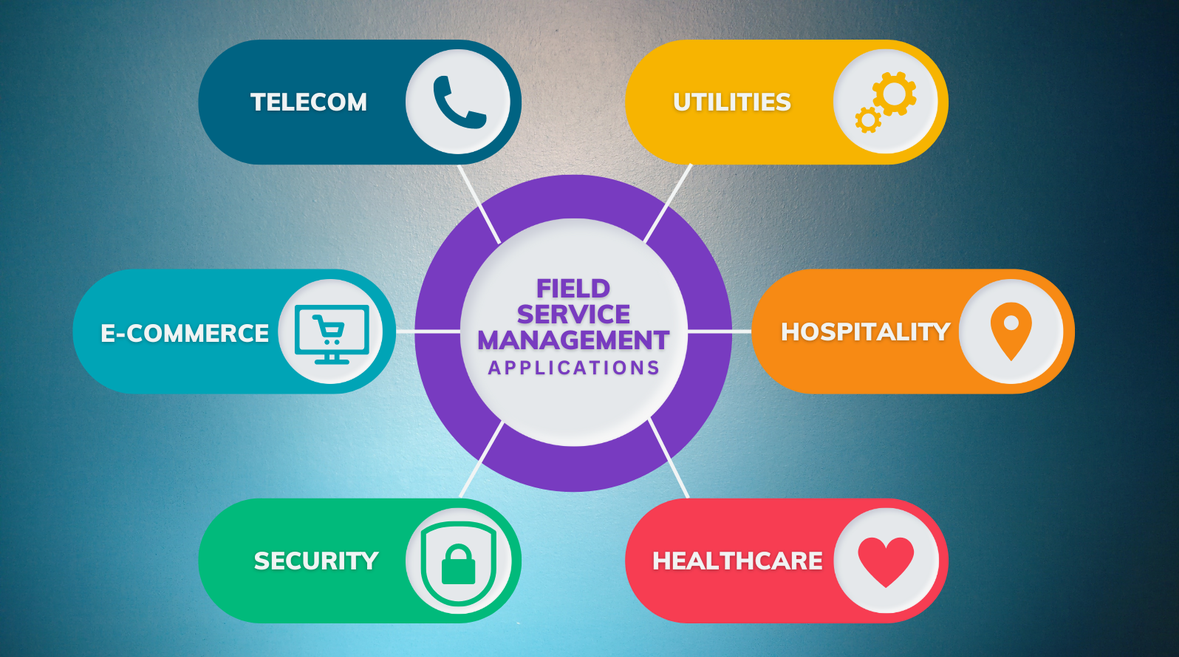
Advance Field Service Management Software applies across manufacturing, HVAC, fleet management, and utility infrastructure — each industry using predictive signals differently based on the specific failure modes and operational stakes involved.
Manufacturing equipment maintenance relies on predictive models to catch early signs of machinery degradation before a failure halts an entire production line, where even brief unplanned downtime can carry substantial cost across dependent processes.
HVAC and building systems service providers use predictive maintenance to forecast system failures before extreme weather events increase both service demand and repair costs, allowing preventive intervention during lower-demand periods rather than competing for emergency technician availability during a heat wave or cold snap.
Fleet and vehicle maintenance operations apply telematics data — engine performance, mileage patterns, component wear indicators — to schedule maintenance before roadside breakdowns occur, reducing the operational disruption and safety risk associated with unexpected vehicle failure.
Utility and infrastructure field service teams use predictive maintenance on critical equipment where failure risks broader service outages, making early intervention a matter of public reliability rather than simply operational efficiency.
Challenges in Shifting From Reactive to Predictive Field Service
Common challenges include dependency on consistent, high-quality sensor data, the upfront cost of IoT deployment across existing equipment, and the cultural shift required to move technician teams from a “fix what’s broken” mindset to a prevention-focused approach. These obstacles are both technical and organizational.
Predictive accuracy depends entirely on data quality. Inconsistent or poorly calibrated sensor data undermines the model’s ability to distinguish genuine warning signs from normal operational variation, producing unreliable predictions that erode confidence in the system. The upfront cost of deploying IoT sensors across existing equipment fleets can also be substantial, particularly for organizations managing large numbers of older assets not originally designed with sensor integration in mind.
Integration complexity presents another significant hurdle, since predictive maintenance requires connecting sensor data, historical maintenance records, and enterprise asset management systems that often exist as separate, poorly integrated platforms. Beyond the technical challenges, there’s a genuine cultural shift required internally — technicians and service teams historically measured by repair speed and call volume need to adopt new success metrics centered on prevention, which requires deliberate change management rather than assuming the transition will happen naturally. Alert fatigue is a related practical risk: overly sensitive predictive models that flag too many false positives quickly train technicians to ignore alerts altogether, undermining the entire system’s value.
Best Practices for Implementing AI-Driven Predictive Maintenance
Successful implementation depends on starting with high-value assets, combining sensor data with technician field expertise, and measuring success by prevented failures rather than completed service call volume alone. These practices help organizations build confidence in predictive capabilities before scaling more broadly.
- Start with high-value or high-failure-risk assets before scaling predictive capabilities fleet-wide
- Combine sensor data with technician field observations to improve model accuracy over time
- Continuously retrain predictive models using new failure and repair data as patterns evolve
- Set clear thresholds to avoid excessive false-positive maintenance alerts that erode technician trust
- Measure success by prevented failures and reduced downtime, not solely by completed service calls
- Maintain clear communication with customers about the purpose and value of proactive maintenance visits
Future Trends in AI-Powered Field Service Management
Emerging trends include digital twin simulations for refining failure predictions, deeper integration between predictive analytics and automated parts procurement, and the expansion of predictive maintenance into outcome-based service contracts. These developments point toward field service becoming an increasingly data-driven, continuously optimized discipline.
Digital twins — virtual models simulating how a specific piece of equipment behaves under varying conditions — are increasingly used to refine failure predictions without needing to observe every failure scenario in the physical world first. Deeper integration between predictive analytics and automated parts procurement is also reducing the lag between identifying a likely component failure and having the replacement part available when the technician arrives.
Augmented reality tools are beginning to guide technicians through complex predictive repairs remotely, allowing less experienced staff to handle specialized interventions with expert guidance overlaid directly onto their field of view. As these capabilities mature, autonomous diagnostics are reducing the need for manual inspection in routine cases, and predictive maintenance is increasingly forming the foundation of outcome-based service contracts, where vendors are compensated based on demonstrated uptime rather than the number of service calls completed.
Key Takeaways
- Reactive field service only responds to equipment that has already failed, while predictive maintenance forecasts failure and intervenes before downtime occurs.
- The hidden costs of reactive repair — emergency labor, expedited parts, customer downtime — consistently exceed the cost of preventing the failure in advance.
- Advance Field Service Management Software combines IoT sensor data with machine learning to detect early failure signals specific to individual assets, not generic equipment models.
- Predictive maintenance shifts field service organizations from cost centers focused on repair speed into strategic partners responsible for customer asset uptime.
- Successful implementation requires starting with high-value assets and combining sensor data with technician field expertise to build model accuracy over time.
- Measuring success by prevented failures, rather than completed service call volume, is essential to capturing the true value of a predictive maintenance program.
Conclusion
The shift from reactive repairs to predictive maintenance isn’t just an operational upgrade — it’s a fundamental change in how field service organizations define reliability. Responding quickly to a breakdown no longer satisfies customer expectations shaped by industries where failures are anticipated and prevented rather than simply repaired.
Evaluating whether your current field service model responds to equipment failure or helps prevent it before it happens is a practical starting point for this transition. The field service organizations winning on customer trust aren’t the ones responding to breakdowns fastest — they’re the ones using Advance Field Service Management Software to ensure fewer breakdowns happen at all.