
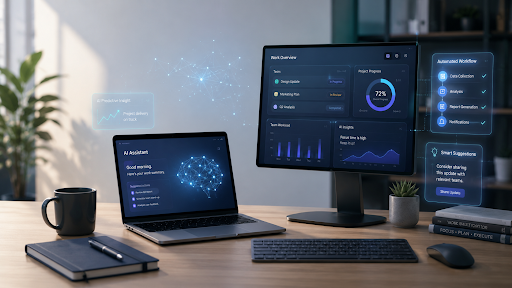
Artificial intelligence has spent years being announced as the future. But somewhere between the hype cycles and the breathless conference keynotes, it actually arrived , quietly, without much ceremony , in the tools most of us use every day.
It didn’t show up as a robot. It showed up as an autocomplete that finally understood context, a grammar suggestion that sounded like a human editor, a search result that answered your question instead of listing ten links and wishing you luck. The shift has been gradual enough that a lot of people haven’t quite registered how different their workflows look today compared to five years ago.
This article is about that shift , specifically, how AI-enhanced tools are changing the way people work, and why the most meaningful improvements are often the least dramatic ones.
The Productivity Myth Gets Complicated
For decades, productivity software promised to save us time. And technically, it did. Spreadsheets replaced ledger books. Word processors replaced typewriters. Email replaced the postal system for most business communication.
But each new tool also created new work. Suddenly you needed to manage your inbox. You needed to format spreadsheets, hunt down formulas, reconcile version histories. The overhead of using powerful software quietly ate into the time the software was supposed to free up.
AI changes this dynamic , not by eliminating the overhead entirely, but by absorbing a lot of it. Writing an email used to mean sitting down to compose it. Now, many email clients will draft a reasonable response based on the thread context. You still review it, tweak it, send it under your name. But the first-draft blank-page problem? Mostly gone.
The same logic applies to code. Junior developers today have access to AI pair-programming tools that suggest completions, catch common bugs, and explain unfamiliar libraries in plain language. None of this replaces the need to actually understand what you’re building , but it dramatically lowers the friction of building it.
Small Tools, Big Impact
Here’s something worth paying attention to: the most useful AI integrations right now aren’t always the most glamorous ones.
Take the world of hardware optimization and performance tuning , an area that serious PC users, gamers, and designers have always had to manage manually. Getting precise control over your mouse sensitivity used to mean digging through driver menus, running test grids, and making educated guesses. Today, utilities have started embedding smarter calibration logic into this process. If you’ve ever used a Mouse DPI checker tool, you know exactly what kind of micro-optimization this represents , it’s a focused, single-purpose utility that removes ambiguity from a setting most people just guess at. That same philosophy of “make the measurement accurate so the human can make a better decision” is showing up across software categories, quietly powered by better algorithms under the hood.
This is AI working where it’s most effective: not replacing human judgment, but giving human judgment better raw material to work with.
Where AI Is Still Falling Short
It would be dishonest not to mention the gaps. AI tools are impressive, but they’re not uniformly reliable , and treating them as infallible is one of the more common mistakes people make when they first adopt them.
Language models, for instance, have a well-documented tendency to sound confident while being wrong. This is a serious problem in professional contexts where the cost of a confident error is high. Medical information, legal research, financial analysis , these are areas where AI tools can help you think, but shouldn’t be the last word on anything consequential.
There’s also the question of context. Most AI tools, however sophisticated, operate without genuine understanding of your specific situation. They work from patterns, which means they work well in common scenarios and poorly in edge cases. The more unusual your situation, the less you should trust a general-purpose AI output without reviewing it carefully.
What Actually Changes With AI
If you strip away the hype, AI tools mostly do one thing well: they reduce the cost of producing a first draft.
That first draft might be a piece of writing, a block of code, a data visualization, a suggested reply, or even a calibrated hardware setting. The cost of getting from zero to something workable drops significantly. From that point forward, you still need human judgment , to evaluate, edit, refine, and take responsibility for the final output.
This is actually a big deal. First drafts are where most productive effort stalls. The blank page, the empty function, the unresponded message , these friction points compound over a workday. Removing them, or even reducing them, has a measurable effect on how much people actually get done.
The quiet revolution in AI isn’t about machines replacing humans at the top of the value chain. It’s about machines handling the friction at the bottom , so humans can spend more time on the parts of work that actually require them.
Getting Practical About It
If you haven’t already, the most useful thing you can do with AI right now is experiment with specificity. Vague prompts produce vague results. When you tell a writing tool exactly what you want , the tone, the audience, the length, the purpose , the output improves substantially.
The same applies to how you integrate AI into your existing workflow. Don’t try to replace everything at once. Find one friction point, whether that’s drafting routine communications, generating code scaffolding, or even identifying the right settings for your hardware setup, and see what a smarter tool can do with it.
The people who get the most out of AI aren’t the ones who trust it most. They’re the ones who understand what it’s actually good at, and route the right problems through it accordingly.
That’s not a complicated idea. But it’s a surprisingly rare one.