
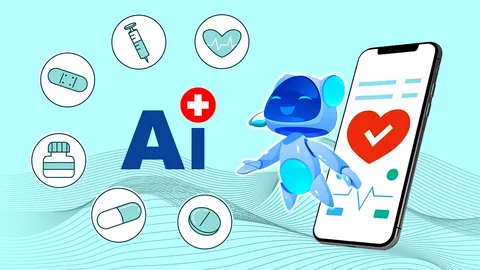
In the fast-evolving world of healthtech, healthcare app development is revolutionizing how patients access care, doctors make decisions, and trials run more smoothly. Imagine a mobile app that predicts heart risks before symptoms strike or uses AI to analyze rehab exercises in real-time. That’s the promise of AI-driven healthcare app development. But as a healthcare mobile app development company or custom healthcare software development company, we can’t ignore the ethical tightrope. With tools like Epic integration and Epic systems integration, developers must balance innovation with responsibility. Let’s dive into the key ethical considerations shaping custom healthcare software development and Epic integration healthcare software development.
The AI Boom in Healthcare Apps
AI isn’t just hype—it’s transforming healthcare app development services. From chatbots triaging symptoms to machine learning models spotting cancers in scans, these apps save lives and cut costs. A custom healthcare software development project might integrate AI for personalized treatment plans, while Epic EHR integration pulls patient data seamlessly into apps via Epic integration. Picture a clinician using an app linked to Epic systems for instant access to histories during telemedicine. According to recent stats, AI in healthcare could add $150 billion to $250 billion annually to the U.S. economy by optimizing workflows (McKinsey, 2023).
Yet, this power demands caution. Ethical lapses—like biased algorithms denying care—could erode trust faster than any app builds it. Developers at firms offering healthcare app development services must prioritize ethics from the design phase.
Data Privacy: The Bedrock of Trust
At the heart of ethical healthcare app development lies data privacy. Health data is gold—sensitive, personal, and ripe for breaches. AI apps thrive on vast datasets, but mishandling them invites disaster. HIPAA in the U.S. or GDPR in Europe set baselines, yet enforcement lags behind tech’s speed.
Consider Epic EHR integration in a custom healthcare software development workflow. Epic’s robust platform handles millions of records, but integrating it into a mobile app means exposing data to new vulnerabilities. A healthcare mobile app development company must encrypt transmissions, anonymize data for AI training, and secure consent granularly—patients should opt in for specific uses, like sharing fitness tracker data for AI-driven insights.
Real-world example: The 2023 MOVEit breach exposed the health records of 8 million, highlighting risks. Ethical developers implement “privacy by design,” using federated learning where AI trains on-device without centralizing data. This protects users while enabling Epic integration for healthcare software development.
Bias and Fairness: AI’s Hidden Flaws
AI sounds objective, but it’s only as good as its training data. Biased inputs lead to biased outputs, a massive ethical pitfall in healthcare app development. Algorithms trained on skewed datasets—say, mostly light-skinned patients—underperform for others, exacerbating disparities.
In custom healthcare software development for clinical trials, AI might recruit participants unfairly if not checked. Or in epic systems integration apps, predictive models could flag high-risk patients inaccurately across ethnic groups. Studies show facial recognition AI errs up to 34% more on darker skin (MIT, 2018).
To counter this, healthcare app development services providers audit datasets for diversity, use fairness metrics like demographic parity, and involve ethicists early. A custom healthcare software development company building rehab apps with motion-tracking AI tests across ages, genders, and abilities. Transparency helps: Explain how models decide, so doctors aren’t blindly following black-box predictions.
Informed Consent and Transparency
Patients deserve to know when AI’s involved. Ethical healthcare app development mandates clear, jargon-free consent. Not vague “we use AI” disclaimers, but specifics: “This app’s AI analyzes your scans to suggest treatments, trained on 10,000 anonymized cases.”
With Epic integration, apps pull epic EHR data automatically—great for efficiency, but patients must consent to sharing. A healthcare mobile app development company shines by using plain-language interfaces, like sliders showing data flow visuals. Post-deployment, transparency reports on AI accuracy build ongoing trust.
Accountability: Who Owns the Mistake?
When AI errs—misdiagnosing a tumor—who’s liable? Developers, hospitals, or the AI itself? In epic ehr integration projects, chains of accountability blur. Ethical frameworks demand “human-in-the-loop” designs, where clinicians override AI, not vice versa.
Custom healthcare software development teams embed audit trails, logging every AI decision for review. Regulations like the EU AI Act classify health AI as “high-risk,” requiring rigorous testing. A forward-thinking custom healthcare software development company partners with legal experts to define liabilities upfront.
Accessibility and Equity: For All, Not Just Some
AI apps risk widening gaps if not inclusive. Ethical healthcare app development ensures accessibility—voice commands for the visually impaired, low-data modes for rural users. In Pakistan or underserved U.S. areas, where healthcare app development services are booming, apps must support local languages and offline functionality.
Epic integration healthcare software development amplifies this: Epic’s dominance means integrations mustn’t lock out smaller clinics. Prioritize equitable AI that serves diverse populations, reducing global health divides.
Sustainability and Long-Term Impact
Finally, consider AI’s environmental toll—training models guzzle energy. Ethical developers optimize for green computing, vital as healthtech scales.
Navigating Ethics in Practice
Leading healthcare mobile app development company teams embed ethics via multidisciplinary squads: coders, clinicians, ethicists. Tools like Google’s What-If Tool probe biases, while standards from WHO guide responsible AI.
For epic systems integration, certify compliance early. Success stories abound—a startup’s AI app for diabetic retinopathy screening, with ethical guardrails, screened 1 million eyes ethically.
The Path Forward
Healthcare app development with AI holds immense promise, but ethics isn’t optional—it’s the differentiator. Whether you’re a custom healthcare software development company tackling Epic integration or offering healthcare app development services, prioritize privacy, fairness, consent, accountability, equity, and sustainability. Done right, these apps don’t just innovate; they heal responsibly.
In healthtech, trust is the ultimate prescription. Let’s build it, one ethical line of code at a time.