
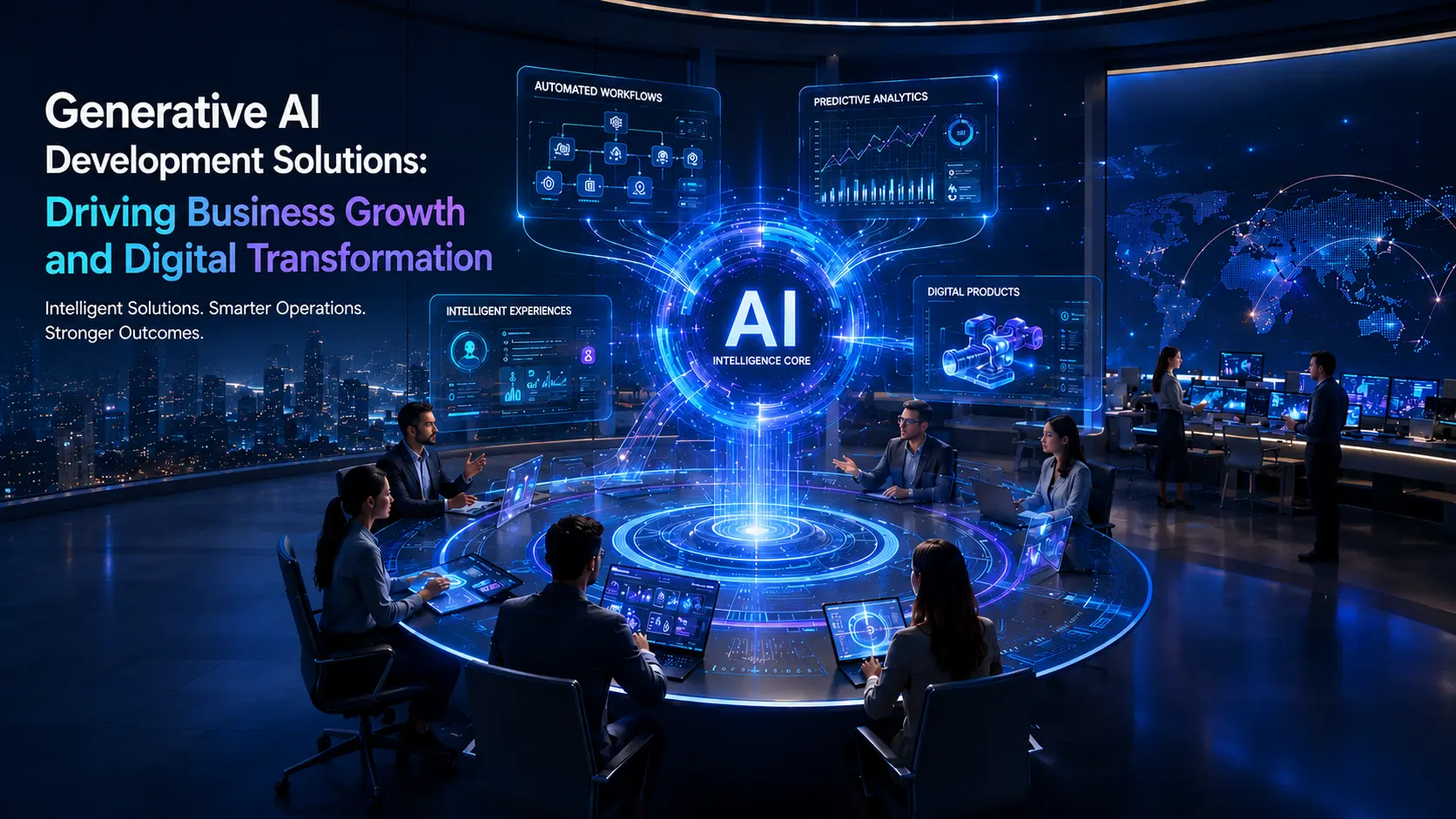
Artificial intelligence has evolved from an emerging technology into a critical business enabler. Organizations across industries are increasingly investing in generative AI development services to automate operations, enhance customer experiences, and accelerate innovation. From intelligent content creation and personalized recommendations to advanced business automation, generative AI is redefining how companies operate in a digital-first environment.
However, building AI-powered solutions is only one part of the equation. To maximize business value, organizations must also leverage AI integration services that seamlessly connect AI capabilities with existing systems, workflows, and data infrastructure. Together, these technologies help businesses improve efficiency, increase scalability, and gain a competitive advantage in rapidly evolving markets.
What Generative AI Means for Modern Businesses
Generative AI refers to artificial intelligence systems capable of creating content, generating insights, producing code, and automating decision-making processes based on large datasets and machine learning models.
Modern organizations use generative AI to:
- Automate repetitive business tasks
- Create personalized customer experiences
- Generate marketing and sales content
- Improve customer support operations
- Accelerate software development
- Enhance business intelligence and analytics
As AI technologies continue to mature, businesses are moving beyond experimentation and integrating AI into core operational strategies.
Benefits of Generative AI Development Services
Enhanced Operational Efficiency
One of the most significant advantages of generative AI development services is the ability to automate time-consuming processes. AI-powered systems can perform tasks faster and more accurately than traditional manual workflows.
Examples include:
- Automated report generation
- Intelligent document processing
- Content creation and optimization
- Workflow automation
- Data analysis and summarization
This allows employees to focus on higher-value strategic activities.
Improved Customer Experience
Generative AI enables organizations to deliver highly personalized interactions across multiple customer touchpoints.
Benefits include:
- AI-powered chatbots and virtual assistants
- Personalized product recommendations
- Real-time customer support
- Automated response generation
- Multilingual customer engagement
These capabilities help improve customer satisfaction while reducing operational costs.
Faster Innovation and Product Development
Organizations can significantly reduce development timelines by using AI-assisted coding, automated testing, and intelligent design support.
Key Innovation Outcomes
- Faster product launches
- Reduced development costs
- Improved software quality
- Accelerated research and development
- Enhanced market responsiveness
How AI Integration Services Accelerate Digital Transformation
While AI models generate valuable insights, businesses achieve maximum impact when those capabilities are fully embedded into existing operations. This is where AI integration services become essential.
Connecting AI with Existing Systems
Many organizations operate complex ecosystems consisting of CRM platforms, ERP systems, cloud applications, and legacy software.
AI integration services help organizations:
- Connect AI tools with business applications
- Enable real-time data sharing
- Improve workflow automation
- Enhance decision-making processes
- Maintain operational continuity
Creating Unified Digital Ecosystems
Successful digital transformation requires seamless collaboration between technology systems.
Areas Commonly Integrated with AI
- Customer Relationship Management (CRM)
- Enterprise Resource Planning (ERP)
- Marketing Automation Platforms
- Supply Chain Management Systems
- Business Intelligence Tools
By integrating AI across these environments, businesses create intelligent ecosystems capable of driving continuous optimization and growth.
Key Industries Adopting AI Solutions
Generative AI adoption is expanding across virtually every sector.
Healthcare
Healthcare providers use AI for:
- Medical documentation
- Clinical decision support
- Patient engagement
- Predictive analytics
Financial Services
Financial institutions leverage AI to:
- Detect fraud
- Automate compliance monitoring
- Improve customer service
- Enhance risk assessment
Retail and E-Commerce
Retail businesses benefit from:
- Personalized shopping experiences
- Inventory optimization
- Demand forecasting
- Automated customer support
Manufacturing
Manufacturers use AI to:
- Predict equipment failures
- Optimize production planning
- Improve quality control
- Streamline supply chain operations
Technology and SaaS
Software companies increasingly invest in generative AI development services to build intelligent applications, automate development processes, and enhance user experiences.
Steps for Successfully Implementing AI Solutions
Organizations that achieve the highest return on investment typically follow a structured implementation strategy.
Step 1: Identify High-Impact Use Cases
Begin by evaluating business challenges that AI can address effectively.
Examples include:
- Customer service automation
- Content generation
- Workflow optimization
- Data analysis
- Predictive forecasting
Step 2: Assess Data Readiness
AI performance depends heavily on data quality.
Organizations should ensure:
- Clean and accurate datasets
- Strong data governance
- Secure data management practices
- Regulatory compliance
Step 3: Select the Right Technology Partner
Choosing experienced providers of generative AI development services helps reduce implementation risks and accelerate deployment.
Step 4: Implement AI Integration Services
Integrating AI with existing systems ensures that insights and automation capabilities deliver measurable business outcomes.
Step 5: Monitor and Optimize Performance
AI implementation is an ongoing process that requires:
- Continuous model improvement
- Performance monitoring
- User feedback collection
- Scalability planning
Conclusion
Artificial intelligence is rapidly becoming a foundational component of modern business strategy. Organizations that leverage can unlock new levels of efficiency, innovation, and customer engagement. At the same time, effective AI integration services ensure that AI capabilities are seamlessly embedded within existing business operations, maximizing long-term value and scalability.
Partnering with experienced technology innovators such as RipenApps can help businesses navigate the complexities of AI adoption, from solution development to seamless integration. With the right expertise and strategic approach, organizations can accelerate implementation, reduce risks, and maximize the value of their AI investments.
As digital transformation continues to accelerate, businesses that adopt a strategic AI roadmap will be better equipped to optimize processes, improve decision-making, and create sustainable competitive advantages. Investing in AI today is no longer an option for forward-thinking organizations; it is a critical step toward future growth and success.
FAQs
What are generative AI development services?
Generative AI development services involve designing, building, and deploying AI-powered solutions that can create content, generate insights, automate workflows, and improve business processes.
Why are AI integration services important for businesses?
AI integration services connect AI technologies with existing business systems, enabling seamless automation, better data utilization, and improved operational efficiency.
Which industries benefit most from generative AI development services?
Industries such as healthcare, finance, retail, manufacturing, and technology benefit significantly from generative AI through automation, personalization, and enhanced decision-making.
How long does it take to implement AI solutions?
Implementation timelines vary depending on project complexity, data readiness, and integration requirements, but many organizations begin seeing results within a few months.
Can small businesses benefit from AI integration services?
Yes. Small businesses can use AI integration services to automate routine tasks, improve customer experiences, reduce operational costs, and scale more efficiently.