
According to recent data from the Institute of Finance and Management (IOFM), companies implementing AI-powered invoice OCR solutions have reduced processing costs by 81% since 2023. This represents an average annual savings of $325,000 for mid-sized businesses processing 5,000 invoices monthly.
- Does your accounts payable team spend hours manually typing invoice data into your systems?
- How many payment delays occur due to invoice processing errors or backlogs?
- What would your finance department achieve if invoice data was available instantly?
Businesses receive invoices in numerous formats – paper, PDFs, emails, or digital files. Traditional processing methods involve manual data entry, which consumes time, introduces errors, and costs money.
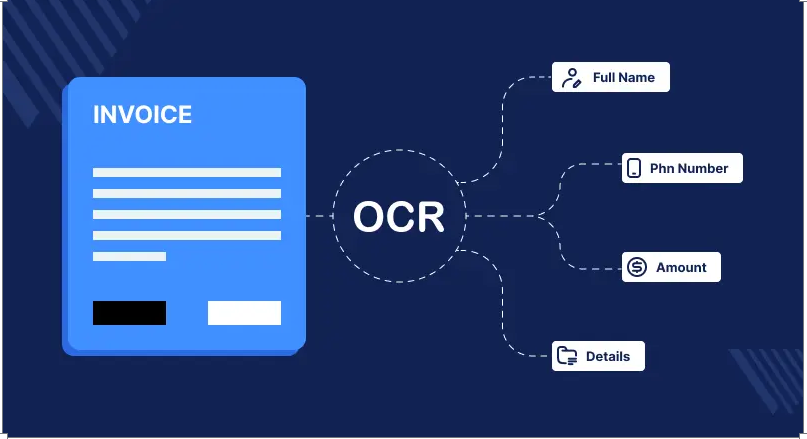
AI-powered invoice OCR transforms this approach by automatically identifying and extracting key data points from any invoice format with minimal human intervention.

What is AI-Powered Invoice OCR?
AI-powered invoice OCR is technology that automatically captures, extracts, and processes information from supplier invoices. This technology uses artificial intelligence to understand both invoice structure and content, then transforms specific data points into structured formats for accounting systems.
The technology combines multiple AI components working in concert. Optical Character Recognition (OCR software) turns printed or digital text into machine-readable format. Machine learning algorithms analyze patterns to locate specific invoice fields. Natural Language Processing (NLP) interprets the context and meaning of extracted text.
Advanced systems adapt to new invoice formats through continuous learning. After processing several invoices from a specific vendor, the system identifies patterns in how that supplier formats their documents and adjusts extraction rules accordingly. This reduces the need for manual configuration when onboarding new suppliers.
Key Components of AI Invoice OCR
- AI invoice OCR systems contain several technological components working together to deliver accurate extraction results. Understanding these components helps organizations select the right solution for their needs.
- Computer vision technology allows the system to analyze the visual layout of invoices. This helps identify data fields based on their position, font characteristics, and proximity to labels. Computer vision is particularly valuable when processing invoices with varying formats and layouts.
- Machine learning algorithms enable the system to improve over time. The algorithms identify patterns in invoice formats and learn to recognize field locations across different vendors. This continuous learning capability makes the system more accurate with each processed invoice.
- Data validation rules check extracted information for accuracy and completeness. These rules verify calculations, match purchase order numbers, and flag discrepancies for review. Validation rules significantly reduce errors that might otherwise require manual correction.
- Integration capabilities connect the OCR system with accounting software, ERPs, and payment systems. This allows extracted data to flow automatically into business systems without manual intervention. Strong integration options are essential for maximizing automation benefits.
Benefits of AI-Powered Invoice OCR
Organizations implementing AI invoice OCR realize numerous benefits that impact operational efficiency, cost structure, and staff productivity.
Cost Reduction
Processing cost decreases significantly with automation. Manual invoice processing costs $15-$40 per invoice on average. AI invoice OCR reduces this to $2-$4 per invoice. For a company processing 5,000 invoices monthly, this represents annual savings of over $840,000.
Error-related costs decline dramatically with automated extraction. The average cost to correct an invoice processing error ranges from $53-$110 depending on when it’s discovered. AI systems with 98.5% accuracy substantially reduce these correction costs.
Operational Improvements
Processing speed increases dramatically with automation. Manual invoice processing takes 8-14 days on average. AI-powered systems reduce this to hours or even minutes. This acceleration improves vendor relationships and provides better visibility into financial obligations.
Exception handling becomes more efficient with AI-assisted review. The system flags only those invoices requiring human attention, with specific fields highlighted for review. This focused approach makes exception handling much faster than full manual review.
Strategic Advantages
Staff reallocation to strategic activities becomes possible with automation. Accounts payable staff can focus on vendor management, payment optimization, and financial analysis rather than manual data entry. This shift creates more value from existing personnel.
Vendor relationship management improves with consistent, accurate processing. Suppliers receive timely payments with fewer queries about invoice status. This consistency builds stronger supplier relationships and may lead to more favorable terms.
Implementation Process for AI Invoice OCR
Implementing AI invoice OCR requires methodical planning and execution. Organizations should follow a structured approach to ensure successful deployment.
Assessment and Planning
Start with a thorough assessment of your current invoice processing workflows. Document the current process steps, handling time, error rates, and costs. Map the flow of invoices through your organization to understand approval workflows and bottlenecks.
Analyze your invoice volume and types. Categorize invoices by format (paper, PDF, electronic) and vendor. Identify the top vendors by volume to prioritize during implementation. A typical business finds that 20% of vendors account for 80% of invoices.
System Selection and Customization
Evaluate AI invoice OCR solutions based on your specific requirements. Consider factors like accuracy rates, handling of your invoice formats, integration capabilities with your accounting system, and scalability. Request vendor demonstrations using your actual invoices to assess performance.
Many organizations benefit from solutions with pre-trained models for common invoice formats. These systems provide faster implementation and higher initial accuracy. Look for systems with strong learning capabilities that improve over time.
Integration with existing accounting systems and ERPs maximizes automation benefits. Ensure the selected solution offers appropriate APIs or pre-built connectors for your financial systems. Test integrations thoroughly during implementation.
Deployment and Training
Roll out the solution in phases, starting with a pilot covering specific vendors or invoice types. This approach allows you to refine the implementation process before full deployment. Most organizations begin with their highest-volume vendors to maximize initial impact.
Monitor system performance closely during the initial weeks after deployment. Track key metrics like processing time, accuracy rates, and exception volumes to identify any necessary adjustments. Address any issues promptly to maintain user confidence.
Measuring ROI of AI Invoice OCR
Organizations implementing AI invoice OCR should establish clear metrics to measure return on investment. This quantifies business impact and justifies technology investment.

Direct Cost Savings
- Processing labor costs: Calculate reduction in manual data entry hours and costs
- Most organizations see 70-85% reduction in data entry time
- Document both headcount reductions and staff reallocation
- Error reduction: Measure decrease in correction activities and costs
- Error rates typically drop from 5-8% to under 1.5%
- Each prevented error saves $53-$110 in correction costs
- Payment optimization: Track financial benefits through:
- Increased capture of early payment discounts (75% improvement typical)
- Reduction in late payment fees
- Better cash flow management
Indirect Benefits
- Faster processing cycles: Measure time from receipt to payment readiness
- Track impact on vendor relationships
- Monitor staff workload distribution improvements
- Staff productivity: Assess output per accounts payable team member
- Look for increases in strategic activities
- Measure reduction in overtime or temporary staffing
- Improved visibility: Calculate how quickly invoice data becomes available
- Better cash management
- More accurate financial reporting and forecasting
Common Challenges and Solutions
Despite significant benefits, organizations may face challenges when implementing AI invoice OCR.
Technical Challenges
- Invoice format variations
- Challenge: Vendors use unique formats or change layouts frequently
- Solution: Adaptive learning systems adjust to changes automatically
- Legacy system integration
- Challenge: Older systems lack modern APIs for data exchange
- Solutions: Middleware connectors, custom integration, or phased upgrades
- Data security concerns
- Challenge: Invoice data contains sensitive business information
- Solution: Strong security controls including encryption and access limitations
Organizational Challenges
- Change management
- Challenge: Staff resistance to new automated processes
- Solution: Clear communication about how automation supports employees
- Process redesign
- Challenge: Simply digitizing inefficient processes limits benefits
- Solution: Review approval workflows to eliminate unnecessary steps
- Ongoing governance
- Challenge: Maintaining system performance over time
- Solution: Clear responsibilities for monitoring and vendor onboarding
Conclusion
AI-powered invoice OCR delivers substantial benefits for businesses that process high invoice volumes. The technology reduces costs while improving accuracy and processing speed. Implementation requires planning but delivers quick returns.
- Cost reduction of 70-85% compared to manual processing methods
- Processing time drops from days to minutes for most invoices
- Staff reallocation to higher-value activities improves financial operations
- Better vendor relationships through consistent, accurate payment processing
FAQs
What is AI-powered invoice OCR?
AI-powered invoice OCR is technology that automatically identifies and captures data from supplier invoices. It uses machine learning to understand invoice structure and extract information accurately.
How accurate is AI invoice OCR technology?
Modern AI invoice OCR systems achieve 95-98.5% accuracy for most business invoices. The accuracy depends on invoice quality and system training with your specific invoice formats.
What invoice formats work with AI OCR?
AI OCR works with all invoice formats including paper, PDF, images, and electronic invoices. Modern systems handle structured, semi-structured, and unstructured invoice layouts from any vendor.
How long does implementation typically take?
Implementation typically takes 4-6 weeks for most organizations. The timeline depends on invoice complexity, integration requirements, and the number of major vendors included.