
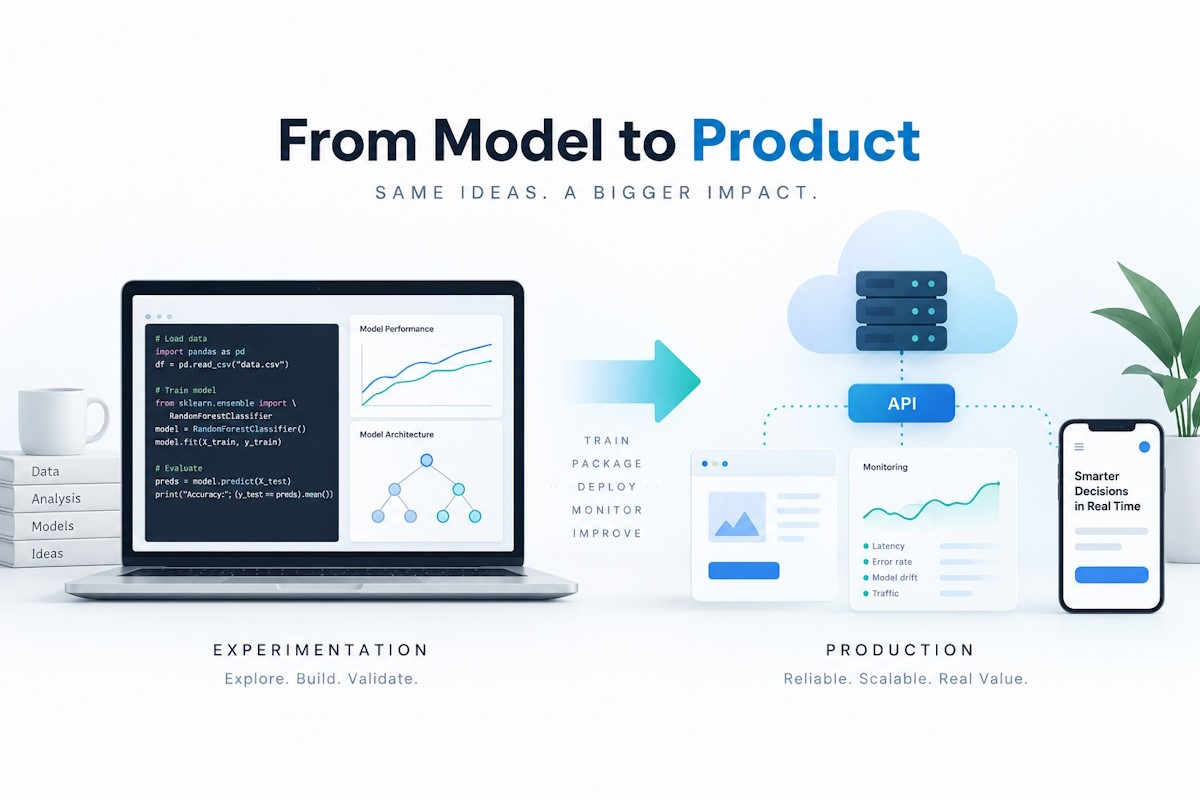
 A data science model can look impressive inside a notebook.
The dataset has been cleaned. Features have been prepared. Training runs are repeatable. Accuracy looks good. The confusion matrix makes sense. A few sample predictions give the team confidence that the underlying idea works.
Then someone asks a simple question: “Can users start using it?”
That question changes the project.
A notebook proves that a model can learn something useful from a particular dataset under controlled conditions. A product has to produce useful results repeatedly while dealing with new data, software failures, changing user behavior, network delays, security rules, and business expectations.
This is the gap between model development and production machine learning.
Moving across that gap does not simply mean hosting a model on a server. The model becomes one component inside a much larger software and data system.
The Model Stops Being the Whole Project
During experimentation, most attention goes toward the model itself.
A data scientist may compare algorithms, tune parameters, test different feature sets, and select the version with the strongest validation results. At this stage, the model can feel like the main deliverable.
In production, the model may represent only a small part of what users actually depend on.
A working ML product may also require:
- a source for live or scheduled data
- data validation rules
- feature processing
- an API or prediction service
- authentication and access controls
- application logic around the prediction
- logging
- model and data version tracking
- fallback behavior
- monitoring
- retraining workflows
- user-facing software
None of these components necessarily improves the model’s F1 score or mean absolute error. They determine whether the prediction can be delivered reliably when another system or a real user needs it.
This is one reason production ML quickly becomes a cross-functional engineering problem rather than a task owned only by the data science team.
Training Data Becomes Live Data
Notebook experiments usually work with a relatively stable dataset.
The team knows its columns. Data cleaning has already happened. Missing values may have been handled. Unexpected records can be inspected manually before training starts.
Production data does not behave so politely.
Fields can arrive empty. A mobile application may begin sending a new value. An upstream database may change a column. A third-party source can alter its format. An event may be recorded twice. A numerical field may suddenly contain a string.
A model can still return a prediction when some of these things happen. That is part of the problem. The software may continue running while prediction quality quietly falls.
Production systems therefore need controls around the data itself.
Common checks include schema validation, permitted ranges, missing-value thresholds, category checks, duplicate detection, freshness checks, and comparisons between training and live distributions.
This connects closely with the broader data pipeline concerns discussed in Data Science Society’s coverage of data engineering services. A model cannot compensate for a data pipeline that feeds it incomplete or incorrectly shaped information.
Offline Accuracy Is Not Product Success
Data science teams naturally rely on model metrics.
Classification models may be judged through precision, recall, ROC-AUC, or F1 score. Forecasting systems may use MAE or RMSE. Ranking models may have their own offline measures.
Those numbers remain useful after release, but the product introduces another set of questions.
- How long does a prediction take?
- What happens if the model service is unavailable?
- How many predictions can the system process at once?
- Does the prediction actually change a user’s decision?
- Are false positives more expensive than expected?
- Do users ignore the recommendation?
- Is prediction quality different for a particular group of inputs?
These questions move evaluation from “Does the model perform well on the test set?” toward “Does the complete system create the intended result?”
Consider a churn prediction model with excellent recall. If the model generates scores after the retention team has already contacted customers, its statistical quality has little operational value.
The model is not useful merely because it is accurate. It must produce the right result at a point where the product or business process can still act on it.
Predictions Need an Interface
Inside a notebook, getting a prediction may be as simple as calling a Python function.
Real applications need a defined way to request and receive that prediction.
For many products, this means placing the model behind an API. An application sends an input, the prediction service processes it, and a response returns in a known format.
That introduces decisions that did not matter during experimentation.
Should predictions happen one at a time or in batches? Should they happen immediately or overnight? How should the API respond when required data is missing? What should happen if the prediction takes too long? Does the application need an older model as a backup?
An e-commerce recommendation service may require very fast responses because the user is waiting for the page. A demand forecasting model may only need to run once each night. A fraud system may need to score transactions in near real time.
The serving design should follow the use case rather than copying a standard architecture.
This is also where data science begins overlapping heavily with AI development services, since connecting models to APIs, applications, databases, cloud systems, and user workflows requires software engineering alongside model knowledge.
Reproducibility Becomes More Than Saving the Notebook
A notebook can contain model code, charts, notes, exploratory cells, and experiments from several days of work.
That flexibility is useful during research. It can become risky when the same work has to be rebuilt six months later.
A production team should be able to answer questions such as:
- Which model version is currently serving predictions?
- Which code produced it?
- Which dataset was used for training?
- Which feature definitions were active?
- Which package versions were used?
- Which parameters were selected?
- Who approved the release?
- Can the previous version be restored?
Saving model-final-v3.pkl on a shared drive does not provide enough history.
Production work benefits from treating model artifacts, training code, configuration, data references, and release records as versioned assets. The goal is not paperwork. It is the ability to understand exactly what is running and reproduce it when something goes wrong.
Latency and Cost Become Model Constraints
A slightly better model is not always the better production choice.
Suppose Model A reaches 94.2 percent accuracy while Model B reaches 93.8 percent. If Model A requires four times as much memory and takes ten times longer to generate a prediction, the smaller accuracy gain may not justify the operating cost.
This trade-off becomes more visible at scale.
A model that performs comfortably during a test with 500 requests may behave very differently when an application generates hundreds of thousands of requests per day.
Teams may need to consider model size, memory use, hardware requirements, request volume, batching, caching, autoscaling, and inference cost.
The best production model is often the one that provides enough predictive quality while meeting the application’s response-time and cost limits.
That is a product decision, not simply a leaderboard decision.
Failure Needs to Be Designed Before It Happens
Notebook experiments tend to fail loudly.
A cell throws an error, and the data scientist sees it.
Production failures can be much less obvious.
The API may time out. An upstream service may become unavailable. Feature data may be several hours old. A new category may appear that the model has never seen. The prediction service may work while returning unusually poor results.
A real product needs a defined response for these cases.
Possible fallback behavior could include returning a default recommendation, using a rule-based decision, calling a previous model, delaying the job, requesting manual review, or informing the user that the prediction is temporarily unavailable.
The right choice depends on the consequences of a bad prediction.
A movie recommendation can tolerate a weak suggestion. A model supporting a high-stakes financial or medical workflow requires much stricter controls and human oversight.
Designing for failure is part of building the product, not a task to add after the first incident.
Testing Expands Beyond Model Validation
A model can pass its validation checks while the surrounding product still fails.
Production testing therefore has several layers.
The data pipeline should be tested to confirm that inputs are processed correctly. The prediction API should be tested for valid and invalid requests. The application’s use of the prediction should be checked. Load tests can reveal whether response times change under heavier traffic.
Teams also need regression tests around feature calculations and preprocessing code. A small software change in a data pipeline can alter model inputs without changing the model file itself.
Testing should cover the boundaries between components, because many production failures happen there.
This is an important shift in mindset. The question is no longer only whether the model works. The question is whether the system around the model keeps supplying, serving, and consuming predictions correctly.
Monitoring Starts After the Release
Traditional software is often monitored through CPU usage, memory, error rates, request counts, and response times.
Machine learning systems need those signals too, plus information about the model and its data.
A production team may track:
- input data distributions
- missing-value rates
- prediction distributions
- feature drift
- response time
- failed prediction requests
- model confidence
- business outcomes
- delayed ground-truth metrics
Suppose a loan risk model was trained when customer behavior followed one pattern. A major economic change could shift that behavior even though the API, database, and application continue working correctly.
From a software perspective, nothing has crashed. From an ML perspective, the relationship between input data and outcomes may have changed.
That is why model monitoring cannot stop at server health.
Ownership Becomes a Product Question
Many ML projects become fragile because nobody knows who owns the model after launch.
The data scientist built it. A platform team deployed it. A product team consumes its predictions. Another group owns the data source.
Who responds when prediction quality drops?
Who decides when retraining is necessary?
Who approves a new model version?
Who owns the cost of inference?
Who checks whether the model is still solving the original business problem?
These questions should be answered before the system becomes business-critical.
Production ML works better when ownership spans the model lifecycle rather than ending at release. Data scientists, ML engineers, software developers, product managers, QA teams, domain specialists, and platform teams may each own different parts of that lifecycle.
The exact structure can vary. Clear responsibility matters more than the job titles.
A Practical Path From Notebook to Product
Teams do not need a huge ML platform before releasing their first model.
A smaller production path can begin with a few disciplined steps.
First, define how the prediction will be used. Identify who or what consumes it, how quickly it is needed, and what happens when no prediction is available.
Next, separate experimentation code from production code. Move stable preprocessing and prediction logic into tested modules.
Create a repeatable training process. Record model versions, datasets, parameters, and evaluation results.
Define the serving method based on the use case. This could be a scheduled batch job, an API, an event-driven worker, or another pattern.
Add validation around incoming data. Do not assume that production inputs will match the training dataset forever.
Test the complete prediction path, not only the model.
Set basic monitoring before release so that the team can see request failures, data changes, and prediction behavior from the beginning.
Last, define ownership. Someone needs to know when to investigate, retrain, roll back, or retire the model.
This path can start small. What matters is treating the model as a maintained software component rather than a file exported from a notebook.
The Real Finish Line Is a Useful System
A notebook answers an important question: can the data support a useful predictive model?
Production asks a harder set of questions.
Can the model receive dependable data? Can other software use it? Can the team reproduce it? Can it respond quickly enough? Can failures be handled safely? Can its behavior be observed after release? Can someone maintain it as data and user behavior change?
Those questions explain why the distance between a successful experiment and a successful ML product is often larger than expected.
The model still matters. Its training data, features, and statistical quality remain central to the work. But once real people or business processes depend on its output, model quality becomes only one part of product quality.
That is the point where a data science project stops being an experiment and starts becoming software.