
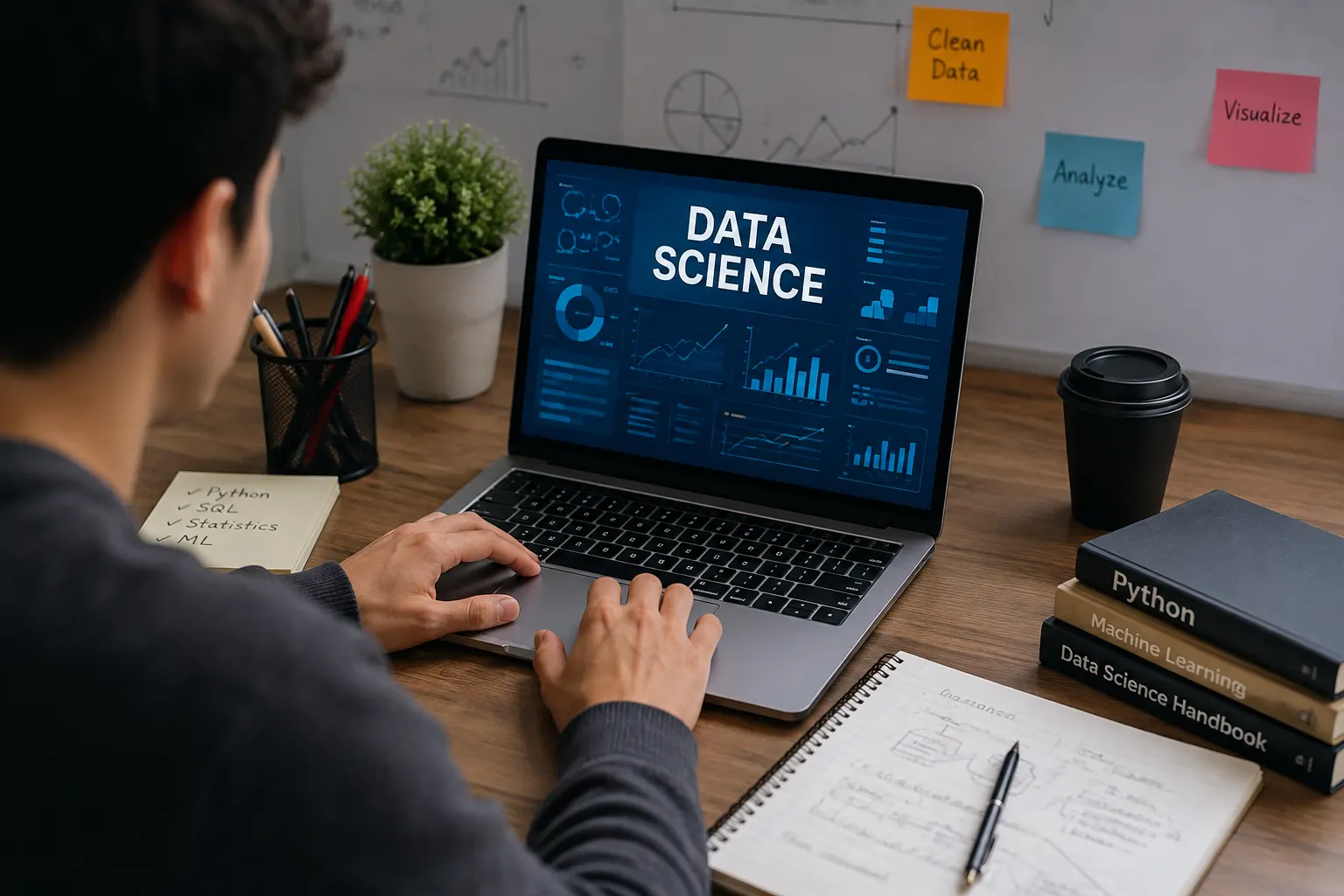

Data science remains one of the hottest job markets today, and enterprises are increasingly turning to data to make informed decisions and remain competitive. With the rise of technology, what is expected of aspiring data scientists is changing too. Employers are seeking someone who not only comprehends data but can use artificial intelligence, machine learning and business savvy to address practical problems in 2026.
If you have just begun your data science career or you’re ready to get your first job, you need to have the right skills. Uncover the essential skills that every data science student must acquire in 2026 to ensure their successful and future-proof career. As per research by the U.S Bureau of Labour Statistics, the data scientist job will increase by 34% between 2024 and 2034.
Top Data Science Skills Every Student Needs In 2026:
These are the top skills that every data science student must acquire for a successful career:
1. Strong Programming Skills
Data science is about programming. Students should have a comfortable handle on writing clean, efficient, and reusable code for the analysis of data and construction of predictive models.
The most popular programming languages are:
- Python
- R
- SQL
Python continues to be the go-to language for its simplicity and the vast array of libraries, including Pandas, NumPy, Scikit-learn, TensorFlow, and PyTorch. Students will be able to work with the tools to manipulate data, build machine learning models, and automate tasks.
2. Statistics & Mathematics
Correct interpretation of data and the construction of reliable models require a solid understanding of mathematical concepts. Data science is not just coding; it’s about analysis and statistical concepts.
Students need to be familiar with the following topics:
- Probability
- Linear algebra
- Calculus
- Hypothesis testing
- Regression analysis
- Descriptive statistics
These ideas are useful for data scientists to assess models, recognise patterns and make predictions. You can also take help from expert Essay Writing Help to assist you.
3. Data Cleaning & Preparation
Frequently, industry experts report that it takes data scientists almost 80% of their time to clean and organise data before any analysis is performed.
Pupils should learn to:
Handle missing values
- Remove duplicate records
- Detect outliers
- Standardise data formats
- Convert raw data to information
Clean data means better models and better insights! Data preparation is one of the most in-demand skills a company wants to acquire.
4. Machine Learning Fundamentals
Machine learning has now become a crucial component in the field of data science. Students should have an understanding of how algorithms learn from data and how different models can be applied to different business problems.
Key machine learning concepts are:
- Supervised learning
- Unsupervised learning
- Classification
- Regression
- Clustering
- Model evaluation
- Feature engineering
Students should not just learn algorithms; they should learn when and why to apply each of them.
5. Artificial Intelligence & Generative AI
Data scientists are becoming increasingly important with the advent of Generative AI. Employers anticipate that graduates will be familiar with AI technologies beyond machine learning in 2026.
Students should be familiar with:
- Large Language Models (LLMs)
- AI-assisted data analysis
- Prompt engineering
- AI ethics
- Model fine-tuning
- AI automation tools
Understanding the integration of AI into workflows can greatly enhance productivity and create new career opportunities.
6. Data Visualisation Skills
Information is only useful if it is understood. Data visualisation is used to present complex information in charts, dashboards, and graphs.
Some common visualisation tools are:
- Tableau
- Power BI
- Matplotlib
- Seaborn
- Plotly
Students should be taught how to clearly express findings to technical and non-technical audiences. Storytelling is a powerful tool for making data interesting, and can make the difference between a successful project and one that gets buried. Take guidance from professional Assignment Writers to help you out.
7. SQL & Database Management
Nearly all organisations have data stored in databases. Hence, SQL continues to be one of the key technical skills that data scientists need.
Pupils should be able to:
- Write SQL queries
- Join multiple tables
- Filter datasets
- Aggregate data
- Optimize database queries
Professionals with strong SQL skills can efficiently extract vast amounts of information for analysis.
8. Cloud Computing Knowledge
Modern businesses are increasingly moving data and conducting data processing on cloud platforms, instead of on local servers.
Understanding of cloud services, including:
- Amazon Web Services (AWS)
- Microsoft Azure
- Google Cloud Platform (GCP)
Can have a significant impact on employability. Students should be familiar with cloud storage, data pipelines and scalable machine learning environments.
Organisations can take advantage of cloud computing to handle huge amounts of data without having to purchase the hardware.
9. Business Understanding
Data science is not only a technology, but it is a way to solve business problems.
Successful data scientists know that:
- Business objectives
- Customer behavior
- Industry trends
- Performance metrics
- Decision-making processes
Technical skills and business knowledge can be used to develop solutions that can create measurable value for organisations.
10. Communication Skills
There are so many amazing data scientists who often fall short due to poor communication skills.
Pupils should learn to:
- Present reports
- Use technical terms in an accessible manner
- Collaborate with teams
- Create compelling presentations
- Write clear documentation
Employers appreciate the ability to communicate between technical groups and business people.
11. Critical Thinking & Problem-Solving
Each data science project comes with its own set of challenges. Students need to be taught to solve problems in a logical manner and not just by using a pre-arranged solution algorithm.
Critical thinking involves:
- The questions to ask are
- Evaluating assumptions
- Testing different approaches
- Interpreting unexpected results
- Making informed recommendations
These abilities help data scientists provide actionable and meaningful solutions.
Understanding Data Ethics & Privacy
In an era where organisations are gathering more and more personal data, ethical data practices are more crucial than ever.
Students should understand:
- Data privacy regulations
- Responsible AI
- Algorithmic fairness
- Bias detection
- Ethical decision-making
Organisations are desperately looking for experts who can develop reliable AI systems without infringing on user privacy.
Conclusion:
Building machine learning models and learning programming languages is not enough to be successful in data science. Employers are seeking ‘all-rounders’ in 2026 with business knowledge, technical skills, a capacity to communicate, ethical sensibilities and a desire to learn.
Programming, statistics, machine learning, data visualisation, SQL, cloud computing, and generative AI are all essential skills, along with problem-solving and collaboration, that can help students succeed in preparing for a career in one of the most sought-after professions in the world.
The future is for data professionals who can turn raw data into valuable information. Get a head start on these key skills today, and you’ll be well-prepared for the future of data science.