
Imagine a warehouse filled with 40,000 boxes of paper records. The shelves hold contracts, insurance claims, personnel files, customer applications, and correspondence collected over several decades. Now, a company wants to use AI to make this information searchable. The proposed solution is straightforward: scan every page, use optical character recognition (OCR) to extract the text, and feed it into a retrieval system that employees and AI assistants can access.
There is a problem with this approach. Many of these records may have passed their required retention periods and should already have been destroyed. Others contain personal information that the company no longer needs. Scanning these documents and adding them to an AI index makes them easier to find, increases the amount of data that may need to be reviewed during litigation, and creates more information that could be exposed in a security breach.
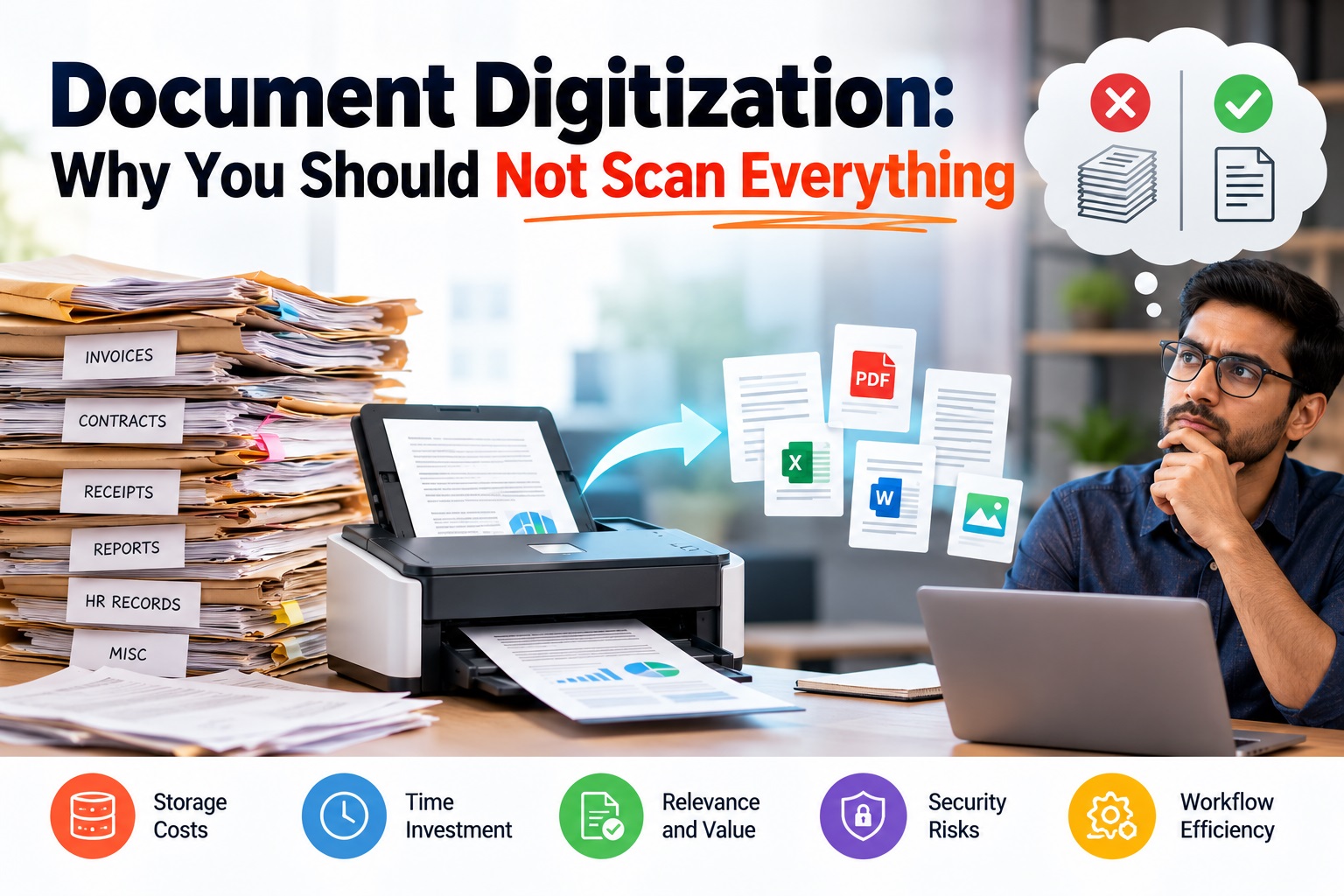
Paper records are not risk-free, but digitizing them can make sensitive information much easier to access and copy. That is why document digitization services should begin with a question that often gets overlooked: which records should not be scanned at all?
Why AI Programs Are Driving a Scanning Rush
Paper archives were once viewed mainly as a storage expense and a records management responsibility. AI has changed that perception. Old contracts, engineering drawings, case files, and correspondence may contain information that is missing from digital systems. Retrieval-augmented generation (RAG) tools can make this information available to employees and AI assistants in seconds.
Companies want to move quickly. They need data to train specialized models, provide context to AI assistants, and create searchable resources for research and compliance. Scanning the entire archive may seem like the easiest way to ensure that nothing useful gets left out.
However, speed alone does not make a digitization project successful. Gartner predicts that 60% of organizations that ignore data governance culture challenges will fail to govern AI successfully by 2027. When a company digitizes records without reviewing their retention status, it carries existing records management problems into its AI environment.
What Changes When Paper Becomes Searchable
The risks associated with a record depend partly on how easily people can find and use it. Digitization changes that access in three important ways.
1- Records Become Easier to Discover During Litigation
During litigation, organizations may need to identify and produce relevant electronically stored information. Records destroyed according to an established retention policy can generally be defended as part of a consistent records management process, provided the destruction was lawful and no preservation obligation applied.
The situation changes when a company scans records that have passed their retention periods and continues to store them digitally. Those records may need to be located, reviewed, and produced during legal proceedings. This can increase legal costs and expose information the company had no reason to retain.
2- Personal Data May Be Retained Longer Than Necessary
Privacy regulations place limits on how long organizations can keep personal information. The General Data Protection Regulation (GDPR), for example, includes a storage limitation principle that generally requires personal data to remain identifiable only for as long as necessary to fulfill its purpose.
The California Consumer Privacy Act (CCPA) also imposes requirements concerning the retention of personal information. In the United States, the Health Insurance Portability and Accountability Act (HIPAA) establishes requirements for protecting certain health information, although it does not set a general retention period for all medical records.
Scanning old customer applications, medical forms, and personnel files can extend the life of information that should have been deleted under applicable policies or requirements. Adding these records to an AI index makes them available to systems and users that may never have needed access to them.
3- A Data Breach Can Expose More Information
Digital records can be copied and shared in large volumes. IBM’s Cost of a Data Breach report found that the global average cost of a data breach reached $4.44 million. The same report found that 20% of organizations experienced breaches linked to shadow AI, or employees’ use of unapproved AI tools. These incidents added an average of $670,000 to breach costs.
When decades of records are stored in a searchable AI index, a compromised account or an improperly used tool can expose far more information than an attacker might find in a physical archive. The risk increases when the index contains personal data that no longer serves a business or legal purpose.
Start With a Retention and Disposition Review
Before scanning begins, organizations should review their archives and decide what to do with each record series. This retention and disposition review helps determine which records need to be digitized, which should remain in paper form, and which can be destroyed.
The process typically involves five steps:
- Inventory the archive. Identify record series by box, department, date range, and content type. Sampling boxes can reveal discrepancies between their labels and their actual contents.
- Match records to the retention schedule. Determine the applicable legal, regulatory, and business retention periods for each record type. If a retention schedule does not exist, the legal and records management teams should establish one.
- Check for legal holds. Records associated with litigation, investigations, or audits may need to be preserved even if their normal retention periods have expired.
- Decide how to handle each record series. Assign one of four dispositions: digitize now, keep in paper form, digitize on demand, or destroy.
- Document every decision. Record the reason for the decision, the person who approved it, and the date. This creates an audit trail and helps demonstrate that the organization followed a consistent process.
The most important part of this review is deciding which records actually need to be digitized. Four options cover most situations:
- Digitize now: Scan active records that have clear business value and must be retained for the foreseeable future.
- Digitize on demand: Keep records that must be retained but are rarely accessed in paper form. Scan them only when someone needs them.
- Keep in paper form: Retain records that have limited business value and only need to be kept for a short period when scanning would cost more than the expected benefit.
- Destroy: Arrange certified destruction for records that have passed their retention periods and are not subject to legal holds or other preservation requirements.
In many archives, records selected for destruction or on-demand digitization account for a substantial portion of the total volume. Excluding them from the initial scanning project can reduce both costs and risks.
Records That Often Belong Outside the Scanning Scope
Every archive has its own requirements, but certain types of records are worth reviewing early because they may no longer need to be digitized.
- Expired personnel files: Records of former employees that have passed their applicable retention periods. These files may contain identification numbers, health information, and bank details.
- Closed customer applications: Loan, insurance, or account applications that were declined or closed years ago and no longer need to be retained.
- Routine transaction records: Invoices, receipts, and delivery notes that have passed the applicable tax, audit, and business retention periods.
- Duplicate copies: Working copies, drafts, and printouts of documents already maintained in an authoritative system.
- Obsolete marketing and event materials: Registration forms, contest entries, and mailing lists that contain personal information but no longer serve a legitimate business purpose.
These records may create privacy and security risks without offering much value to AI applications. Their dates, labels, and document types can also make them relatively easy to identify during an initial review.
However, organizations should not assume that a record can be destroyed simply because it is old or duplicated. They must check the applicable retention requirements, legal holds, and other preservation obligations before making a final decision.
What Good Document Digitization Services Include
Once the scope is set, digitization itself still needs care. A strong program covers:
- Document preparation: removing staples, repairing damaged pages, and sorting records by series.
- Scanning at the right quality: resolution and color settings matched to the document type and later use.
- OCR and data extraction: turning images into searchable text and pulling key fields such as dates, names, and reference numbers.
- Indexing and metadata: tagging each file with record type, owner, date, and retention period.
- Quality control: checking page counts, image quality, and extraction accuracy on samples.
- Secure transport and chain of custody: tracking boxes from the shelf to the scanner and back, or to destruction.
- Certified destruction: documented disposal of paper originals once digital copies are verified, where policy allows.
The metadata step matters most for AI. A scanned contract that carries its retention date, owner, and access level can be governed. One that arrives as an untagged PDF in a shared folder cannot.
Preparing Digitized Records for RAG and Model Training
Digitized records that feed AI systems need extra controls beyond a standard records program:
- Carry retention metadata into the index. When a record reaches the end of its retention period, it should be removed from the source system and from every vector index built on it.
- Respect access rights at retrieval. A RAG tool should return only content the user is allowed to see. Personnel files and legal records need strict permissions.
- Redact personal data where it is not needed. Many AI use cases need the business content of a record, not the names, addresses, or identity numbers in it.
- Separate training from retrieval. Records used to train a model are hard to remove later. Keep sensitive or short-retention records out of training sets.
- Log usage. Track which records the AI system retrieves, for whom, and how often, so audits and deletion requests can be handled.
These controls turn a digitized archive into a governed knowledge source. Without them, the archive becomes a liability that grows with every new AI tool connected to it.
Choosing a Data Digitization Company
Many data digitization companies focus on scanning volume and speed. For AI-bound archives, the better questions cover governance:
- Does the provider support a retention and disposition review before scanning, or only after?
- How does it record retention periods, legal holds, and access levels in file metadata?
- Can it redact personal data during extraction?
- What chain-of-custody controls cover boxes in transit and on site?
- Does it offer certified destruction with documentation?
- Which security certifications does it hold, such as SOC 2 Type II or ISO/IEC 27001?
A data digitization company that raises retention questions before quoting a price is thinking about risk. One that quotes only per-page rates may scan everything by default.
Structuring Data Digitization Outsourcing
The way a digitization contract is priced can influence how the work is carried out. If a provider is paid only for each page scanned, the arrangement rewards volume, even when some records do not need to be digitized.
Data digitization outsourcing should therefore include the retention and disposition review as a separate phase, with clearly defined deliverables. These should include an archive inventory, a disposition plan, and a destruction log where applicable.
Once the review is complete, the contract can set per-page rates for records approved for immediate digitization, along with separate rates for on-demand retrieval and certified destruction. This approach gives the organization a clearer picture of the costs associated with each decision and reduces the incentive to scan records unnecessarily.
A phased rollout can make the project easier to manage. Start with one department or record series, complete the process from retention review through indexing, and measure how the records are distributed across the disposition categories. The results can help the organization estimate costs, identify process improvements, and build a business case for expanding the program.
Make the Decision Before the First Scan
Document digitization services are most effective when organizations decide what to retain before deciding what to scan. A retention and disposition review can reduce project costs, remove records that no longer need to be kept, and limit the personal information entering AI systems.
The goal is not to digitize the largest possible number of pages. It is to make the right information accessible while keeping unnecessary data out of systems where it could be searched, copied, or exposed.
As companies prepare their paper archives for AI, one question deserves attention before scanning begins: which records still serve a legitimate purpose, and which should have been destroyed already?