
When working with data structures, particularly queues, understanding the difference between a simple queue and a circular queue is vital for selecting the right approach for specific applications. Below is a detailed comparison between these two types of queues.
What is a Simple Queue?
A simple queue, also known as a linear queue, follows the FIFO (First In, First Out) principle. This means that the element inserted first is the one removed first. It has a straightforward structure:

- Insertion (enqueue) occurs at the rear.
- Deletion (dequeue) occurs at the front.
Key Characteristics:
- Linear structure.
- Fixed size, leading to potential inefficiency if elements are removed but the space isn’t reused.
- Commonly implemented using arrays or linked lists.
Example Use Cases:
- Scheduling tasks.
- Print queue management.
- Customer service ticketing systems.
What is a Circular Queue?
A circular queue is a more advanced version of the simple queue where the last position is connected back to the first, forming a circle. This structure efficiently utilizes the available space by reusing positions that become vacant after element removal.
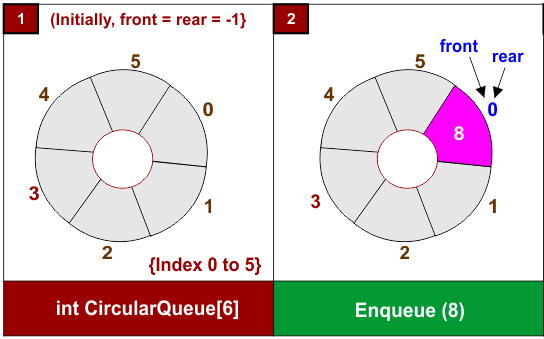
Key Characteristics:
- Circular structure.
- Efficient use of memory since unused spaces are recycled.
- Requires additional logic to distinguish between a full and empty queue.
- Commonly implemented using arrays or linked lists with modular arithmetic for index calculation.
Example Use Cases:
- Memory management in operating systems.
- Handling streaming data.
- Buffering in network communications.
Comparison Table: Simple Queue vs Circular Queue
| Feature | Simple Queue | Circular Queue |
| Structure | Linear | Circular |
| Memory Utilization | May waste memory due to fixed size | Optimized by reusing vacant spaces |
| Implementation | Easier to implement | Requires modular arithmetic logic |
| Efficiency | May lead to inefficiency | More efficient in terms of memory use |
| Common Use Cases | Task scheduling, ticket systems | Buffers, streaming data, memory mgmt |
| Overflow Condition | Occurs when rear reaches max size | Occurs when queue is truly full |
Key Differences Explained
- Memory Utilization:
- In a simple queue, once elements are removed, the vacant space is not reused, which can lead to memory inefficiency.
- A circular queue resolves this issue by looping back to the beginning, making better use of available space.
- Complexity:
- Simple queues are easier to implement due to their straightforward nature.
- Circular queues require additional logic to handle the wrap-around using modular arithmetic.
- Performance:
- Circular queues are generally more efficient for applications requiring a fixed-size buffer.
Which Queue to Choose?
- Choose a simple queue if memory usage is not a concern and you need a quick, straightforward solution.
- Opt for a circular queue when working with fixed memory and need to manage resources efficiently, such as in embedded systems or real-time applications.
Conclusion
While both simple and circular queues serve the purpose of managing elements in a FIFO order, their differences lie in structure, efficiency, and use cases. A clear understanding of these distinctions will help you choose the right data structure based on your application’s requirements.