
Business intelligence dashboards basically track what happened yesterday. On the other hand, decision intelligence tells you what you can do about it today. Also, firms cannot afford hindsight-only analytics anymore. So now, leaders need new systems that don’t just report; they recommend, execute, and learn over time. In this article, we are going to discuss the difference between decision intelligence and business intelligence.
What Is Business Intelligence?
Business intelligence provides reports and visualizations of past information. Suppose the visual of sales perceptions, customer turnover, or stock quantities. Tableau, Power BI, and Looker emerge in this area.
BI answers: “What happened? Why did it happen?”
-
Monthly revenue by region
-
Top products by margin
-
Website traffic sources
-
Customer acquisition costs
Strength: Perfect for understanding past performance and sharing with executives.
Limitation: Static reports require human interpretation to become actions.
What Is Decision Intelligence?
Decision intelligence starts by applying data science, AI, and behavioral insights to provide recommendations that are actionable. It does not stop at the insight; it simulates the situation and forecasts the results, proposing the best choices.
DI answers: “What should we do next? What’s the best option?”
-
“Raise prices 8% on Product X in Europe, expected +$2.3M revenue”.
-
“Reallocate 15% of marketing budget to LinkedIn for 22% ROI lift.”
-
“Delay Product Y launch 3 months to capture 18% more market share.”
Key difference: DI continuously learns from decision outcomes, getting smarter over time.
Core Differences: Side-by-Side Comparison
|
Aspect |
Business Intelligence |
Decision Intelligence |
|
Focus |
What happened (past) |
What should happen (future) |
|
Output |
Reports & dashboards |
Specific recommendations |
|
Speed |
Daily/weekly refresh |
Real-time optimization |
|
AI Role |
Basic visualization |
Core decision engine |
|
Decision Making |
Human interprets data |
AI + human collaboration |
|
Learning |
Static models |
Continuously improves |
BI = Rearview mirror. DI = GPS with traffic predictions.
Industry Applications: Where Each Wins
1. Finance & FP&A
BI: Monthly P&L reports, budget variance analysis
DI: “Cut marketing spend 12% in Q3, shift to retention save $1.2M while growing revenue 8%.”
2. Supply Chain & Operations
BI: Inventory levels, supplier performance dashboards
DI: “Reroute 20% of shipments via Singapore saves $450K, arrives 3 days early.”
3. Sales & Revenue Operations
BI: Pipeline reports, win/loss by rep
DI: “Prioritize Deals A, C, F this week 73% probability of closing $2.1M by quarter end”
4. Marketing
BI: Campaign ROI, channel performance
DI: “Pause Facebook ads, double a company’s spend—projected 28% lead cost reduction.”
5. HR & Talent
BI: Headcount reports, turnover rates
DI: “Promote Sarah to Account Executive now—92% retention probability vs 43% if delayed”
When to Choose Each Approach
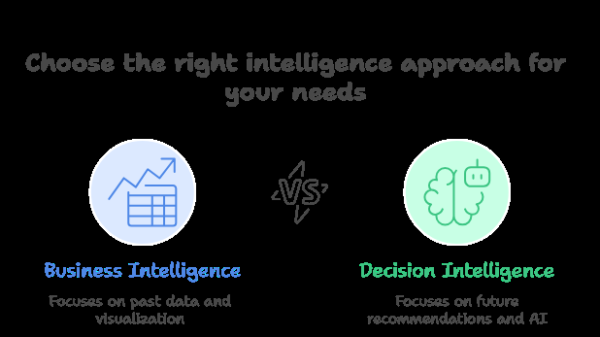
Choose BI when:
-
Explaining past performance to executives
-
Creating standard operational reports
-
Teams are comfortable interpreting dashboards
-
Budget/timeline constraints
Choose DI when:
-
Decisions need to scale across teams
-
Real-time market conditions matter
-
Consistent decision quality critical
-
Willing to invest in AI infrastructure
Smart enterprises do both: BI for reporting, DI for optimization.
Implementation Success Checklist
-
Begin with executive sponsorship: Strong executive support ensures cross-team collaboration, strategic alignment, and commitment to successful decision intelligence implementation.
-
Decide on one high-pain decision first: To make it successful, focus on one high-impact problem first, as this will help you to achieve quick wins and generate organizational momentum.
-
Assure quality of data: Data must be true, consistent, and uncontaminated because data of low quality lessens reliability in trust and prediction.
-
Establish a human verification loop: Predictions are more likely to be validated by human agents, and this aspect promotes transparency, accountability, and confidence so that DI does not substitute judgment.
-
Measure decision adoption: Do not just track accuracy, but also effective adoption to make sure that recommendations are incorporated into the actual working process.
-
Prepare to constantly retrain: Periodic retraining of models preserves the predictions as accurate, relevant, and trustworthy in the constantly changing market and moving patterns of data.
The 2026 Reality
Business intelligence explains the past. Decision intelligence owns the future. Enterprises running both see 3-5x better outcomes than BI-only teams. The gap isn’t closing.
Your best decision-makers succeed through experience and intuition. DI packages that are tailored for everyone. That’s not incremental, it’s transformational.
Start now. Markets wait for no one.